
Catalogue Search | MBRL


Are you sure you want to remove the book from the shelf?

{{itemTitle}}
367
result(s) for
"MAURICE CHARNEY"
Sort by:


Style in Hamlet
Shakespeare intended his plays to be seen, not read. With this thought uppermost in mind, Charney offers here a provocative analysis of Hamlet, the most stylistically inventive of all Shakespeare's plays, strictly in terms of its style-by which he means the distinct modes of expression used by the playwright in accomplishing his dramatic ends. Careful consideration is given to the stagecraft of the play, to lighting and sound effects, gesture and scenery. The play's imagery is discussed with attention to its style as well as to its content. Each of the three main characters is examined in terms of his unique mode of expression. Among the interesting discoveries this approach allows is a new perspective on the character of Hamlet, who is found to have four distinct styles which he employs as the occasion demands.
Originally published in 1969.
The Princeton Legacy Library uses the latest print-on-demand technology to again make available previously out-of-print books from the distinguished backlist of Princeton University Press. These editions preserve the original texts of these important books while presenting them in durable paperback and hardcover editions. The goal of the Princeton Legacy Library is to vastly increase access to the rich scholarly heritage found in the thousands of books published by Princeton University Press since its founding in 1905.
eBook
Shakespeare's style
Shakespeare's Style presents a detailed consideration of aspects of Shakespeare's writing style in his plays.Each chapter offers a detailed discussion about a single feature of style in a chosen Shakespeare play.
eBook

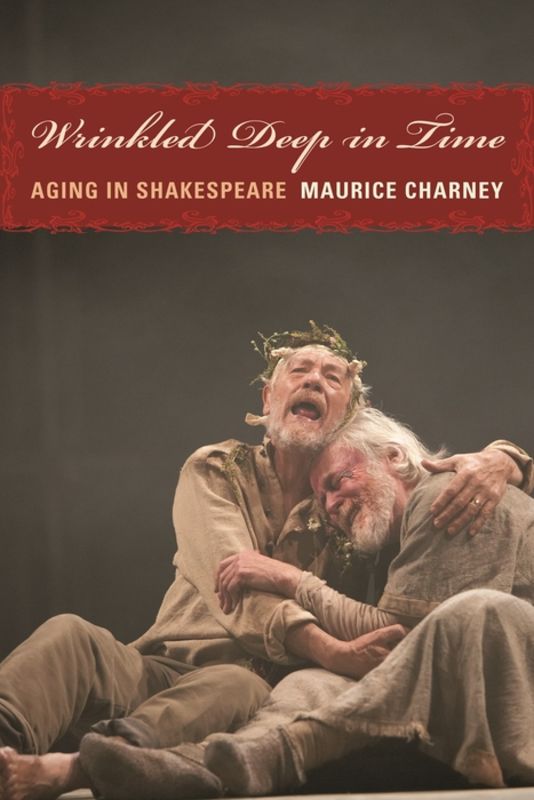
Wrinkled Deep in Time
Shakespeare was acutely aware of our intimate struggles with aging. His dramatic characters either prosper or suffer according to their relationship with maturity, and his sonnets eloquently explore time's ravaging effects. \"Wrinkled deep in time\" is how the queen describes herself inAntony and Cleopatra, and at the end ofKing Lear, there is a tragic sense that both the king and Gloucester have acquired a wisdom they otherwise lacked at the beginning of the play. Even Juliet matures considerably before she drinks Friar Lawrence's potion, and Macbeth and his wife prematurely grow old from their murderous schemes.
Drawing on historical documents and the dramatist's own complex depictions, Maurice Charney conducts an original investigation into patterns of aging in Shakespeare, exploring the fulfillment or distress of Shakespeare's characters in combination with their mental and physical decline. Comparing the characterizations of elderly kings and queens, older lovers, patriarchal men, matriarchal women, and the senex-the stereotypical old man of Roman comedy-with the history of life expectancy in Shakespeare's England, Charney uncovers similarities and differences between our contemporary attitudes toward aging and aging as it was understood more than four hundred years ago. From this dynamic examination, a new perspective on Shakespeare emerges, one that celebrates and deepens our knowledge of his subtler themes and characters.
eBook

Poetic justice and the disguises of Edgar in King Lear
[...]I think it is useful to examine one outrageous claim for poetic justice by Edgar in the final scene (5.3) of King Lear because it impinges so strongly on our interpretation of the play. Bridget Gellert Lyons offers an explanation of this in her persuasive and eloquent essay called \"The Subplot as Simplification in King Lear\": she emphasizes the fact that Edgar's didacticism owes a debt to \"old-fashioned literary forms, like the morality play and the chivalric romance, through which it represents experience\" (25). [...]the audience is surely as skeptical of Edgar's assuming the role of spiritual doctor as it is of the Duke's blandly asserted bed trick in Measure for Measure. All other quotations from Shakespeare are from the individual volumes of The Complete Signet Classic Shakespeare, ed. by Sylvan Barnet. 2 See many passing references in William R. Elton's King Lear and the Gods. 3 See Samuel Johnson's comment on the ending of the play: \"A play in which the wicked prosper, and the virtuous miscarry, may doubtless be good, because it is a just representation of the common events of human life: but since all reasonable beings naturally love justice, I cannot easily be persuaded, that the observation of justice makes a play worse; or, that if other excellencies are equal, the audience will not always rise better pleased from the final triumph of persecuted virtue\" (704).
Journal Article
Adopting styles, inserting selves: Nabokov's Pale Fire
There are quite a few casual references to Shakespeare's play in Nabokov's novel; for example, he speaks of \"prickly-chinned Phrynia, pretty Timandra with that boom under her apron\" (210); the young king of Zembla has in his closet \"a thirty-twomo edition of Timon of Athens translated into Zemblan by his uncle Conmal, the Queen's brother\" (125)2; as a gloss on Unes 39-40 of John Shade's poem, Kinbote introduces variants that remind him of Timon's scene with the three banditti (4.3) from which the \"pale fire\" passage is drawn. (95) Nabokov is speaking about his unique postmodern or experimental approach to writing a novel, in which the narrative-the so-called \"fiction\"-is subordinated to the poetic style or atmosphere created by the author. [...]all novels are essentially forms of self-expression in which there is a continuous merging of what we normally think of as prose and poetry. (517-22) Shade's use of \"preterist\" recalls a Proustian passage in The Real Life of Sebastian Knight from Knight's novel The Doubtful Asphodel: \"Now, when it was too late, and Life's shops were closed, he regretted not having bought a certain book he had always wanted; never having gone through an earthquake, a fire, a train-accident; never having seen Tatsienlu in Tibet, or having heard blue magpies chattering in Chinese willows; not having spoken to that errant schoolgirl with shameless eyes, met one day in a lonely glade; not having laughed at the poor little joke of a shy ugly woman, when no one had laughed in the room; having missed trains, allusions and opportunities; not having handed the penny he had in his pocket to that old street-violinist playing to himself tremulously on a certain bleak day in a certain forgotten town.\" Kinbote goes on to quote from an earlier poem of Shade (existing only in manuscript) called \"The Swing,\" \"being the last short piece that our poet wrote\" (94): The setting sun that lights the tips Of TV's giant paperclips Upon the roof; The shadow of the doorknob that At sundown is a baseball bat Upon the door; The cardinal that likes to sit And make chip-wit, chip-wit, chip-wit Upon the tree; The empty little swing that swings Under the tree: these are the things That break my heart.
Journal Article
Hamlet
UNLIKE Laertes, Hamlet has no single, identifiable style, nor does he, like Claudius, have a pair of styles, ornate and simple, ready for all occasions. We may distinguish at least four different styles for Hamlet: 1. a self-conscious style expressed chiefly in parody; 2. a witty style associated with his madness; 3. a passionate style used primarily in the soliloquies; and 4. a simple style for narration and special effects. These are only four possibilities among many, but they should help to make the point that Hamlet’s mode of expression varies widely in different contexts. Laertes follows with a murderous
Book Chapter
Secrecy and Poison
IN THE recent prolific growth of studies of imagery, there has been an unfortunate turn to subtlety of interpretation. The image patterns have been heard singing their siren “undersongs” in despite of the main composition. I believe this emphasis is unfortunate, especially in the drama, because the leading imagery of a play has to be very obvious in order to accomplish its effects. If repetition is crucial to the idea of a symbolic theme, its workings must necessarily be cumulative and reinforcing rather than self-contained and self-expressive. I am, of course, simplifying the issues, but it would seem to me
Book Chapter