
Catalogue Search | MBRL


Are you sure you want to remove the book from the shelf?

{{itemTitle}}
58
result(s) for
"MacCormack, Patricia"
Sort by:

Posthuman Ethics
Posthuman theory asks in various ways what it means to be human in a time when philosophy has become suspicious of claims about human subjectivity. Those subjects who were historically considered aberrant, and our future lives becoming increasingly hybrid show we have always been and are continuously transforming into posthumans. What are the ethical considerations of thinking the posthuman? Posthuman Ethics asks not what the posthuman is, but how posthuman theory creates new, imaginative ways of understanding relations between lives. Ethics is a practice of activist, adaptive and creative interaction which avoids claims of overarching moral structures. Inherent in thinking posthuman ethics is the status of bodies as the site of lives inextricable from philosophy, thought, experiments in being and fantasies of the future. Posthuman Ethics explores certain kinds of bodies to think new relations that offer liberty and a contemplation of the practices of power which have been exerted upon bodies. The tattooed and modified body, the body made ecstatic through art, the body of the animal as a strategy for abolitionist animal rights, the monstrous body from teratology to fabulations, queer bodies becoming angelic, the bodies of the nation of the dead and the radical ways in which we might contemplate human extinction are the bodies which populate this book creating joyous political tactics toward posthuman ethics.
eBook

Cinesexuality
Cinesexuality explores the queerness of cinema spectatorship - represented as a unique encounter of desire, pleasure and perversion beyond binary dialectics of subject/object and image/meaning. Through a variety of cinematic examples, the book encourages a radical shift to spectatorship as itself inherently queer beyond what is watched and who watches.
eBook
Cinemasochism
This work deals with the study of sexuality in spectator’s relation to the film. Such relation to film image is masochistic in its nature, as cinema is real, material and forcefully affective. The cinesexual relation is inter-kingdom relation because art and physiology are traversed and cross breed. As such, the encounter between the image and the body is one of the silence and avisuality, and spectatorship can be thought as an avisual practice of self. Cinemasochism embraces the impossibility of self in the face of the force of the image without, acknowledging the impossibility within all representation or signification.
Journal Article

POSTHUMAN TERATOLOGY
This chapter will explore ways of thinking posthuman teratology. Teratology has referred to the study of monsters and monstrosity in all epistemic incarnations, though most often in medicine and physiology. Two inclinations resonate with two effects encountered in relations with monsters. Irrefutable and irresistible wonder and terror have led, in the life sciences, to a compulsion to cure or redeem through fetishization, making sacred or simply sympathetic. The effect that monstrosity has upon the “nonmonstrous” is an inherently ambiguous one, just as monsters themselves are defined, most basically, as ambiguities. The hybrid and the ambiguous hold fascination for the “nonmonster”
Book Chapter
Deleuze and the Schizoanalysis of Cinema
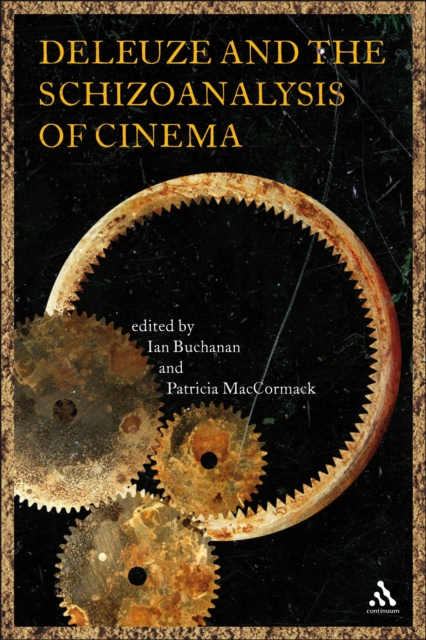
In 1971, Deleuze and Guattari’s collaborative work, Anti-Oedipus: Capitalism and Schizophrenia caused an international sensation by fusing Marx with a radically rewritten Freud to produce a new approach to critical thinking, which they provocatively called “schizoanalysis.” Deleuze and the Schizoanalysis of Cinema explores the possibilities of using this concept to investigate cinematic works in both the Hollywood and non-Hollywood tradition. It attempts to define what a schizoanalysis of cinema might be and introduces a variety of ways in which a schizoanalysis might be applied. This collection opens up a fresh field of inquiry for Deleuze scholars and poses an exciting challenge to cinema studies in general. Featuring some of the most important cinema studies scholars working on Deleuze and Guattari today, Deleuze and the Schizoanalysis of Cinema is a cutting edge collection that will set the agenda for future work in this area. Contributors include: Gregory Flaxman, Amy Herzog, Joe Hughes, Gregg Lambert, Patricia MacCormack, Bill Marshall, David Martin-Jones, Elena Oxman, Patricia Pisters, Anna Powell and Mark Riley.
eBook

Rebuilding the Fabulated Bodies of the Hoard-Warriors
When Anglo-Saxon warriors buckled on gem encrusted, intricately wrought gold arms and armor, they did not merely transform their appearance, but shifted their fundamental ontology. We consider objects from the Staffordshire Hoard as embodiments of
fah
and
ælf
-
sciéne
, specifically Anglo-Saxon ideas of visual splendor, and the modern notion of bling in order to excavate their role in the transformation of men into posthuman teratological wonders. We strive to imagine the hoard not as a series of objects but as embodied apparatuses inextricable from those who wore them and from the violence they were intended to fend off, yet accelerate.
Journal Article

Lovecraft through Deleuzio-Guattarian Gates
This essay picks up on Deleuze and Guattari's brief invocation of the work of H.P. Lovecraft. Deleuze and Guattari's project to develop a philosophy of sorcery as a mode of thought that gestures toward becoming-imperceptible is considered by reading examples in Lovecraft's \"cosmic horror\" of the terrors and revolutions available through the becomings of his protagonists. Contextualising his work outside of traditional genres of fantasy and science fiction, this essay offers the reading of Lovecraft's writings as a passing through gates. This liberating practice produces encounters with abstract alterity, beginning with the ethical consideration of the preliminary otherness of women and the animal in Deleuze and Guattari's work, via becoming-monstrous, to an infinite territory beyond representation, signification, and perception itself.
Journal Article

Epilogue
This conclusion presents some closing thoughts on the concepts discussed in the preceding chapters of this book. The book offers some singular despositifs which show the blind spots, wounds, fountains and redirectives which populate territories that attempt to homogenize and regulate all life through limiting the system of operation as well as life itself. Posthuman ethics occupy an ecosophical terrain of thought coalescent as material, affective and activist. Posthuman ethics create other ways for that which cannot be assimilated instead of the majoritarian options of being forced to be or slaughtered. The gradual cessation of human life on Earth and in the Universe is the beginning of the contemplation of the eternity of life affects, of the life of all ecosophical cosmic interaction. The book shows modern human life as driven and obsessed with conceptual death while reproducing death machines and nations of the dead.
This conclusion presents some closing thoughts on the concepts discussed in the preceding chapters of this book. The book offers some singular despositifs which show the blind spots, wounds, fountains and redirectives which populate territories that attempt to homogenize and regulate all life through limiting the system of operation as well as life itself. Posthuman ethics occupy an ecosophical terrain of thought coalescent as material, affective and activist. Posthuman ethics create other ways for that which cannot be assimilated instead of the majoritarian options of being forced to be or slaughtered. The gradual cessation of human life on Earth and in the Universe is the beginning of the contemplation of the eternity of life affects, of the life of all ecosophical cosmic interaction. The book shows modern human life as driven and obsessed with conceptual death while reproducing death machines and nations of the dead.
Book Chapter
Posthuman Ethics
Posthuman theory asks in various ways what it means to be human in a time where philosophy has become suspicious of claims about human subjectivity. Inherent in thinking posthuman ethics is the status of bodies as the site of lives inextricable from philosophy, thought, experiments in being and fantasies of the future. Posthuman Ethics examines certain kinds of bodies to think new relations that offer liberty and a contemplation of the practices of power which have been exerted upon bodies. The privileged site of Posthuman Ethics is historically and philosophically the oppressed site of life which does not register as entirely viable within humanist operations of knowledge, power and majoritarian systems. The field of posthuman Ethics deal with life which resembles nothing except itself and not consistent with itself temporally, only tactically. Posthuman ethics is a negotiation of distance in the ways relation is structured, or destructured.
Posthuman theory asks in various ways what it means to be human in a time where philosophy has become suspicious of claims about human subjectivity. Inherent in thinking posthuman ethics is the status of bodies as the site of lives inextricable from philosophy, thought, experiments in being and fantasies of the future. Posthuman Ethics examines certain kinds of bodies to think new relations that offer liberty and a contemplation of the practices of power which have been exerted upon bodies. The privileged site of Posthuman Ethics is historically and philosophically the oppressed site of life which does not register as entirely viable within humanist operations of knowledge, power and majoritarian systems. The field of posthuman Ethics deal with life which resembles nothing except itself and not consistent with itself temporally, only tactically. Posthuman ethics is a negotiation of distance in the ways relation is structured, or destructured.
Book Chapter
Mystic Queer
Desire in non-opposition is queer. Queer has its own genealogy, beginnings seeking to orient homosexuality independent of heterosexuality, through anti-object as same, anti-act, anti-theory toward liberation from the theatrical paradigms whereby the materiality of desire emerges via structuring scaffolds. Traversive lines between queer and feminism, feminism and gay studies, gay studies and diffability sexuality to new experiments in non-human sexuality as not animal per se but a kind of theoretical bestiary of fabulated creatures which we both become and with which we consort. The fiction of the sexualized subject is mirrored and unfolded by the fictive of the sexual partner’ or object’ as primarily an imagined and creative catalyst for unravelling despotic locales of desire. Sexuality is a negotiative moment for which no vocabulary yet exists. In order to think queer any recognition must be a catalyst for passing beyond rather than an affirmation and thus validation of difference added to the taxonomy of sexualities.
Desire in non-opposition is queer. Queer has its own genealogy, beginnings seeking to orient homosexuality independent of heterosexuality, through anti-object as same, anti-act, anti-theory toward liberation from the theatrical paradigms whereby the materiality of desire emerges via structuring scaffolds. Traversive lines between queer and feminism, feminism and gay studies, gay studies and diffability sexuality to new experiments in non-human sexuality as not animal per se but a kind of theoretical bestiary of fabulated creatures which we both become and with which we consort. The fiction of the sexualized subject is mirrored and unfolded by the fictive of the sexual partner' or object' as primarily an imagined and creative catalyst for unravelling despotic locales of desire. Sexuality is a negotiative moment for which no vocabulary yet exists. In order to think queer any recognition must be a catalyst for passing beyond rather than an affirmation and thus validation of difference added to the taxonomy of sexualities.
Book Chapter