
Catalogue Search | MBRL


Are you sure you want to remove the book from the shelf?

{{itemTitle}}
1,901
result(s) for
"MacDonald, D. R"
Sort by:


Response assessment in neuro-oncology (a report of the RANO group): assessment of outcome in trials of diffuse low-grade gliomas
Although low-grade gliomas (LGG) have a less aggressive course than do high-grade gliomas, the outcome of these tumours is ultimately fatal in most patients. Both the tumour and its treatment can cause disabling morbidity, particularly of cognitive functions. Because many patients present with seizures only, with no other signs and symptoms, maintenance of quality of life and function constitutes a particular challenge in LGG. The slow growth pattern of most LGG, and the rare radiological true responses despite a favourable clinical response to treatment, interferes with the use of progression-free survival as the primary endpoint in trials. Overall survival as an endpoint brings logistical challenges, and is sensitive to other non-investigational salvage therapies. Clinical trials for LGG need to consider other measures of patient benefit such as cognition, symptom burden, and seizure activity, to establish whether improved survival is reflected in prolonged wellbeing. This Review investigates clinical and imaging endpoints in trials of LGG, and provides response assessment in neuro-oncology (RANO) criteria for non-enhancing tumours. Additionally, other measures for patients with brain tumours that assess outcome are described. Similar considerations are relevant for trials of high-grade gliomas, although for these tumours survival is shorter and survival endpoints generally have more value than they do for LGG.
Journal Article

Infinity wars
What does Infinity hold for the Marvel Universe? As the Infinity Stones come to Earth, so too comes the war for control over them. But none who wield the stones truly understand the power they contain...or comprehend what it would take to bring them to their end! The nature of the cosmos itself hangs in the balance as we learn the answer to the question on everyone's lips: Who is Requiem? The ramifications of this story will be felt throughout Infinity for years to come! As cosmic war begins to rage, Gerry Duggan and Mike Deodato Jr. gaze into the Infinite - and bring the truth to light!
Book

Evaluating networked drug checking services in Toronto, Ontario: study protocol and rationale
Background
The increasing incidence of fatal opioid overdose is a public health crisis in Canada. Given growing consensus that this crisis is related to the presence of highly potent opioid adulterants (e.g., fentanyl) in the unregulated drug supply, drug checking services (DCS) have emerged as part of a comprehensive approach to overdose prevention. In Canada’s largest city, Toronto, a network of DCS launched in 2019 to prevent overdose and overdose-related risk behaviors. This network employs mass spectrometry technologies, with intake sites co-located with supervised consumption services (SCS) at three frontline harm reduction agencies. The protocol and rationale for assessing the impact of this multi-site DCS network in Toronto is described herein. The aims of this study are to (1) evaluate the impact of DCS access on changes in and factors influencing overdose and related risk behaviors, (2) investigate the perceived capacity of DCS to prevent overdose, and (3) identify composition (qualitative and quantitative) trends in Toronto’s unregulated drug supply.
Methods
We will use a parallel-mixed-methods design with complementary data sources (including data from chemical analysis of drug samples, quantitative intake and post-test surveys, SCS, coroners, paramedic services, and qualitative interviews), followed by a meta-inference process wherein results from analyses are synthesized.
Results
Whereas most DCS globally target “recreational drug users,” in Toronto, this networked DCS will primarily target marginalized people who use drugs accessing frontline services, many of whom use drugs regularly and by injection. This evolution in the application of DCS poses important questions that have not yet been explored, including optimal service delivery models and technologies, as well as unique barriers for this population. Increasing information on the unregulated drug supply may modify the risk environment for this population of people who use drugs.
Conclusions
This study addresses evidence gaps on the emerging continuum of overdose prevention responses and will generate critical evidence on a novel approach to reducing the ongoing high incidence of drug-related morbidity and mortality in Canada and elsewhere.
Journal Article

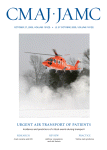
Incidence and predictors of critical events during urgent air–medical transport
Little is known about the risks of urgent air–medical transport used in regionalized health care systems. We sought to determine the incidence of intransit critical events and identify factors associated with these events.
We conducted a population-based, retrospective cohort study using clinical and administrative data. We included all adults undergoing urgent air–medical transport in the Canadian province of Ontario between Jan. 1, 2004, and May 31, 2006. The primary outcome was intransit critical events, which we defined as death, major resuscitative procedure, hemodynamic deterioration, or inadvertent extubation or respiratory arrest.
We identified 19 228 patients who underwent air–medical transport during the study period. In-transit critical events were observed in 5.1% of all transports, for a rate of 1 event per 12.6 hours of transit time. Events consisted primarily of new hypotension or airway management procedures. Independent predictors of critical events included female sex (adjusted odds ratio [OR] 1.3, 95% confidence interval [CI] 1.1–1.5), assisted ventilation before transport (adjusted OR 3.0, 95% CI 2.3–3.7), hemodynamic instability before transport (adjusted OR 3.2, 95% CI 2.5–4.1), transport in a fixed-wing aircraft (adjusted OR 1.5, 95% CI 1.2–1.8), increased duration of transport (adjusted OR 1.02 per 10-minute increment, 95% CI 1.01–1.03), on-scene calls (adjusted OR 1.7, 95% CI 1.4–2.1) and type of crew (adjusted OR 0.6 for ad -vanced care paramedics v. critical care paramedics, 95% CI 0.5–0.7).
Critical events occurred in about 1 in every 20 air–medical transports and were associated with multiple risk factors at the patient, transport and system levels. These findings have implications for the refinement of training of paramedic transport crews and processes for triage and transport.
Journal Article

Response assessment criteria for brain metastases: proposal from the RANO group
CNS metastases are the most common cause of malignant brain tumours in adults. Historically, patients with brain metastases have been excluded from most clinical trials, but their inclusion is now becoming more common. The medical literature is difficult to interpret because of substantial variation in the response and progression criteria used across clinical trials. The Response Assessment in Neuro-Oncology Brain Metastases (RANO-BM) working group is an international, multidisciplinary effort to develop standard response and progression criteria for use in clinical trials of treatment for brain metastases. Previous efforts have focused on aspects of trial design, such as patient population, variations in existing response and progression criteria, and challenges when incorporating neurological, neuro-cognitive, and quality-of-life endpoints into trials of patients with brain metastases. Here, we present our recommendations for standard response and progression criteria for the assessment of brain metastases in clinical trials. The proposed criteria will hopefully facilitate the development of novel approaches to this difficult problem by providing more uniformity in the assessment of CNS metastases across trials.
Journal Article

A Robust Rapid-Response Probe for Measuring Bottom-Hole Temperatures in Deep-Ocean Boreholes
A new probe has been constructed for making temperature measurements 1.1 m ahead of the bit in Ocean Drilling Program (ODP) boreholes. Temperatures are recorded at positions 1 and 11 cm above the tip of the probe. The combination of the dual temperature records and accelerometer data provides valuable information about disturbances that may affect the quality of measurements. Long battery life, and memory access via an external communications port, allow service-free operation for the full duration of typical drilling legs. Temperature resolution varies over the 110 K measurement range, from nominally 1 mK from -5 to 20 °C, to about 10 mK at 105 °C. The small (8 mm) diameter of the probe tip allows rapid thermal equilibration after penetration. The shallow (2.5°), continuous taper of the lower part of the probe serves to reduce the tendency of the formation to be cracked when the tool is pushed into the formation. It is sufficiently robust, however, to survive penetration into highly consolidated sediment and occasional contact with igneous rock. The tool was used for a total of 44 bottom-hole temperature measurements between 38 and 573 meters below seafloor (mbsf) during Leg 168, as well as for several logging runs in open holes. We anticipate adding a port in the tip to permit measurement of formation fluid pressure, and to enhance the utility of the tool for logging temperature profiles in open holes.[PUBLICATION ABSTRACT]
Journal Article

Therapy-related chromosomal changes and cytogenetic heterogeneity in human gliomas
The karyotypes of 18 primary 'untreated' gliomas, 6 recurrent gliomas treated with radiotherapy and/or chemotherapy and 2 gliomas before and after treatment are described, based on observations using standard cytogenetic techniques. In comparison to the untreated gliomas there were relatively consistent chromosome differences in the treated gliomas, including (1) deletions of the long arm of chromosome 7 with breakpoint at q22, possibly induced by alkylating agents, and (2) numerous single cell abnormalities or unrelated clones of structural abnormalities, presumably induced by radiotherapy.
Journal Article