
Catalogue Search | MBRL


Are you sure you want to remove the book from the shelf?

{{itemTitle}}
3,043
result(s) for
"MacDonald, Neil"
Sort by:


Definition and classification of cancer cachexia: an international consensus
To develop a framework for the definition and classification of cancer cachexia a panel of experts participated in a formal consensus process, including focus groups and two Delphi rounds. Cancer cachexia was defined as a multifactorial syndrome defined by an ongoing loss of skeletal muscle mass (with or without loss of fat mass) that cannot be fully reversed by conventional nutritional support and leads to progressive functional impairment. Its pathophysiology is characterised by a negative protein and energy balance driven by a variable combination of reduced food intake and abnormal metabolism. The agreed diagnostic criterion for cachexia was weight loss greater than 5%, or weight loss greater than 2% in individuals already showing depletion according to current bodyweight and height (body-mass index [BMI] <20 kg/m
2) or skeletal muscle mass (sarcopenia). An agreement was made that the cachexia syndrome can develop progressively through various stages—precachexia to cachexia to refractory cachexia. Severity can be classified according to degree of depletion of energy stores and body protein (BMI) in combination with degree of ongoing weight loss. Assessment for classification and clinical management should include the following domains: anorexia or reduced food intake, catabolic drive, muscle mass and strength, functional and psychosocial impairment. Consensus exists on a framework for the definition and classification of cancer cachexia. After validation, this should aid clinical trial design, development of practice guidelines, and, eventually, routine clinical management.
Journal Article
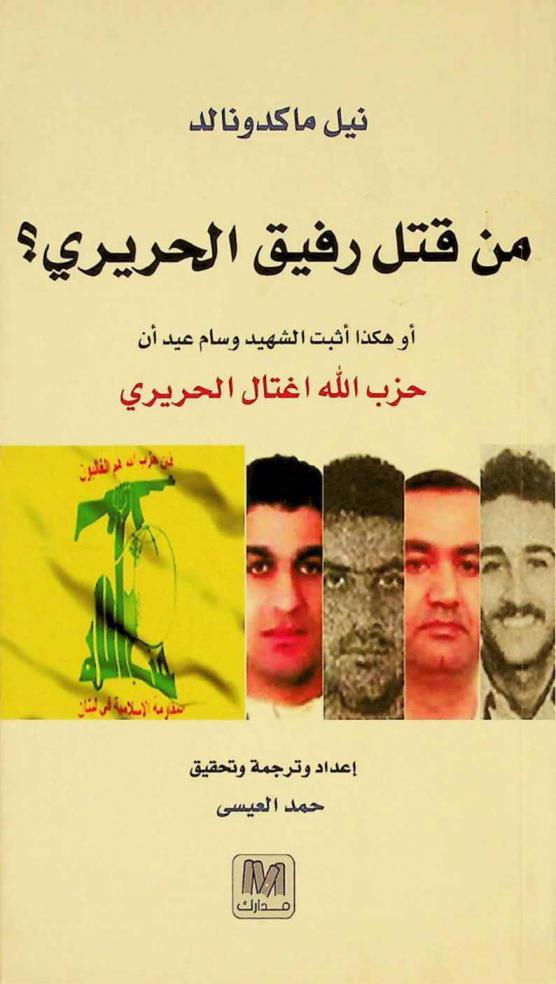
من قتل رفيق الحريري ؟ أو هكذا أثبت الشهيد وسام عيد أن حزب الله اغتال الحريري
النقيب عيد لم يكن مهتما بالخوض في بعض النظريات المتشعبة والمثيرة التي تسود لبنان. لقد استنتج منطقيا بنفسه أن العثور على أول آثار القتلة كانت تتطلب عملية رياضية تسمى ب «عملية الحذف» (Process of Elimination). ومن شركات الهاتف اللبنانية، حصل عيد على سجلات المكالمات ل «جميع» الهواتف المحمولة التي اتصلت مع أبراج الاتصالات في المنطقة المجاورة مباشرة لفندق سان جورج، حيث وقع الانفجار الهائل الذي نتجت عنه حفرة عميقة. وبعدما حصل عيد على تلك السجلات، بدأ بعملية الحذف حيث استبعد مئات من الهواتف في المنطقة في ذلك الصباح، استبعد أيضا تلك الخاصة بالقتلى ال 22، ثم تلك التي تخص حاشية الحريري، ثم أولئك الناس الذين في الجوار وأجريت معهم مقابلات وثبت أن موقفهم سليم. وبسرعة معقولة، اكتشف الهواتف «الحمراء» التي استخدمها فريق الاغتيال. ولكنه لم يتوقف عند هذا الحد.
BOOK

Epidemiology of Early Monkeypox Virus Transmission in Sexual Networks of Gay and Bisexual Men, England, 2022
After community transmission of monkeypox virus was identified in Europe, interviews of 45 case-patients from England indicated transmission in international sexual networks of gay and bisexual men since April 2022. Interventions targeting sex-on-premises venues, geospatial dating applications, and sexual health services are likely to be critical for outbreak control.
Journal Article


Identification of neutrophil-derived proteases and angiotensin II as biomarkers of cancer cachexia
Background:
Cachexia is a metabolic disorder characterised by muscle wasting, diminished response to anti-cancer treatments and poor quality of life. Our objective was to identify blood-based biomarkers of cachexia in advanced cancer patients. Hence, we characterised the plasma cytokine and blood cell mRNA profiles of patients grouped in three cohorts: patients with cachexia, pre-cachexia (no cachexia but high CRP levels: ⩾5 mg l
−1
) and no cachexia (no cachexia and CRP: <5 mg l
−1
).
Methods:
A total of 122 newly diagnosed cancer patients with seven cancer types were studied prior to their initial therapy. Plasma levels of 22 cytokines were quantified using the bio-plex technology. mRNAs isolated from whole blood and expression profiles were determined by the chip array technology and Ingenuity Pathway Analysis (IPA) software.
Results:
In comparison with non-cachectic individuals, both pre-cachectic and cachectic patients showed an increase (⩾1.5-folds) in mRNA expression of neutrophil-derived proteases (NDPs) and significantly elevated angiotensin II (Ang II) (
P
=0.005 and
P
=0.02, respectively), TGF
β
1 (
P
=0.042 and
P
<0.0001, respectively) and CRP (both
P
<0.0001) in the plasma. Moreover, cachectic patients displayed a significant increase in IL-6 (
P
=0.005), IL-8 (
P
=0.001) and absolute neutrophil counts (
P
=0.007).
Conclusions:
Ang II, TGF
β
1, CRP and NDP are blood biomarkers for cancer cachexia. These findings contribute to early diagnosis and prevention of cachexia.
Journal Article

Impact on health outcomes and productive work of adding anti-PD-1 agents to treat early-stage cancers in the United Kingdom: a modelling study
Anti-PD-1 agents are recommended in adjuvant or perioperative settings in some early-stage cancers. The health and productivity benefits of anti-PD-1 use on a population level, however, are unknown.
A decision model was developed to quantify the health and productivity outcomes of adding anti-PD-1 agents to traditional management strategies in the adjuvant or perioperative setting for melanoma stage IIB/IIC/III, triple negative breast cancer, and renal cell carcinoma in the United Kingdom. The model consisted of four separate Markov models and compared outcomes in two scenarios: one where anti-PD-1 agents are restricted to advanced/metastatic disease, against one where anti-PD-1 agents are used as adjuvant or perioperative therapy for early-stage cancers. Population and incidence inputs were obtained from nation-specific sources, while efficacy and quality of life data were informed by the individual trials. Productivity outcomes were estimated using a human capital approach.
Between 2023 and 2032, 57,075 (60.4%) of 94,426 patients with early-stage cancers eligible for adjuvant or perioperative treatment are estimated to receive anti-PD-1 agents. This was associated with an increase in total life years (8,878, 2.4%), quality-adjusted life-years (9,029, 3.1%), and event-/disease-/recurrence-free life years (25,149, 9.0%), and a reduction in progression events or recurrences (6,839, 16.8%), active metastatic treatments (4,845, 14.0%), and deaths (3,013, 16.2%). The clinical benefits also resulted in a gain in productive years (20,717, 17.6%).
The use of anti-PD-1 agents in adjuvant or perioperative settings can lead to substantial health and productivity gains. Effective planning and investment are needed for timely access to these agents for patients.
Journal Article

Restoration of native-dominated plant communities on a Centaurea stoebe-infested site
Questions Restoring native‐dominated plant communities often requires controlling invasive species, reintroducing native species, and implementing continued management practices. Can single herbicide applications to control Centaurea stoebe L. encourage establishment of seeded native species more effectively than a single mowing? Can annual hand pulling to control C. stoebe favor the persistence of seeded native species? Can mid‐spring burning reduce C. stoebe and increase native forbs and grasses? After eight years, will the restored plant communities differ from those in untreated areas? Location Bass River Recreation Area, Ottawa County, MI, USA. Methods We studied the effects of site preparation (mowing, clopyralid, glyphosate), hand pulling of C. stoebe, and burning on restoring native plant communities on a C. stoebe‐infested site. Over eight years, we quantified the development of the plant communities on plots seeded with native grasses and forbs, and report on the second four years here. Results Native‐dominated plant communities developed using both herbicides, but while clopyralid provided longer control of C. stoebe, clopyralid‐treated plots had fewer native species than glyphosate‐treated plots. Native‐dominated plant communities also developed on plots that were only mowed once before seeding, achieving similar native species richness as the glyphosate treatment. Hand pulling controlled C. stoebe, burning increased relative cover of native graminoids and decreased that of non‐native grasses, and hand pulling and burning in combination increased relative cover of native forbs. After eight years, the restored plant communities had greater native species cover and richness and higher mean Coefficient of Conservatism, Floristic Quality Index, and Shannon's Diversity Index values than untreated areas. Conclusions Site preparation, seeding, hand pulling of C. stoebe, and annual burning facilitated restoration of native‐dominated plant communities on a C. stoebe‐infested site. Effects accumulated over a period of eight years, illustrating the importance of continued management and monitoring as part of similar restoration efforts. Seeding native species, in combination with integrated management strategies to control Centaurea stoebe and to favor native species, produced native‐dominated plant communities that possessed many of the attributes of restored ecosystems. The eight‐year study allowed evaluation of the progressive effects of treatments through time, emphasizing the importance of persistent efforts to implement and assess successful restoration of native plant communities. Associated image: Hand‐pulled and burned plot on July 7, 2016, dominated by native North American grasses and forbs.
Journal Article

Chronic Nitrate Additions Dramatically Increase the Export of Carbon and Nitrogen from Northern Hardwood Ecosystems
A long-term field experiment was initiated to simulate chronic atmospheric N deposition, a widespread phenomenon in industrial regions of the world. Eight years of experimental nitrate (NO3) additions (3 g NO3--N m-2 per year) to four different northern hardwood forests located along a 500 km geographic gradient dramatically increased leaching losses of NO3--N, dissolved organic carbon (DOC), and dissolved organic nitrogen (DON). During the last two water years, the average increase in solution NO3--N and DON leaching from the NO3--amended plots was 2.2 g N m-2, equivalent to 72% of the annual experimental N addition. Results indicate that atmospheric N deposition may rapidly saturate some northern hardwood ecosystems across an entire biome in the upper Great Lakes Region of the USA. Changes in soil C and N cycling induced by chronic N deposition have the potential in this landscape to significantly alter the flux of DOC and DON from upland to aquatic ecosystems. Michigan Gradient study site characteristics are similar to those of European forests most susceptible to N saturation.
Journal Article

The Pursuit of Life
This volume examines crucial concerns in palliative care,
including the proper balance between comfort and cure for the
patient, the integration of spiritual well-being, and the
challenges of providing care in the absence of basic medical
services and supplies.
In the first section, palliative-care pioneers Constance Dahlin,
Eduardo Bruera, Neil MacDonald, and Declan Walsh recount the early
history of the discipline. Part 2 discusses the role of poetry,
prose, plays, and other aspects of the humanities in the practice
of palliative care. Part 3 explores essential current issues in the
field, including autonomy, the use of opioids, and the impact of
artificial intelligence on the evolution of palliative care. The
final section focuses on the spiritual dimensions of pain and
suffering.
Rich with anecdotes and personal stories and featuring
contributions from pioneers and current practitioners, The
Pursuit of Life is an essential assessment of the past,
present, and future of palliative care.
In addition to the editors, the contributors include W. Andrew
Achenbaum, Stacy L. Auld, Elena Pagani Bagliacca, Costantino
Benedetti, Courtenay Bruce, Eduardo Bruera, Joseph Calandrino, Jim
Cleary, Constance Dahlin, Andrea Ferrari, Mauro Ferrari, Joseph J.
Fins, Bettie Jo Tennon Hightower, Kathryn B. Kirkland, Robin W.
Lovin, Neil MacDonald, Charles Millikan, Dominique J. Monlezun,
Tullio Proserpio, Giovanna Sironi, Daniel P. Sulmasy, and Declan
Walsh.
eBook