
Catalogue Search | MBRL


Are you sure you want to remove the book from the shelf?

{{itemTitle}}
43
result(s) for
"MacSwan, Jeff"
Sort by:

A Multilingual Perspective on Translanguaging
Translanguaging is a new term in bilingual education; it supports a heteroglossic language ideology, which views bilingualism as valuable in its own right. Some translanguaging scholars have questioned the existence of discrete languages, further concluding that multilingualism does not exist. I argue that the political use of language names can and should be distinguished from the social and structural idealizations used to study linguistic diversity, favoring what I call an integrated multilingual model of individual bilingualism, contrasted with the unitary model and dual competence model. I further distinguish grammars from linguistic repertoires, arguing that bilinguals, like monolinguals, have a single linguistic repertoire but a richly diverse mental grammar. I call the viewpoint developed here a multilingual perspective on translanguaging.
Journal Article
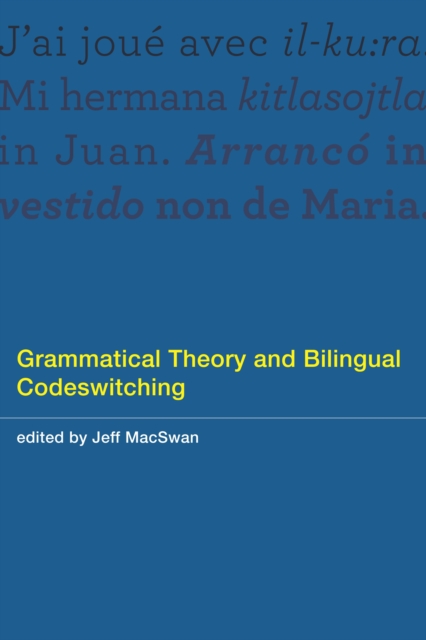
Grammatical Theory and Bilingual Codeswitching
Codeswitching is the alternate use of two or more languages among bilingual interlocutors. It is distinct from borrowing, which involves the phonological and morphological integration of a word from one language into another. Codeswitching involves the mixing of phonologically distinctive elements into a single utterance:Mi hermano bought some ice cream.This volume examines the grammatical properties of languages mixed in this way, focusing on cases of language mixing within a sentence. It considers the grammar of codeswitching from a variety of perspectives, offering a collection of theoretically significant work by the leading researchers in the field.Each contribution investigates a particular grammatical phenomenon as it relates to bilingual codeswitching data, mostly from a Minimalist perspective. The contributors first offer detailed grammatical accounts of codeswitching, then consider phonological and morphological issues that arise from the question of whether codeswitching is permitted within words. Contributors additionally investigate the semantics and syntax of codeswitching and psycholinguistic issues in bilingual language processing. The data analyzed include codeswitching in Spanish-English, Korean-English, German-Spanish, Hindi-English, and Amerindian languages.ContributorsShoba Bandi-Rao, Rakesh M. Bhatt, Sonia Colina, Marcel den Dikken, Anna Maria Di Sciullo, Daniel L. Finer, Kay E. González-Vilbazo, Sílvia Milian Hita, Jeff MacSwan, Pieter Muysken, Monica Moro Quintanilla, Erin O'Rourke, Ana Teresa Pérez-Leroux, Edward P. Stabler Jr., Gretchen Sunderman, Almeida Jacqueline Toribio
eBook

Codeswitching and generative grammar: A critique of the MLF model and some remarks on “modified minimalism”
This article presents an empirical and theoretical critique of the Matrix Language Frame (MLF) model (Myers-Scotton, 1993; Myers-Scotton and Jake, 2001), and includes a response to Jake, Myers-Scotton and Gross's (2002) (JMSG) critique of MacSwan (1999, 2000) and reactions to their revision of the MLF model as a “modified minimalist approach”. The author argues that although a new structural definition of the Matrix Language (ML) makes the MLF model falsifiable, its empirical predictions are inconsistent with the facts of codeswitching (CS). The author also identifies significant theoretical problems associated with the MLF model, and suggests that it be rejected on empirical and theoretical grounds, and on grounds of scientific parsimony. In addition, the author contends that JMSG's critique of the Minimalist approach to CS rests on conceptually significant misreadings of published research in CS and in the theory of syntax, and that JMSG fail to motivate their central claim, namely, that a Minimalist approach to CS cannot succeed without incorporating the ML construct. It is further shown that an analysis of the CS facts which JMSG consider as their test case may be straightforwardly pursued within the Minimalist Program without appealing to the ML construct or any other aspect of the MLF model. The author concludes with the recommendation that research on CS depart from the formulation of general CS-specific constraints like the MLF model and engage in the task of analyzing language contact phenomena in terms of independently motivated constructs of linguistic theory.
Journal Article

Learning English Bilingually: Age of Onset of Exposure and Rate of Acquisition Among English Language Learners in a Bilingual Education Program
This article asks whether children enrolled in a bilingual education program learn English in a reasonable amount of time, and whether older children learn English faster than younger children. Children (N = 89) were found to achieve parity with native English speakers in a range of 1 to 6.5 years and in an average of 3.31 years on measures of English language. Indirect comparisons with other data suggest that children in bilingual education programs learn English as fast as or faster than children in all-English programs, and an ANOVA analysis indicates that older school-age children in the sample learn English faster than younger children, F(4, 84) = 9.037, p < .001, adjusted R
2
= .268. The evidence supports the underlying rationale of bilingual education programs; in addition, the authors argue that English-only programs may inhibit successful learning of academic subject matter.
Journal Article


Programs and Proposals in Codeswitching Research
Codeswitching (CS) is the alternate use of two or more languages among bilingual interlocutors. The present book focuses on grammatical properties of languages mixed in this way, narrowing in on cases ofintrasententialCS—that is, language mixing below sentential boundaries, as illustrated in (1).
(1)Mi hermanobought some ice cream.
‘My brother bought some ice cream.’
CS is traditionally differentiated fromborrowing, which involves the phonological and morphological integration of a word from one language (say, Englishtype) into another (Spanishtypiar). CS involves the mixing of phonologically distinctive elements into a single utterance, as illustrated in
Book Chapter
A Multilingual Perspective on Translanguaging
Translanguaging is a new term in bilingual education; it supports a heteroglossic language ideology, which views bilingualism as valuable in its own right. Some translanguaging scholars have questioned the existence of discrete languages, further concluding that multilingualism does not exist. I argue that the political use of language names can and should be distinguished from the social and structural idealizations used to study linguistic diversity, favoring what I call an integrated multilingual model of individual bilingualism, contrasted with the unitary model and dual competence model. I further distinguish grammars from linguistic repertoires, arguing that bilinguals, like monolinguals, have a single linguistic repertoire but a richly diverse mental grammar. I call the viewpoint developed here a multilingual perspective on translanguaging.
Book Chapter

Three Theories of the Effects of Language Education Programs: An Empirical Evaluation of Bilingual and English-Only Policies
We empirically evaluated three theoretical models—the threshold hypothesis, transfer theory, and time-on-task theory—for educating English language learners (ELLs), with a focus on the role of language factors in explaining achievement differences among ELLs. Participants were 196 sixth graders with Spanish language backgrounds who started learning English in kindergarten and then were continuously enrolled in a U.S. school. Structural equation modeling was used to estimate the extent to which Spanish and English language and literacy—skills that are emphasized differentially in competing theories for educating ELLs—predict academic achievement assessed in English. Results indicated that Spanish literacy, over and above English language proficiency, was substantially predictive of academic achievement, consistent with the transfer theory. This model was a more focused version of the threshold hypothesis, in that the weaker predictor of Spanish oral language proficiency was excluded. Time-on task theory was not supported.
Journal Article
Remarks on Jake, Myers-Scotton and Gross's response: There is no “Matrix Language”
This research note presents reactions to Jake, Myers-Scotton and Gross's (2005) response to MacSwan (2005), the latter offered as a response to Jake, Myers-Scotton and Gross (2002) and as a general critique of the MLF model of Myers-Scotton and colleagues. The note responds to the authors' analysis of various linguistic examples and to their continued assertion that the MLF model (and “matrix language” concept in particular) is necessary to any successful analysis of codeswitching data. The authors' critique of MacSwan's (2005) analysis of some Spanish–English DP facts is shown to fail, demonstrating that there is no “matrix language”. The note advocates that researchers reject across-the-board constraints on codeswitching in favor of a research agenda which relies upon independently motivated principles of grammar for the analysis of bilingual language data, with no codeswitching-specific mechanisms permitted.
Journal Article
Remarks on Jake, Myers-Scotton and GrossE14s response: There is no aMatrix Languagea
This research note presents reactions to Jake, Myers-Scotton and GrossE14s (2005) response to MacSwan (2005), the latter offered as a response to Jake, Myers-Scotton and Gross (2002) and as a general critique of the MLF model of Myers-Scotton and colleagues. The note responds to the authorsE14 analysis of various linguistic examples and to their continued assertion that the MLF model (and amatrix languagea concept in particular) is necessary to any successful analysis of codeswitching data. The authorsE14 critique of MacSwanE14s (2005) analysis of some SpanishaEnglish DP facts is shown to fail, demonstrating that there is no amatrix languagea. The note advocates that researchers reject across-the-board constraints on codeswitching in favor of a research agenda which relies upon independently motivated principles of grammar for the analysis of bilingual language data, with no codeswitching-specific mechanisms permitted.
Journal Article