
Catalogue Search | MBRL


Are you sure you want to remove the book from the shelf?

{{itemTitle}}
77
result(s) for
"Macleod, Michelle"
Sort by:


Robust gold nanorods stabilized by bidentate N-heterocyclic-carbene–thiolate ligands
Although N-heterocyclic carbenes (NHCs) have demonstrated outstanding potential for use as surface anchors, synthetic challenges have limited their application to either large planar substrates or very small spherical nanoparticles. The development of a strategy to graft NHCs onto non-spherical nanomaterials, such as gold nanorods, would greatly expand their utility as surface ligands. Here, we use a bidentate thiolate–NHC–gold(
i
) complex that is easily grafted onto commercial cetyl trimethylammonium bromide-stabilized gold nanorods through ligand exchange. On mild reduction of the resulting surface-tethered NHC–gold(
i
) complexes, the gold atom attached to the NHC complex is added to the surface as an adatom, thereby precluding the need for reorganization of the underlying surface lattice upon NHC binding. The resulting thiolate–NHC-stabilized gold nanorods are stable towards excess glutathione for up to six days, and under conditions with large variations in pH, high and low temperatures, high salt concentrations, or in biological media and cell culture. We also demonstrate the utility of these nanorods for in vitro photothermal therapy.
N-heterocyclic carbenes (NHCs) are valuable surface anchors, but their use has remained limited to either spherical or planar nanomaterials. Now, they have been grafted onto gold nanorods through a bidentate ligand featuring a thiolate and a NHC–gold complex. The resulting nanorods are robust towards a wide range of harsh conditions and show promise for photothermal therapy.
Journal Article
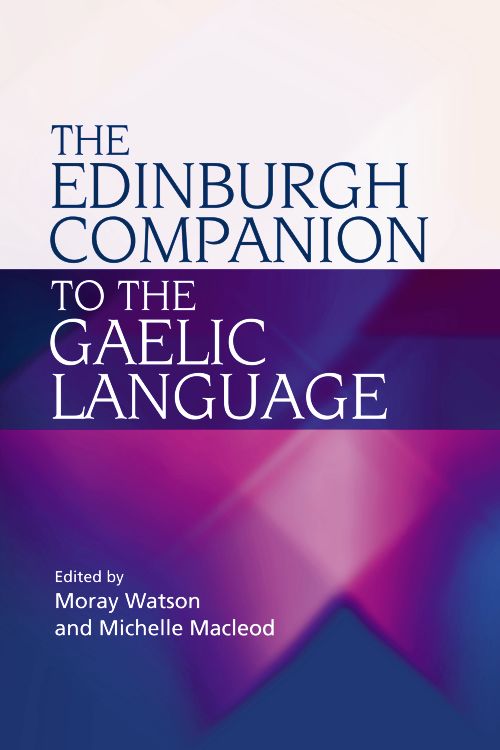
The Edinburgh Companion to the Gaelic Language
Bringing together a range of perspectives on the Gaelic language, this book covers the history of the language, its development in Scotland and Canada, its spelling, syntax and morphology, its modern vocabulary, and the study of its dialects. It also addresses sociolinguistic issues such as identity, perception, language planning and the appearance of the language in literature. Each chapter is written by an expert on their topic.
The book has been written accessibly with a non-specialist audience in mind. It will have a particular value for those requiring introductions to aspects of the Gaelic language. It will also be of great interest to those who are embarking on research on Gaelic for the first time. Authors include Colm O Baoill, David Adger, Rob Dunbar, Seosamh Watson, Ken Nilsen, Ken MacKinnon and Ronald Black.
This book:
*Deals with a wide range of aspects of Gaelic*Places the study of the Gaelic language within the context of modern linguistic research*Encourages and supports further study*Includes chapters by a number of leading experts on Gaelic language
eBook

Young Speakers: A Pilot Study of Gaelic Bilinguals’ Language Practices
Studies of primary school pupils’ Gaelic to date have largely relied on criterion referenced tests to measure attainment against curricular expectations: with only NicLeòid’s (2015) work on student attitudes and Nance’s research (e.g. 2013 and 2015) on comparative phonology bucking this trend. There is a surprising lack of information or research about the language forms and bilingual repertoire of young speakers. A better understanding of young people’s language practices requires the Gaelic research community to develop datasets from spontaneous interactions. This paper draws on a pilot study with a primary 5-6 school cohort in Gaelic-medium education. Using a combination of audio and audio-visual data from the classroom together with data on young speakers’ language attitudes, this paper examines pupils’ determination and strategies to maintain the classroom language as Gaelic. The results of this pilot study can inform the development of new methodologies for collaborative research with the school community on children’s linguistic development and attainment. Such research, it is argued, is necessary in light of the dependency of the Gaelic language planning model on the primary school for the production of new Gaelic speakers.
Journal Article

Multimedia web-based intervention and implementation of motivational factors in incentive strategies on learning motivation
Learning motivation is the most dynamic factor among the individual factors of language learners and the driving force of foreign language learning. This paper attempts to explore the multimedia web-based intervention mechanism of incentive strategies in the process of second language acquisition (SLA) through four aspects of factors affecting foreign language learning motivation, including cognition, emotion, social environment and learners’ characteristics, in order to improve the affective disorder in language learning and transform the SLA from static into multi-level dynamic learning activity, so as to improve the learning effect. The study implemented the experiment and evaluated its results. The results indicate that the intervention of motivational factors in second language acquisition has positive effect on learners’ acquisition of English.
Journal Article

Language in Society
This chapter offers a glimpse at many aspects of Gaelic in society since 1800: it is not a linguistic analysis of how the language has changed in this period; rather it highlights some of the key areas of linguistic and social interaction. The nineteenth century was a period of immense change for Gaelic speakers. Highland and rural society, in which Gaelic was mainly based, changed dramatically over the course of the century and the process of change that began in the nineteenth century is still felt today. Issues relating to the nineteenth-century Gaelic community have been well documented (Withers 1984,
Book Chapter

Language and Identity in Modern Gaelic Verse
Sociolinguists and (linguistic) anthropologists have long believed that language is one of the key factors in determining a person’s identity. One eminent scholar, Joshua Fishman, states in the Introduction to hisHandbook of Language and Ethnic Identity(1999) that
although language has rarely been equated with the totality of ethnicity, it has, in certain historical, regional and disciplinary contexts been accorded priority within that totality […] How and when the link between language and ethnicity comes about, its saliency and potency, its waxing and waning, its inevitability and the possibility of its sundering, all need to be examined.¹
Fishman also
Book Chapter