
Catalogue Search | MBRL


Are you sure you want to remove the book from the shelf?

{{itemTitle}}
6
result(s) for
"Mahendran, Kesi"
Sort by:

Discursive governance in politics, policy, and the public sphere
\"Discursive governance refers to implicit mechanisms of governance such as narratives, leitmotifs, and strategic metaphors in political language. It examines how the framing of policies affects political and social representations in accordance with the wishes of political authorities. Ad hoc discourses generate a space where politicians configure, transmit, and initiate politics ideationally, rather than vouchsafing substantial policy change with respect to governance. This book studies the dynamics of political discourse in governance processes. It demonstrates the process in which political discourses become normative mechanisms, first marking socially constructed realities in politics, second playing a role in delineating the subsequent policy frames, and third influencing the public sphere. The key contribution of this volume is tracing the discursive relationships among actors, namely governments and political parties, policy participants and societal actors, and the public in European nation states, intergovernmental organizations, subnational or regional entities, and geographies beyond Europe where European norms trigger ideational processes of change. The book extends earlier work in the field by exploring how policy and politics create social knowledge, make some ideas publicly salient, and bring together coalitions of actors that find certain policy alternatives attractive and eventually generate political and policy change\"-- Provided by publisher.
Book

Multilateralism under Fire: How Public Narratives of Multilateralism and Ideals of a Border-Free World Repudiate the Populist Re-Bordering Narrative
How do global multilateral arrangements such as the United Nations (UN) and World Health Organization (WHO), vital to post-pandemic recovery, connect to the public understanding of multilateralism? The Citizen Worldview Mapping Project (CWMP) conducted in England, Scotland and Sweden examines how the degree of migration–mobility interacts with worldviews. CWMP asked participants (N = 24) to rule the world using an online interactive world mapping tool. Citizens were first interviewed on their migration–mobility, then invited to draw or remove borders on the world to manage human mobility. Citizens then engaged in a dialogue with António Guterres’ 2018 address to the United Nations General Assembly on multilateralism. Dialogical analysis showed how, when empowered to rule the world, the majority of participants, irrespective of the degree of migration–mobility, expressed an ideal of a border-free world, even if they then went on to construct borders around the world. We understand this as a democratic dialogical ideal of a border-free world. Participants articulated rich narratives and social representations of international relations, yet did not have a formal understanding of the reified concept of multilateralism. Bridging this gap between the consensual sphere of the public’s ideals based on social representations of cooperation and conflict and the reified sphere containing political narratives of multilateralism is a key step to longer-term post-pandemic recovery. A first step will be further studies into how an ideal of a border-free world can reconfigure political resistance to xenophobic populist re-bordering.
Journal Article
Everyday Narratives of Resistance and Reconfigurations of Political Protest after the Pandemic—Editors’ Introduction
Perhaps one of the most demanding challenges of the arrival of the COVID-19 crisis in early 2020 was the extent to which it arrived on top of a series of existing global crises [...]
Journal Article

From Polarized We/They Public Opinion on European Integration Towards Social Representations of Public Dialogue
Social psychology has established that oppositional we/they categorization is central to dis/identification with European integration (Chryssochoou, 2000; Hewstone, 1986; Mummendey & Walduz, 2004). As Europe faces fresh uncertainties, for example, Brexit, this article reveals the multipositional features of public-opinion formation. Drawing on meta-representational approaches, it reveals how we/they categorization moves from oppositional forms towards diplomatic nonoppositional forms when citizens speak about the general public in \"a public capacity\" (Dewey, 1927/1954). Two interview-led studies in England, Ireland, Germany, Scotland, and Sweden (n = 100) brought participants into dialogue with the ideals of European integration. Analysis reveals six dialogical positions on the general public—avant-garde, advocating, homesteading, distancing, segmenting, and progressive. These rest on social representations of the public as having freedom from movement, freedom of movement, and freedom through movement. Understanding the public's multipositional capacities and the interplay between self-world narratives and European integration narratives is one step towards depolarization and public dialogue on Europe.
Journal Article
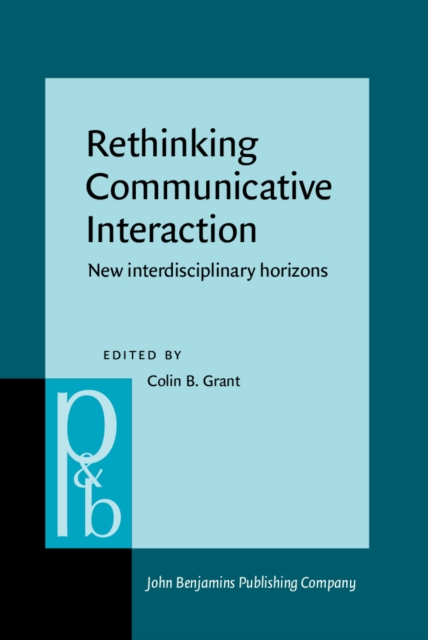
Rethinking communicative interaction : new interdisciplinary horizons
This volume breaks open traditional disciplinary confines and approaches the full complexity of communicative interaction from an impressive range of exciting state-of-the-art perspectives in social psychology, conversation analysis, hermeneutics, constructivist psychology, communication theory, computational neuroscience, sociology of communication, second language pragmatics, ergonomic interaction theory and computer-mediated interaction studies. In so doing, it sets out to establish a new research agenda in which communication science is understood as a human-social science par excellence. This collection of fifteen essays by seventeen scholars from Canada, the United States, Brazil, Ireland, the Netherlands, Germany and the UK will be of interest to scholars and students in all of the above fields. The editor, Colin B. Grant, is Reader in Modern Languages in the School of Management and Languages, Heriot Watt University, Edinburgh, where he runs the interdisciplinary social communication science research group. He is author of Literary Communication from Consensus to Rupture (1995), Functions and Fictions of Communication (2000) and chief editor of Language-Meaning-Social Construction (2001).
eBook
Who are the new Euro-believers?
Populism and the expressive citizen Etienne Balibar identifies two root causes of the current European phase of multiple crises firstly - inequalities - which have led to hopelessness and fragmentation and the crystallizing of power relations between states, and secondly the resurgence of nationalism. Populism - the powerful rhetorical business of taking up the voice of the ordinary person against the established elite currently combines with nationalism, ranging from a patriotic belief or a desire for sovereignty to racism and xenophobia.
Magazine Article