
Catalogue Search | MBRL


Are you sure you want to remove the book from the shelf?

{{itemTitle}}
15,807
result(s) for
"Main, A"
Sort by:


High-level semi-synthetic production of the potent antimalarial artemisinin
NRC publication: Yes
Journal Article
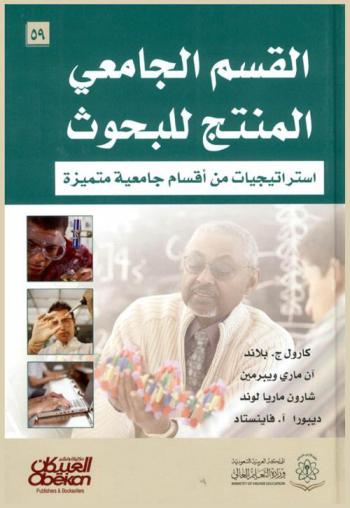
القسم الجامعي المنتج للبحوث : استراتيجيات من أقسام جامعية متميزة
يتضمن هذا الكتاب استراتيجيات مستندة إلى مقابلات وحوارات مع رؤساء وعمداء وجميعهم يحتلون مراتب رفيعة على الصعيد القومي لقدراتهم ومنجزاتهم البحثية ويمثلون تخصصات علمية متنوعة وكليات مختلفة وجماعات متباينة وهو موجه بصورة خاصة إلى العمداء ورؤساء الأقسام وغيرهم ممن يتولون مسؤولية الحفاظ على إنتاجية الأساتذة للبحوث وزيادتها والنتيجة النهائية لذلك عرض ملزم لأفضل الممارسات والدروس وممارسات توظيف الأساتذة وبرامج التعليم التوجيهي الإرشادي وأنظمة المكافآت وأنشطة بناء الثقافة وتوزع الموارد المالية والبشرية.
Book

Performance of the LHCb RICH detector at the LHC
The LHCb experiment has been taking data at the Large Hadron Collider (LHC) at CERN since the end of 2009. One of its key detector components is the Ring-Imaging Cherenkov (RICH) system. This provides charged particle identification over a wide momentum range, from 2–100 GeV/
c
. The operation and control, software, and online monitoring of the RICH system are described. The particle identification performance is presented, as measured using data from the LHC. Excellent separation of hadronic particle types (
π
, K, p) is achieved.
Journal Article


Experimental Modeling of Spinal Cord Injury: Characterization of a Force-Defined Injury Device
We examined the ability of a novel spinal cord injury (SCI) device to produce graded morphological and behavioral changes in the adult rat following an injury at thoracic level 10 (T10). The injury device uses force applied to the tissue as the control variable rather than tissue displacement. This has the advantage of eliminating errors that may arise from tissue movement prior to injury. Three different injury severities, defined by the amount of force applied to the exposed spinal cord at T10 (100, 150, and 200 kdyn), were evaluated at two different survival times (7 and 42 d). Unbiased stereology was employed to evaluate morphological differences following the injury. Quantitative behavioral assessment employed the Basso, Beattie, and Bresnahan locomotive rating scale. There was a significant force-related decline in locomotive ability following the injury. Animals subjected to a 200-kdyn injury performed significantly worse than animals subjected to a 100- and 150-kdyn injury. The locomotor ability at different days post injury significantly correlated with the amount of force applied to the spinal cord. Statistical analysis revealed several significant force-related morphological differences following the injury. The greatest loss of white and gray matter occurred at the site of injury impact and extended in both a rostral and caudal direction. Animals subjected to the greatest force (200 kdyn) displayed the least amount of spared tissue at both survival times indicative of the most severe injury. The amount of spared tissue significantly correlated with the locomotor ability. This novel rodent model of SCI provides a significant improvement over existing devices for SCI by reducing variability with a constant preset force to define the injury.
Journal Article

Functional and ecosystem service differences between tree species: implications for tree species replacement
Key messageTree species differ in their functioning at the scale of an individual tree which will result in differences in ecosystem service provision. Replacement trees for diseased trees should take account of functional differences.Globally tree species composition is changing due to species loss from pests and pathogens. The impact of this change on ecological functioning is rarely tested. Using six sites across the UK, with multiple tree species at each site, we test for functional differences between three species threatened by disease in the UK: Quercus petraea, Q. robur and Fraxinus excelsior and six other species: Acer pseudoplatanus, Castanea sativa, Fagus sylvatica, Quercus cerris, Quercus rubra, and Tilia x europaea, which have previously been suggested as ecological replacements. Differences between species were detected for all the variables measured: nitrogen mineralization, decomposition rate, total soil carbon and nitrogen, soil pH, soil temperature, and bark water holding capacity. Non-native Quercus species were only suitable replacements for native Quercus for some of the functions measured but replicating native Quercus functioning using a mixture of other species may be possible. The functioning of F. excelsior was different from most other tree species, suggesting that replicating its functioning with replacement tree species is difficult. The work highlighted that which species replaces diseased trees, even at the scale of single trees, will impact on the functions and ecosystem services provided.
Journal Article

Challenges to Seagrass Restoration in the Indian River Lagoon, Florida
Seagrasses provide valuable ecosystem services, including improved water quality, carbon sequestration, and sediment stabilization. Unfortunately, these critical habitats are declining globally due to a range of anthropogenic impacts. Restoration practitioners have made efforts to mitigate loss through the introduction of seagrass transplants. However, seagrass restoration has low success rates and is plagued by water quality concerns and ecosystem degradation. Studies to improve seagrass restoration efforts have targeted different functional taxa to allow for greater stability and recovery of threatened ecosystems, and excluded macro-grazers to limit losses to newly established and restored seagrasses. We hypothesized greater seagrass (Halodule wrightii) health when restored in conjunction with hard clams (Mercenaria mercenaria) and protected from grazers using herbivore exclusion devices (HEDs) in the Indian River Lagoon (IRL), Florida. While our study experienced high rates of seagrass mortality, we were able to observe significant differences in seagrass health between IRL sub-lagoons and observed the positive effects of HEDs on seagrass health. The observed high species mortality highlights how restoration in the IRL is hindered by biotic and abiotic stressors, site selection, and a lack of clear restoration protocols. As we see ongoing declines in water quality and loss of foundational species, informed site selection, greater understanding of grazer presence, and multi-species restoration will provide an informed approach for future seagrass restoration projects globally.
Journal Article

The potential role of the antioxidant and detoxification properties of glutathione in autism spectrum disorders: a systematic review and meta-analysis
Background
Glutathione has a wide range of functions; it is an endogenous anti-oxidant and plays a key role in the maintenance of intracellular redox balance and detoxification of xenobiotics. Several studies have indicated that children with autism spectrum disorders may have altered glutathione metabolism which could play a key role in the condition.
Methods
A systematic literature review and meta-analysis was conducted of studies examining metabolites, interventions and/or genes of the glutathione metabolism pathways i.e. the γ-glutamyl cycle and trans-sulphuration pathway in autism spectrum disorders.
Results
Thirty nine studies were included in the review comprising an
in vitro
study, thirty two metabolite and/or co-factor studies, six intervention studies and six studies with genetic data as well as eight studies examining enzyme activity.
Conclusions
The review found evidence for the involvement of the γ-glutamyl cycle and trans-sulphuration pathway in autistic disorder is sufficiently consistent, particularly with respect to the glutathione redox ratio, to warrant further investigation to determine the significance in relation to clinical outcomes. Large, well designed intervention studies that link metabolites, cofactors and genes of the γ-glutamyl cycle and trans-sulphuration pathway with objective behavioural outcomes in children with autism spectrum disorders are required. Future risk factor analysis should include consideration of multiple nutritional status and metabolite biomarkers of pathways linked with the γ-glutamyl cycle and the interaction of genotype in relation to these factors.
Journal Article

The Impact of Tick Parasites on the Behaviour of the Lizard Tiliqua rugosa
Populations of the Australian sleepy lizard, Tiliqua rugosa, near Mt. Mary, South Australia carry natural infestations of two tick species Aponomma hydrosauri and Amblyomma limbatum. In field experiments at two sites, 18 km apart, lizards with experimentally increased tick loads had smaller home ranges, moved shorter distances in a day, and were found basking more but moving less often than lizards from which ticks were experimentally removed. The results were consistent for adult lizards in two years, and for sub-adults in a third year. Laboratory trials showed that juvenile lizards that had tick infestations had lower sprint speeds than uninfested siblings, and that adults with tick infestations had less endurance than those that were uninfested. The results contrast with those of a previous survey that showed that lizards with high tick loads had greater body size and remained longer at a site, but indicate that there may be a balance, for lizards, between the fitness advantages in occupying habitats with high-quality resources, and the costs from parasites that also prefer those habitats.
Journal Article