
Catalogue Search | MBRL


Are you sure you want to remove the book from the shelf?

{{itemTitle}}
42
result(s) for
"Malik, Pravir"
Sort by:

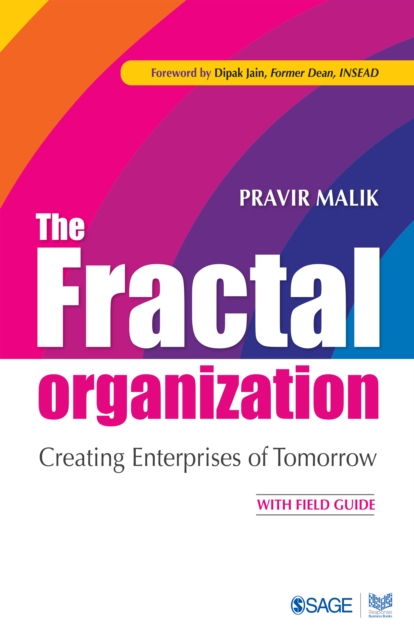
The fractal organization : creating enterprises of tomorrow
The biggest challenge facing leaders today is the creation of organizations that are capable of surviving and flourishing in these uncertain times. How does one create an organization that is sustainable in the long run, how can organizations be ready for uncertainties that the markets place upon them, how can an organization be simply brilliant by design? This book leverages the proposed meta-theory for progressive organizational design and dynamics real-world reflections to create fractal-based sustainable enterprises of tomorrow. In this meta-theory all instances of organization, from the smallest, such as an idea or a person, to the largest, such as global markets and planet earth herself, are fractals: the essence of their way of being is repeated on scales both smaller and larger than themselves. There is however, a particular class of fractals, that of progress, of which The Fractal Ladder is an ever-present manifestation, which spawns organizations that are truly progressive and sustainable in nature. In the scheme of things this class of fractals is of critical importance, and to master its replication and to fully understand the impact it will have in creating sustainable and dynamic organizations is a practical necessity. Divided into three parts, Part I - Theory, will present the theory behind the Fractal Organization. Part II - Exercises, will translate key elements of the fractal-based world-view into practical activities and exercises at the personal and workplace levels. Part III - Reflections, will apply the basic logic of the sun-marked physical-vital-mental fractal to many practical problems and situations we are faced with daily to suggest ways to address them.
eBook

A CASE STUDY VALIDATION OF THE APPLICATION OF A GENERALISED EQUATION OF INNOVATION IN COMPLEX ADAPTIVE SYSTEMS
This article leverages a mathematical model of innovation for complex adaptive systems (CAS) to explore, ex post facto, organisational innovation investigations conducted by the first author at Stanford University Medical Center. Tapping into the meta-level and more varied sources of innovation, as illustrated by a generalised equation of innovation, requires that habitual patterns along the physical, vital, mental, and integral dimensions be overcome. The experimental work used frameworks and software consistent with the generalised equation of innovation in CAS to assist in overcoming such patterns at the personal, team, and departmental levels, thereby allowing deeper sources of innovation to come into being.
Journal Article

Development and Evaluation of a Framework for an Engine of Innovation in Complex Adaptive Systems
The emerging, multi-disciplinary field of Complex Adaptive Systems (CAS) is an alternative to linear, reductionist thinking. It is based on the observations that real-world systems, regardless of scale, are emergent, complex, adaptive, and evolutionary. In this research the scale of CAS examined range from distances of Planck’s constant to Gigaparsecs. CAS has also heavily leveraged the interpretations of several recent Nobel Laureates and assumes too that the world is random, indeterministic, and chaotic. But randomness, chaos, and indeterminism can hardly create the progressive, increasingly harmonious world that we are a part of.At the heart of this issue lies confusion around what innovation in CAS really is. The essential approach to arriving at a mathematical basis of innovation for CAS here has been to view systems from the outside-in as opposed to from the inside-out and the bottom-up. In this approach innovation is conceptualized as existing in every single space-time point-instant in a system. There is a process of precipitation by which this innovation may express itself through a series of quaternary-based architectural forces that are the prime sources of innovation. These series or arrays of forces may further precipitate by informing organizational signatures. Organizations can be thought of as formations with a unique signature at their center, and can vary in complexity and scale. The unique signature for each organization is usually hidden though by common surface dynamics, and “to innovate” is to work through and change the habitual and common patterns in order to allow the deeper founts of innovation to become active at the surface level. When this happens, it is then that innovation occurs.Once that is more clearly seen then the erected probabilistic and uncertainty functions assumed to be true of the fundamental layers of nature, will be relegated to their place as interim devices in model building.The nature of innovation can be progressively elaborated through inductive reasoning to arrive at a mathematical framework for innovation in CAS. Rather than assume a chaotic, random, indeterministic world as a starting point, this framework can be built assuming a purposeful, ordered world characterized by qualified determinism. Equations to provide insight into the inherent innovation bias of our system, the nature of each point in the system, the broad architectural forces behind the development of organizations, the inherent uniqueness of each organization, the way to think about varying cultures or organizations, and theinherent dynamismof our system, form the edifice of this framework. The resulting model can then be used deductively to reinforce observations, and predictively to suggest directions and / or steps to emerging trends.This research hence, through deriving mathematical equations, and by further applying these to various domains ranging from the quantum, to the atomic, to the cellular, to the astrophysical, has been able to provide mathematical contributions to the theory of CAS and to various CAS application areas.With respect to the theory of CAS, mathematical contributions have been made to understanding the underlying directional bias of CAS activity, understanding the nature of each point in any CAS, and creating mathematical sets for architectural forces that are posited to be behind the development of any CAS. Further, mathematical contributions have been made to understanding the inherent dynamics in any CAS, the dynamics of stagnation and growth in CAS, and the balance of randomness and determinism of any CAS. Mathematical contributions also extend to framing complexity in CAS, understanding what can drive sustainability of CAS, and arriving at a general set of mathematical operators true of any CAS.
Dissertation