
Catalogue Search | MBRL


Are you sure you want to remove the book from the shelf?

{{itemTitle}}
24
result(s) for
"Mandelbaum, Michael, author"
Sort by:

The rise and fall of peace on Earth
\"The Rise and Fall of Peace on Earth examines that singularly peaceful quarter century. Its initial three chapters describe how and why peace came to be established in three important parts of the world: Europe (Chapter 1), where it was most firmly embedded; East Asia (Chapter 2), which was more peaceful than at any other time in its modern history; and the Middle East (Chapter 3), the least peaceful of the three regions during those 25 years. These chapters also describe and explain how and why the unprecedentedly peaceful conditions in each of the three regions came to an end. The fourth and final chapter explores the prospects for the revival of peace in the future\"-- Provided by publisher.
Book
The Nuclear Future
While specifically defining many of the technical terms that
have made this subject so inaccessible, Michael Mandelbaum
discusses the weapons systems and nuclear doctrine of both the
United States and the Soviet Union along with their predicted
impact on the future of the arms race.
eBook

The four ages of American foreign policy : weak power, great power, superpower, hyperpower
\"Terrorist attacks on New York City and Washington D.C. on September 11, 2001, launched the United States into three wars: a global war on terror; a war in Afghanistan; and a war against Saddam Hussein's regime in Iraq. In both Afghanistan and Iraq American efforts to install stable, democratic, friendly governments encountered opposition, and the United States found itself fighting against insurgencies in both places. In 2008, a severe financial crisis struck America, which led to a prolonged global recession. By the end of this period, Russia, China, and Iran had begun to mount serious challenges to American interests in Europe, East Asia, and the Middle East respectively. This brought an end to the fourth age of American foreign policy\"-- Provided by publisher.
BOOK

Mission Failure
Mission Failure argues that, in the past 25 years, the U.S. military has turned to missions that are largely humanitarian and socio-political - and that this ideologically-driven foreign policy generally leads to failure.
eBook
Democracy's good name : the rise and risks of the world's most popular form of government
The acclaimed author of The Ideas that Conquered the World investigates the reasons for democracy's exponential rise in the last century and critically examines democracy's potential in the Middle East, Russia, and China.
eBook
The Ideas That Conquered The World
At the dawn of the twenty-first century, three ideas dominate the world: peace as the preferred basis for relations between and among different countries, democracy as the optimal way to organize political life, and free markets as the indispensable vehicle for the creation of wealth. While not practiced everywhere, these ideas have--for the first time in history--no serious rivals. And although the terrorist attacks of September 11, 2001, were terrible and traumatic, they did not \"change everything,\" as so many commentators have asserted. Instead, these events served to illuminate even more brightly the world that emerged from the end of the Cold War.InThe Ideas That Conquered the World,Michael Mandelbaum describes the uneven spread (over the past two centuries) of peace, democracy, and free markets from the wealthy and powerful countries of the world's core, where they originated, to the weaker and poorer countries of its periphery. And he assesses the prospects for these ideas in the years to come, giving particular attention to the United States, which bears the greatest responsibility for protecting and promoting them, and to Russia, China, and the Middle East, in which they are not well established and where their fate will affect the rest of the world.Drawing on history, politics, and economics, this incisive book provides a clear and original guide to the main trends of the twenty-first century, from globalization to terrorism, through the perspective of one of our era's most provocative thinkers.
eBook
The Frugal Superpower
In this incisive new book, Michael Mandelbaum argues that the era marked by an expansive American foreign policy is coming to an end. During the seven decades from the U.S. entry into World War II in 1941 to the present, economic constraints rarely limited what the United States did in the world. Now that will change. The country's soaring deficits, fueled by the huge costs of the financial crash and of its entitlement programs-Social Security and Medicare-will compel a more modest American international presence.In assessing the consequences of this new, less expensive foreign policy, Mandelbaum, one of America's leading foreign policy experts, describes the policies the United States will have to discontinue, assesses the potential threats from China, Russia, and Iran, and recommends a new policy, centered on a reduction in the nation's dependence on foreign oil, which can do for America and the world in the twenty-first century what the containment of the Soviet Union did in the twentieth.
eBook
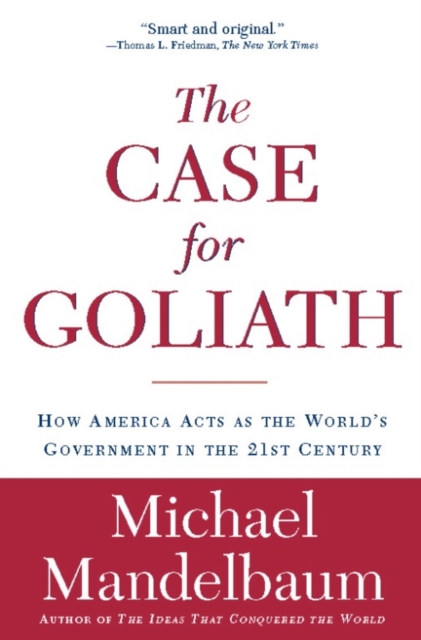
The case for Goliath : how America acts as the world's government in the twenty-first century
How does the United States use its enormous power in the world? In The Case for Goliath, Michael Mandelbaum offers a surprising answer: The United States furnishes to other countries the services that governments provide within the countries they govern.Mandelbaum explains how this role came about despite the fact that neither the United States nor any other country sought to establish it. He describes the contributions that American power makes to global security and prosperity, the shortcomings of American foreign policy, and how other countries have come to accept, resent, and exert influence on America's global role. And he assesses the prospects for the continuation of this role, which depends most importantly on whether the American public is willing to pay for it.Written with Mandelbaum's characteristic blend of clarity, wit, and profound understanding of America and the world,The Case for Goliathoffers a fresh and surprising approach to an issue that obsesses citizens and policymakers the world over, as well as a major statement on the foreign policy issues confronting the American people today.
eBook
PRO SEASON STARTS TONIGHT, How football resembles war, America's favorite spectator sport features an element many say they oppose - violence
The football field has the potential to be in the 21st century what the zoo became in the 20th: a place where something once common but now rare is on display. Indeed, it has the potential to be more than that. At the beginning of the 20th century the philosopher and psychologist William James called for the development of a \"moral equivalent of war,\" by which he meant an enterprise incorporating the desirable features of armed conflict, such as courage, discipline and camaraderie, without the destruction that war brings. In the 21st century football may play precisely that role, in which case millions of Americans will continue to watch and enjoy the games, and admire those who play in them, far into the future. Even as football has prospered, however, violence has become less legitimate in American life. The declining tolerance for interpersonal violence has coincided with, and is probably linked to, the rise in the status of women. The popularity of boxing, the sport that embodies violence in its purest form, has dropped sharply. The last third of the 20th century also witnessed a sharp decline in the standing of football's distant cousin, warfare, with more and more people coming to consider this age-old practice both barbarous and unnecessary.
Newspaper Article

TOO IMPORTANT FOR GENERALS?
Though it is a useful guide to many of the specific issues of the nuclear age, ''Counsels of War'' is less satisfactory in tackling the broader questions these issues raise. What effect, for example, did the experts have on the course of policy? The book's organization suggests their influence rose and then fell over four decades. Its first part, covering the first 15 years of the nuclear age, is entitled ''Missionaries,'' implying that the civilian experts were outsiders trying to win the adoption of their ideas. The second, called ''Crusaders,'' spans the years when Robert McNamara was Secretary of Defense, during which, the reader might infer, the experts had the chance to put their ideas into practice. The section describing the period from the end of the 1960's to the present is called ''Apostates,'' suggesting a loss of faith in received doctrines. While this is provocative and not altogether inaccurate, there are important exceptions to this characterization of the experts' role - the dissident scientists of the 1950's were very much insiders, for example. Is the world more or less safe because of the experts' exertions? One of the book's epigraphs -Lord Salisbury's observation that ''no lesson seems to be so deeply inculcated by the experience of life as that you should never trust in experts'' - leaves the impression that in Mr. [Gregg Herken]'s view, their contributions have not been wholly beneficial. At the book's end, he sees an ''encouraging sign'' in the growing involvement in nuclear matters of ''the vast number of American citizens who are not experts on the bomb.'' The reader might well conclude that the author believes the specialists have made a mess of things and more extensive popular control of nuclear policy can help to set things right. But the idea is not substantiated. What, finally, are the important themes underlying the controversies that ''Counsels of War'' describes? What, beyond the merits of particular weapons, have the arguments been about? At the end of the book, the author appears to suggest that the debates of the last 40 years have failed to deal with the most important question of all - what are nuclear weapons for?
Newspaper Article