
Catalogue Search | MBRL


Are you sure you want to remove the book from the shelf?

{{itemTitle}}
121
result(s) for
"Manent, Pierre"
Sort by:


Metamorphoses of the City
Metamorphoses of the City is a sweeping interpretation of Europe's ambition to generate ever better forms of collective self-government, from ancient city-states and empires to a universal church and the nation-state. But the nation-state is nearing the end of its line, Pierre Manent says, and what will supplant it remains to be seen.
eBook
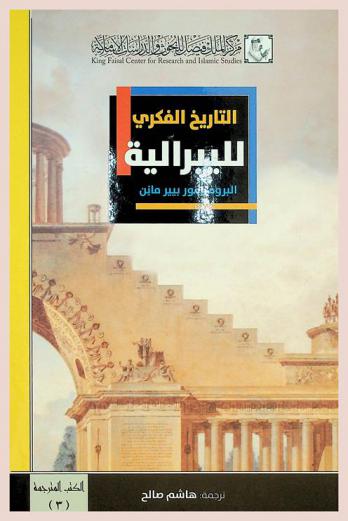
التاريخ الفكري لليبرالية
يعد الكتاب إضافة مهمة للمكتبة العربية وهو من الكتب التأسيسية في مجال الفلسفة الليبرالية والفكر السياسي، ويمثل إطلالة موجزة على التاريخ الأوروبي عبر سياحة فكرية في عقول ثمانية فلاسفة ومفكرين أوروبيين تنسب إليهم تأسيس الفكرة ويناقش الكتاب الخطوط العريضة والمكونات الفكرية المؤسسة للفلسفة الليبرالية وتشكيلها بوصفها التيار الأساسي للسياسة الحديثة في أوروبا والغرب منذ ثلاثة قرون ويحلل الكتاب أبعاد الخلفية التاريخية التي سبقت الفلسفة الليبرالية وأسهمت في انبثاقها مستعرضا أبرز الأفكار المؤسسة للفلسفة الليبرالية في تطوراتها التاريخية ومحدداتها المفاهيمية المختلفة والمتنوعة.
BOOK

Metamorphoses of the city : on the Western dynamic
Metamorphoses of the City is a sweeping interpretation of Europe's ambition to generate ever better forms of collective self-government, from ancient city-states and empires to a universal church and the nation-state. But the nation-state is nearing the end of its line, Pierre Manent says, and what will supplant it remains to be seen.
eBook

The Crisis of Liberalism
Liberalism as a governing order is barely two centuries old. A response to the great alternatives presented by Europe's political history, it represents a unique synthesis of the ancient and the modern. But globalization has cast a deep shadow across liberalism's future by separating economic activity and the political community of belonging. Thus we are threatened not only by massive impoverishment but also by a political dislocation and a moral rift as well.
Journal Article
Metamorphoses of the City
What is the best way to govern ourselves? The history of the West has been shaped by the struggle to answer this question, according to Pierre Manent. A major achievement by one of Europe's most influential political philosophers, Metamorphoses of the City is a sweeping interpretation of Europe's ambition since ancient times to generate ever better forms of collective self-government, and a reflection on what it means to be modern.
Manent's genealogy of the nation-state begins with the Greek city-state, the polis. With its creation, humans ceased to organize themselves solely by family and kinship systems and instead began to live politically. Eventually, as the polis exhausted its possibilities in warfare and civil strife, cities evolved into empires, epitomized by Rome, and empires in turn gave way to the universal Catholic Church and finally the nation-state. Through readings of Aristotle, Augustine, Montaigne, and others, Manent charts an intellectual history of these political forms, allowing us to see that the dynamic of competition among them is a central force in the evolution of Western civilization.
Scarred by the legacy of world wars, submerged in an increasingly technical transnational bureaucracy, indecisive in the face of proliferating crises of representative democracy, the European nation-state, Manent says, is nearing the end of its line. What new metamorphosis of the city will supplant it remains to be seen.
eBook

THE TRAGEDY OF THE REPUBLIC
The republican idea seems so near and familiar to us, it envelops us to the point that we would experience it as a kind of impiety to hold it at a distance in order to describe and judge it; its \"value\" paralyzes us. [...]we are heirs to a very long history, in the course of which different political bodies have grown and declined under the same name of \"republic.\" What now limits our political interest in the experience of republican Rome is the well-founded feeling that there is a qualitative difference between ancient and modern republicanism. Since representative government is the great invention of modern politics, what would be the point of seeking useful teachings in an ancient, that is, non-representative republic? Far be it from me to minimize the importance of the question of political representation. Representative government has over time been adopted in all European countries and many more besides, not from love of representation for its own sake, but because, in their experience, the representative has seemed to be the best form of republican government. Shakespeare's Roman plays thus make available to us not, of course, a historical document, but an interrogation or inquiry into the motives of the actors of the Roman Republic, the regime that left the deepest mark on the history of Europe and of the West.
Journal Article
REPURPOSING EUROPE
Islam throughout its history has largely preserved the form, the impulse, and the consciousness of empire (traits that are found with renewed vigor today), while Western Christianity, though born in an imperial form, and very much subject to great missionary and conquering movements, found its relative stability in a very different arrangement. Today, because we hold the history of Europe at a distance, because we have emptied Europe of its old nations and its old religion, Islam's entry into European life appears to elite opinion as a problem that does not arise.\\n No longer daring to be at home in their own countries, Europeans seek repose in moving toward a post-national future, a movement that nothing can control or slow down.
Journal Article