
Catalogue Search | MBRL


Are you sure you want to remove the book from the shelf?

{{itemTitle}}
59
result(s) for
"Mani, Inderjeet"
Sort by:


The imagined moment : time, narrative, and computation
Time is a key aspect of narrative. It can advance a story, illuminate its role in our daily lives, and help us understand how events unfold. In this groundbreaking interdisciplinary work, Inderjeet Mani uses recent developments in linguistics and computer science to analyze the use of time in narrative form. The Imagined Moment outlines directions for an emerging discipline of \"corpus narratology, \" an approach involving the computer analysis and interpretation of multimillion-word collections of narrative text. This approach, Mani explains, could alter the very foundations of narrative theory. Accordingly, he develops a computer representation for timelines and applies it to a variety of literary works. Among these are such classics as One Hundred Years of Solitude, \"A Hunger Artist, \" Swann's Way, Jealousy, Candide, and \"The Short Happy Life of Francis Macomber.\" Along the way, Mani considers stories embedded in temporal cycles; the cognitive processes involved in the construal of events in time; the modeling of narrative progression in terms of changes in readers' evaluation of characters; the study of variations of tempo in fiction; and time in computer-mediated forms of storytelling.
eBook

SpatialML: annotation scheme, resources, and evaluation
SpatialML is an annotation scheme for marking up references to places in natural language. It covers both named and nominal references to places, grounding them where possible with geo-coordinates, and characterizes relationships among places in terms of a region calculus. A freely available annotation editor has been developed for SpatialML, along with several annotated corpora. Inter-annotator agreement on SpatialML extents is 91.3
F
-measure on a corpus of SpatialML-annotated ACE documents released by the Linguistic Data Consortium. Disambiguation agreement on geo-coordinates on ACE is 87.93
F
-measure. An automatic tagger for SpatialML extents scores 86.9 F on ACE, while a disambiguator scores 93.0 F on it. Results are also presented for two other corpora. In adapting the extent tagger to new domains, merging the training data from the ACE corpus with annotated data in the new domain provides the best performance.
Journal Article
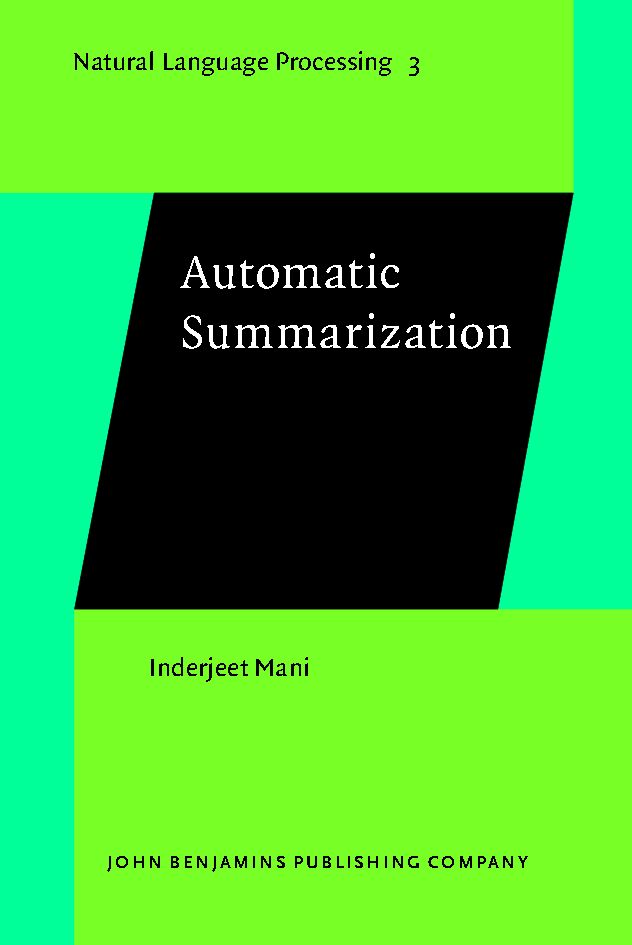
Automatic Summarization
With the explosion in the quantity of on-line text and multimedia information in recent years, there has been a renewed interest in automatic summarization. This book provides a systematic introduction to the field, explaining basic definitions, the strategies used by human summarizers, and automatic methods that leverage linguistic and statistical knowledge to produce extracts and abstracts. Drawing from a wealth of research in artificial intelligence, natural language processing, and information retrieval, the book also includes detailed assessments of evaluation methods and new topics such as multi-document and multimedia summarization. Previous automatic summarization books have been either collections of specialized papers, or else authored books with only a chapter or two devoted to the field as a whole. This is the first textbook on the subject, developed based on teaching materials used in two one-semester courses. To further help the student reader, the book includes detailed case studies, accompanied by end-of-chapter reviews and an extensive glossary.Audience: students and researchers, as well as information technology managers, librarians, and anyone else interested in the subject.
eBook
SUMMAC: a text summarization evaluation
The TIPSTER Text Summarization Evaluation (SUMMAC) has developed several new extrinsic and intrinsic methods for evaluating summaries. It has established definitively that automatic text summarization is very effective in relevance assessment tasks on news articles. Summaries as short as 17% of full text length sped up decision-making by almost a factor of 2 with no statistically significant degradation in accuracy. Analysis of feedback forms filled in after each decision indicated that the intelligibility of present-day machine-generated summaries is high. Systems that performed most accurately in the production of indicative and informative topic-related summaries used term frequency and co-occurrence statistics, and vocabulary overlap comparisons between text passages. However, in the absence of a topic, these statistical methods do not appear to provide any additional leverage: in the case of generic summaries, the systems were indistinguishable in accuracy. The paper discusses some of the tradeoffs and challenges faced by the evaluation, and also lists some of the lessons learned, impacts, and possible future directions. The evaluation methods used in the SUMMAC evaluation are of interest to both summarization evaluation as well as evaluation of other 'output-related' NLP technologies, where there may be many potentially acceptable outputs, with no automatic way to compare them. [PUBLICATION ABSTRACT]
Journal Article

The language of time : a reader
This reader collects and introduces important work on the use of linguistic devices in natural languages to situate events in time: whether they are past, present, or future; whether they are real or hypothetical; when an event might have occurred, and how long it could have lasted.
eBook

Summarizing Similarities and Differences Among Related Documents
Discussion of text summarization in information-retrieval systems focuses on summarizing the similarities and differences in information content among documents. Highlights a tool for analyzing document collections such as multiple news stories about an event or sequence of events. Contains 58 references. (Author/LRW)
Journal Article

The Language of Time
This reader collects and introduces important work in linguistics, computer science, artificial intelligence, and computational linguistics on the use of linguistic devices in natural languages to situate events in time: whether they are past, present, or future; whether they are real or hypothetical; when an event might have occurred, and how long it could have lasted. Clear, self-contained editorial introductions to each area provide the necessary technical background for the non-specialist, explaining the underlying connections across disciplines.
eBook

SpatiaIML: annotation scheme, resources, and evaluation
SpatialML is an annotation scheme for marking up references to places in natural language. It covers both named and nominal references to places, grounding them where possible with geo-coordinates, and characterizes relationships among places in terms of a region calculus. A freely available annotation editor has been developed for SpatialML, along with several annotated corpora. Inter-annotator agreement on SpatialML extents is 91.3 F-measure on a corpus of SpatialML-annotated ACE documents released by the Linguistic Data Consortium. Disambiguation agreement on geo-coordinates on ACE is 87.93 F-measure. An automatic tagger for SpatialML extents scores 86.9 F on ACE, while a disambiguator scores 93.0 F on it. Results are also presented for two other corpora. In adapting the extent tagger to new domains, merging the training data from the ACE corpus with annotated data in the new domain provides the best performance.
Journal Article