
Catalogue Search | MBRL


Are you sure you want to remove the book from the shelf?

{{itemTitle}}
640
result(s) for
"Marche, Stephen"
Sort by:


The Patroclization of Pat Tillman
At the heart of war is the moment when heroes are turned into inanimate objects. At the beginning of the grand interpretation of The Iliad by the twentieth-century French Catholic philosopher Simone Weil, \"The Iliad, Poem of Might,\" she proposes a definition of might: \"It is that ? that turns anybody who is subjected to it into a thing. Exercised to the limit, it turns man into a thing in the most literal sense: it makes a corpse of him. Somebody was here, and the next minute there is nobody here at all; this is a spectacle the Iliad never wearies of showing us.\" In this light, the death of Patroclus - a beautiful young man turned into nobody - inhabits the intellectual centre of the poem, as well as its primary plot hinge. Patroclus's final words, which amount to a lengthy oration, predict swift revenge from Achilles, but then his ability to speak is cut short by the pure effect of might, the silencing of the killed. Patroclus's corpse becomes the subject of the entire next book of The Iliad. AT [PAT TILLMAN]'s funeral, which was attended by various political and military dignitaries, the story was spun in the clearest terms. The traditional narrative required the fulfilment of three conventions: Tillman was killed by the enemy; as a fallen soldier, he was entitled to national recognition; and he was going to a better place. No less a representative than Senator John McCain made this last point at the funeral: \"You will see Pat again when a loving God reunites us all with our loved ones.\" Maria Shriver backed him up: \"Pat, you are home. You are safe.\" This religious approach stung Tillman's brother, Richard, who was barely able to speak from grief and also had a beer in his hand at the podium as he spoke: \"Make no mistake, [Pat] 'd want me to say this. He's not with God. He's fucking dead. He's not religious. So thanks for your thoughts, but he's fucking dead.\" Tillman's mother's fury was sparked in 2007 by a comment made by a Lieutenant Colonel Ralph Kauzlarich that blamed the Tillman«' inability to let go of their son's death on their atheism: \"When you die, I mean, there is supposedly a better life, right?\" Kauzlarich said. \"Well, if you are an atheist and you don't believe in anything, if you die, what is there to go to? Nothing. You are worm dirt.\" The religious dimension of the traditional dead hero narrative had been violated.
Journal Article

The next civil war : dispatches from the American future
\"On a small two-lane bridge in a rural county that loathes the federal government, the US Army uses lethal force to end a stand-off with hard-right militias, or anti-government patriots. Inside an ordinary diner, a disaffected young man with a handgun takes aim at the American president stepping in for impromptu photo-op, and a bullet splits the hyper-partisan country into violently opposed mourners and revelers. In New York City, a category 2 hurricane plunges entire neighborhoods underwater and creates millions of refugees overnight, a blow that comes on the heels of a devastating financial crash and years of catastrophic droughts, and tips America over the edge into ruin. These nightmarish scenarios are just three of the five possibilities most likely to spark devastating chaos in the United States that are brought to life here. Drawing upon sophisticated predictive models and nearly two hundred interviews with experts, military leaders, law enforcement officials, agricultural specialists, environmentalists, war historians, and political scientists, journalist Stephen Marche predicts the terrifying future collapse that so many of us do not want to see unfolding in front of our eyes. Marche has spoken with soldiers and counter-insurgency experts about what it would take to control the population of the United States, and the battle plans for the next civil war have already been drawn up. And not by novelists. By colonels\"--Book jacket flap.
BOOK
The iPad and Twenty-First-Century Humanism
The new insubstantiality of text destroys the imperialism of knowledge, for good and ill. It destroys the necessity of a locus. Take the case of Early English Books Online, which put every single early modern printed book online and easily accessible. The colonialist structure of English academia took a huge blow the day it appeared. That instant, there was no need for the vast majority of scholars to visit the Bodleian anymore, no need to be introduced to that antiquated world of whichway-does-the-sherry- rotate and who-wears-the-academic-robes and Rhodes-nostalgia and the rest of that faux-civilized nonsense. The genuine power that a great library once represented was, at a stroke, undone. \"The only romance was their names,\" as Hemingway said of broken-down Cuban houses. Printed books have always been the preserve of the homeless; now text belongs to the disembodied. Text is now a spirit world, unreal and ghostly.For the free world, which will increasingly be synonymous with the world of unlimited text, the power of technological change is already beginning to dissipate. The quantity of information has lost its power to excite. Now the business of quality is beginning to intrude. This process is exactly what happened in early modern England, after the explosion of the pamphlets following the widespread dissemination of printing presses. England needed a way of telling the good information from the bad information. Therefore the leading scientists of the day founded the Royal Society. The explosion of information, which challenges established loci of power, eventually requires the development of new loci. The limits of crowd - sourcing are already being felt. Wikipedia is using academics and setting up separate more reliable zones on its website. The latest trend in journalism - represented in Canada by OpenPile (openfile.ca) - takes crowdsourcing as an engine and then sends out reporters, trained professional reporters, to research the information the crowd produces. The job of elites, of the professional humanists, in the middle of this massive explosion of new information couldn't be clearer: to weed out the nutjobs, to qualify, to humanize knowledge.It is fascinating, and depressing, to witness the response of the academic humanities department to this massive challenge. Other than a few worthy endeavours Like EEBO, the response has been negligible. One reason is the gerontocracy created in academia by tenure and the lack of mandatory retirement - departments can remain comfortably ensconced in their technophobia for decades. The real problem, however, is that they are still trying, as they have been for 30 years, to be anything other than humanists. The current trend is literary neuroscience - to find connections between rhyme patterns and firing synapses. Anything but humanism - Marxism, poststructuralism, neuroscience. The liberal humanities are like awkward mechanics at a fancy dress ball where everybody's car has broken down - too vain to do the basic job that only they can do: establish good texts, and say what they mean, and later how they mean, and why. Only professional scholars in the humanities are capable of this task. Only they are trained to refine text, to establish the distinction between rough and polished knowledge, to localize and contextualize the massive influx of information.
Journal Article
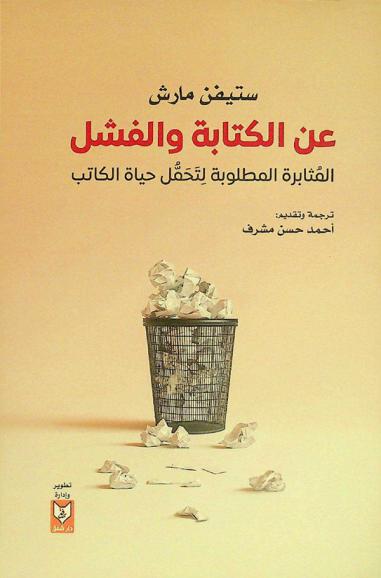
عن الكتابة والفشل : المثابرة المطلوبة لتحمل حياة الكاتب
كتاب \"عن الكتابة والفشل : المثابرة المطلوبة لتحمل حياة الكاتب\" للكاتب ستيفن مارش يتناول الجانب المظلم والخفي من حياة الكتابة، حيث يعتبر الفشل جزءا لا يتجزأ من حياة الكاتب، والنجاح هو الاستثناء النادر. يقدم مارش في هذا الكتاب قصصا ملهمة وحقيقية عن التحديات التي واجهها أشهر الأدباء قبل أن يصلوا إلى قمة المجد. الكتاب يسلط الضوء على أهمية المثابرة والصبر في مواجهة الإخفاقات المتكررة، ويقدم نصائح عملية للكتاب حول كيفية التعامل مع الفشل وتحويله إلى جزء من رحلة النجاح.
Book

The Glittering Skull: Celebrity Culture as World Religion
8 In the nineteenth century, aristocracy by talent emerged from aristocracy by birth. The Romantic poets were the first genuine celebrities as we know them today - men more famous for their lives than for their art. Beaches in Italy and Greece are still noted for the fact that [Byron] rode on them. Much as in the case with [Britney Spears], the demand for Byron's hair was intense - so intense that he often sent strands from his favourite dog Boatswain to his adoring female fans in place of the genuine article. Despite the non-stop attention paid to every detail of their lives, every celebrity hides a bit: \"Who are these people really?\" is the question that we can't answer but can't stop asking. The icon retreats behind the screen. Smoke and mirrors hide the fire and reflection. None of the Romantic poets lived \"in society\"; none were associated with London or New York; they all had to flee either to the Lake District or the Continent. Walt Whitman could stay in the city when he was unknown, writing and self- publishing Leaves of Grass, but by the time he became a true celebrity - and he lived into the era when he actually received the title - he moved to the country. In the largest Aztec festival of the year, the feast of Toxcatl, a young man, selected by the king, was given complete freedom for a year. He was treated like a god, decorated in gold and quetzal feathers, given four beautiful wives, but at the ceremony of the end of the year he himself, of his own will, had to climb the steps of the temple, and willingly suffer his heart to be cut out of his body. Celebrity involves its own destruction. And the bigger the celebrity the more glamorous the destruction. The power of Diana's death was that her celebrity birth and death occurred in the same moment. She was the People's Princess - the people gave birth to her, and the people destroyed her. The mourners who laid flowers at her grave were the same readers of tabloids who kept the paparazzi in business. Everyone cried when Elton lohn sang \"Candle in the Wind\" - Diana's final elegy was a song written for [Marilyn Monroe], and how appropriate it was that the act of memorialization should show her complete exchangeability as a person. No one knew or cured about her person - they cared about the face on the memorial plate. But we should pity neither her nor any celebrity. It is quite easy not to be famous. If you want to be a god, don't be surprised when they strap you to the altar and bring out the obsidian blade. 19 Celebrity culture is neopaganism - it finds human value in flesh and image. No one would claim to subscribe to its tenets, yet no one escapes its power. To deny celebri tydom, to reject it consciously (\"I don't pay attention to any ofthat nonsense\"), is a form of dissent that only reinforces its dominance. A flight from celebrity culture is a selfimposed exile from the world as it is. Some do choose to flee. They choose the \"classic\" look, imitating celebrities that no one remembers. Others flee into countercultural cool, a very short journey to the lower circles of the demigods of the celebrity world - girls in Feist haircuts, boys in Decemberists costumes, old men precisely as grubbily unkempt as Allen Ginsberg. No doubt people exist on earth who don't know about George Clooney or Madonna or [Brad Pitt] or Jennifer Aniston, just as there are 700 million subsistence level farmers in China who neither take nor remove. They are off the grid. Celebrities are the grid.
Journal Article