
Catalogue Search | MBRL


Are you sure you want to remove the book from the shelf?

{{itemTitle}}
30
result(s) for
"Margetts, Anna"
Sort by:
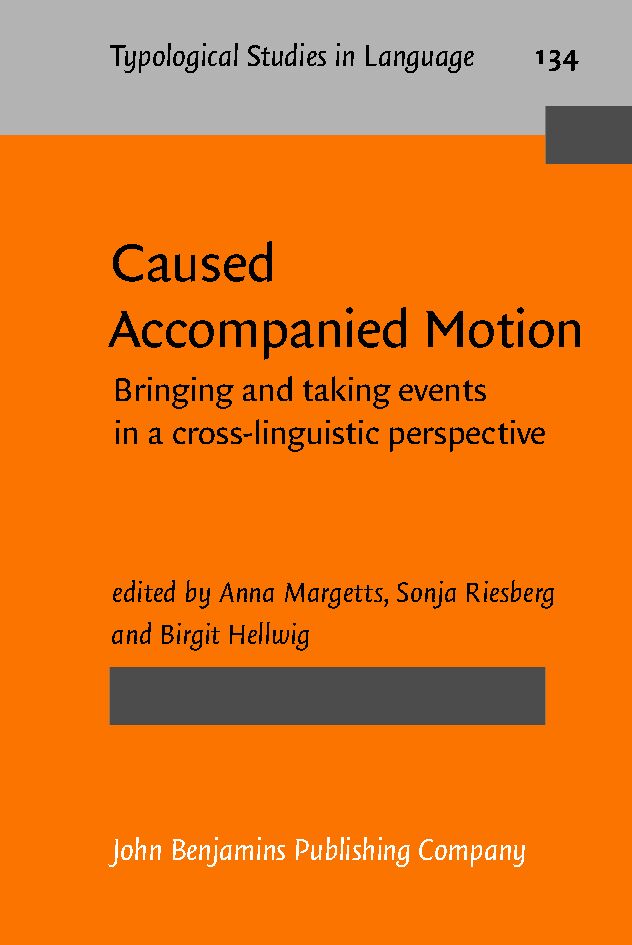
Caused accompanied motion : bringing and taking events in a cross-linguistic perspective
This volume investigates the linguistic expression of directed caused accompanied motion events, including verbal concepts like BRING and TAKE. Contributions explore how speakers conceptualise and describe these events across areally, genetically, and typologically diverse languages of the Americas, Austronesia and Papua. The chapters investigate such events on the basis of spoken language corpora of endangered, underdescribed languages and in this way the volume showcases the importance of documentary linguistics for linguistic typology. The semantic domain of directed caused accompanied motion shows considerable crosslinguistic variation in how meaning components are conflated within single lexemes or distributed across morphemes or clauses. The volume presents a typology of common patterns and constraints in the linguistic expression of these events. The study of crosslinguistic event encoding provided in this volume contributes to our understanding of the nature, extent and limits of linguistic and cognitive diversity.
eBook

PERSON SHIFT AT NARRATIVE PEAK
Narrators like to highlight important events in their stories. In some languages, they may shift to first- or second-person pronouns to refer to third-person referents in order to do so. Such pronoun shifts show functional parallels with tense shifts like the historical present, as both highlight events through shifts in deictic categories. Longacre (1983:138–39) discusses the parallels between person and tense shifts in his account of narrative peak, that is, the formal marking of important narrative events. Labov (1972) analyzes similar strategies as internal evaluations. Person shifts constitute a phenomenon of the discourse-syntax interface and present a clear case of discourse structure influencing grammar. Both person shifts themselves and their motivation in narrative structure have been little investigated. The article reviews person shifts in a number of languages reported in the literature and analyzes in detail the characteristics of this discourse strategy in Saliba-Logea, an Oceanic language of Papua New Guinea. The study contributes to the growing body of research on pronouns and person markers, and on referring expressions more generally, by adding a new angle of investigation. Previous studies have tended to focus on the morphosyntactic choices of referring expressions and their motivations, that is, on the choices between lexical nouns, free vs. bound pronouns, and so forth. The present study focuses on the paradigmatic choices between different person forms within one and the same morphosyntactic expression type. In doing so it offers a new perspective on pronoun choice and the factors influencing it crosslinguistically. While some types of person shift appear to be rare, overall, the strategy of person shift at narrative peak seems to constitute a solid crosslinguistic phenomenon.
Journal Article

Transitivity Discord in Some Oceanic Languages
Some Oceanic languages have clause types that feature intransitive verbs cooccurring with what looks like an object argument. Such constructions are sometimes described as noun incorporation, but there is evidence for two distinct constructions: noun incorporation, and clauses with what I will call transitivity discord, featuring intransitive verbs and object nouns. Such discord constructions have transitive and intransitive features that are manifested on different structural levels and they can be described as showing a mismatch between verb-level and clause-level transitivity. They share features with noun incorporation, but they are structurally different in that the object noun has syntactic independence rather than being part of the verb.
Journal Article
Three-Participant Events in Oceanic Languages
In this study I investigate the linguistic strategies available in Oceanic languages for the encoding of events with three participants (such as expressions of 'sending', 'giving', 'showing', 'telling', or doing something for someone's benefit). The notion of three-participant events is traditionally associated with the concept of ditransitive clauses, but there are, in fact, a variety of other strategies found cross-linguistically, and only some of these involve ditransitive constructions. Languages may differ considerably in which of these methods of encoding they productively use. In the present study I explore which of the strategies are used in the Oceanic language group. This may be a first step toward establishing whether language families or groups differ in their preferences for certain strategies and whether such preferences correlate with other typological features. While in some strategies all three event participants are encoded by syntactic means, in other strategies the involvement of a third participant is essentially evoked by pragmatics. The Oceanic language group seems to show a greater preference for such pragmatic strategies than is familiar from the study of the better-known European languages.
Journal Article
From Implicature to Construction: Emergence of a Benefactive Construction in Oceanic
It has long been observed that in many languages around the world possessive relations and benefactive relations are expressed by the same morphemes. There are examples of functional extension in both directions, with possessive constructions developing from benefactive ones, and vice versa. But there are also claims in the literature about the unidirectionality of this process, predicting that the development from possessive to benefactive constructions should not occur. This paper presents a detailed case study of the development of specialized benefactive expressions in Oceanic languages, where they commonly derive from expressions of attributive possession. The development starts with a possessive construction carrying a pragmatically implicated benefactive reading that gradually becomes grammaticalized and manifested in the morphosyntax of the language. This process may finally result in a benefactive construction that is syntactically and/or morphologically distinct from the expression of possession from which it originates. Syntactically, the process sets off from an object NP consisting of a noun and its modifier. In the process of grammatical change, this modifier is reanalyzed as a separate constituent, syntactically and semantically independent of the object noun. Based on data from Oceanic languages, three stages in the extension from possession to benefaction are identified. Also discussed are the contextual prerequisites for the benefactive implicature to arise in the first place.
Journal Article
Positional Slots in Saliba Complex Verbs
Saliba, an Oceanic language of Papua New Guinea, has complex predicates in which two or more stems combine to form a single word. The stems in these complex verbs can express a number of functions including cause and result, manner, directionality, and other adverbial-like functions. It is possible to identify a number of positional slots in these constructions, based on the sequential ordering and cooccurrence restrictions of stems. The slots in complex verbs host different classes of stems, and different types of relations between the slots can be distinguished.
Journal Article
From implicature to construction: emergence of a benefactive construction in Oceania
It has long been observed that in many languages around the world possessive relations and benefactive relations are expressed by the same morphemes. There are examples of functional extension in both directions, with possessive constructions developing from benefactive ones, and vice versa. But there are also claims in the literature about the unidirectionality of this process, predicting that the development from possessive to benefactive constructions should not occur. This paper presents a detailed case study of the development of specialized benefactive expressions in Oceanic languages, where they commonly derive from expressions of attributive possession. The development starts with a possessive construction carrying a pragmatically implicated benefactive reading that gradually becomes grammaticalized and manifested in the morphosyntax of the language. This process may finally result in a benefactive construction that is syntactically and/or morphologically distinct from the expression of possession from which it originates. Syntactically, the process sets off from an object NP consisting of a noun and its modifier. In the process of grammatical change, this modifier is reanalyzed as a separate constituent, syntactically and semantically independent of the object noun. Based on data from Oceanic languages, three stages in the extension from possession to benefaction are identified. Also discussed are the contextual prerequisites for the benefactive implicature to arise in the first place. Reprinted by permission of University of Hawaii Press
Journal Article
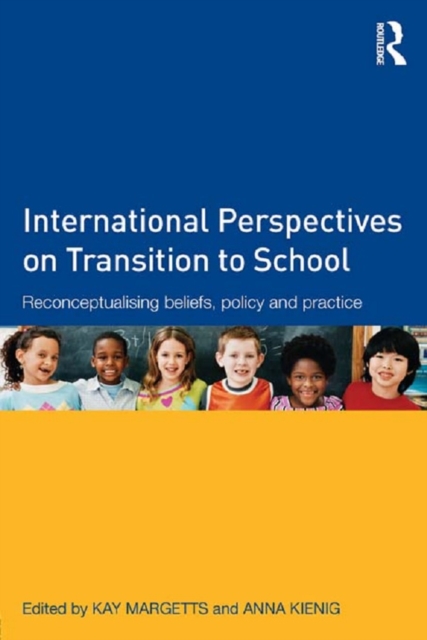
International Perspectives on Transition to School
With increasing attention given by governments and policy makers to children's transition to school, and the associated need for educators, families and communities to be supported in the process, changes are often required to existing structures and pedagogy.
This book is framed around the notion of transition as a time of change for those involved in the transition process and as a time for reconceptualising beliefs, policy and practice.
It explores transition from a number of international perspectives and raises issues around the coherence of:
how children perceive and respond to starting school;
the roles and expectations of parents;
developmental changes for parents;
supporting children with diverse learning needs;
how policy, curriculum and pedagogy are conceived and implemented.
Readers will be informed about current practices and issues arising out of research in Europe, Scandinavia, the United Kingdom and Australia and will be stimulated to consider how they can change their own transition beliefs, policies and practices.
Transition to school: Contemporary Perspectives and Change is essential reading for researchers and educators and anyone wanting to know more about the transition to school and how to support young children, their families and schools.
eBook