
Catalogue Search | MBRL


Are you sure you want to remove the book from the shelf?

{{itemTitle}}
941,527
result(s) for
"Maria, S"
Sort by:
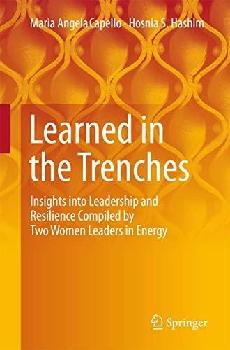
Learned in the trenches : insights into leadership and resilience compiled by two women leaders in energy
This book shares the learnings and perspectives of two pioneer women who waded the many challenges posed by multiculturalism and gender in one of the corporate environments more rigid and traditional in the business world: the energy sector in the Middle East. How they managed to create a growth space for themselves and their teams is a story of professional and personal tenacity, shaping a privileged perspective that enabled them to understand the root causes of barriers, as well as envision plausible solutions. They propose in the book not only their vision, but a remarkable collection of unfiltered interviews to influential leaders in the energy sector, to complete a vision of what is key to achieve success when leading or consulting in a corporate environment. The book offers a compilation of very personal approaches to professionalism, resilience, work, and ultimately, success, from within and outside the ranks of highly regarded corporations in the energy sector. The ultimate aim is that of triggering a self-reflection in the readers, grounded on the learnings and perspectives of those who made it to the highest roles of one of the less understood business environments.
Book

Cell-specific characterization of the placental methylome
Background
DNA methylation (DNAm) profiling has emerged as a powerful tool for characterizing the placental methylome. However, previous studies have focused primarily on whole placental tissue, which is a mixture of epigenetically distinct cell populations. Here, we present the first methylome-wide analysis of first trimester (
n
= 9) and term (
n
= 19) human placental samples of four cell populations: trophoblasts, Hofbauer cells, endothelial cells, and stromal cells, using the Illumina EPIC methylation array, which quantifies DNAm at > 850,000 CpGs.
Results
The most distinct DNAm profiles were those of placental trophoblasts, which are central to many pregnancy-essential functions, and Hofbauer cells, which are a rare fetal-derived macrophage population. Cell-specific DNAm occurs at functionally-relevant genes, including genes associated with placental development and preeclampsia. Known placental-specific methylation marks, such as those associated with genomic imprinting, repetitive element hypomethylation, and placental partially methylated domains, were found to be more pronounced in trophoblasts and often absent in Hofbauer cells. Lastly, we characterize the cell composition and cell-specific DNAm dynamics across gestation.
Conclusions
Our results provide a comprehensive analysis of DNAm in human placental cell types from first trimester and term pregnancies. This data will serve as a useful DNAm reference for future placental studies, and we provide access to this data via download from GEO (GSE159526), through interactive exploration from the web browser (
https://robinsonlab.shinyapps.io/Placental_Methylome_Browser/
), and through the R package
planet
, which allows estimation of cell composition directly from placental DNAm data.
Journal Article

Catching kisses
A journey of the heart follows a handful of kisses as it travels throughout the United States from San Francisco and New Orleans to New York City.
Book

Coronal bright points
Coronal bright points (CBPs) are a fundamental class of solar activity. They represent a set of low-corona small-scale loops with enhanced emission in the extreme-ultraviolet and X-ray spectrum that connect magnetic flux concentrations of opposite polarities. CBPs are one of the main building blocks of the solar atmosphere outside active regions uniformly populating the solar atmosphere including active region latitudes and coronal holes. Their plasma properties classify them as downscaled active regions. Most importantly, their simple structure and short lifetimes of less than 20 h that allow to follow their full lifetime evolution present a unique opportunity to investigate outstanding questions in solar physics including coronal heating. The present Living Review is the first review of this essential class of solar phenomena and aims to give an overview of the current knowledge about the CBP general, plasma and magnetic properties. Several transient dynamic phenomena associated with CBPs are also briefly introduced. The observationally derived energetics and the theoretical modelling that aims at explaining the CBP formation and eruptive behaviour are reviewed.
Journal Article


In-Vivo Quantitative Proteomics Reveals a Key Contribution of Post-Transcriptional Mechanisms to the Circadian Regulation of Liver Metabolism
Circadian clocks are endogenous oscillators that drive the rhythmic expression of a broad array of genes, orchestrating metabolism and physiology. Recent evidence indicates that post-transcriptional and post-translational mechanisms play essential roles in modulating temporal gene expression for proper circadian function, particularly for the molecular mechanism of the clock. Due to technical limitations in large-scale, quantitative protein measurements, it remains unresolved to what extent the circadian clock regulates metabolism by driving rhythms of protein abundance. Therefore, we aimed to identify global circadian oscillations of the proteome in the mouse liver by applying in vivo SILAC mouse technology in combination with state of the art mass spectrometry. Among the 3000 proteins accurately quantified across two consecutive cycles, 6% showed circadian oscillations with a defined phase of expression. Interestingly, daily rhythms of one fifth of the liver proteins were not accompanied by changes at the transcript level. The oscillations of almost half of the cycling proteome were delayed by more than six hours with respect to the corresponding, rhythmic mRNA. Strikingly we observed that the length of the time lag between mRNA and protein cycles varies across the day. Our analysis revealed a high temporal coordination in the abundance of proteins involved in the same metabolic process, such as xenobiotic detoxification. Apart from liver specific metabolic pathways, we identified many other essential cellular processes in which protein levels are under circadian control, for instance vesicle trafficking and protein folding. Our large-scale proteomic analysis reveals thus that circadian post-transcriptional and post-translational mechanisms play a key role in the temporal orchestration of liver metabolism and physiology.
Journal Article


Tight junctions: from simple barriers to multifunctional molecular gates
Key Points
Tight junctions are intercellular adhesion complexes in epithelia and endothelia that control paracellular permeability. This paracellular diffusion barrier is semipermeable: it is size- and charge-selective.
Paracellular ion permeability at tight junctions is largely determined by their claudin composition. Claudins are a family of transmembrane proteins that are thought to form gated ion-selective paracellular pores through the paracellular diffusion barrier.
Tight junctions form the border between the apical and basolateral cell surface domains in polarized epithelia, and support the maintenance of cell polarity by restricting intermixing of apical and basolateral transmembrane components.
Tight junctions are an integral component of the evolutionarily conserved signalling mechanisms that control epithelial-cell polarization and the formation of morphologically and functionally distinct apical domains.
Tight junctions form bidirectional signalling platforms that receive signals from the cell interior, which regulate their assembly and function, and that transduce signals to the cell interior to control cell proliferation, migration, differentiation and survival.
Tight junctions are part of an interconnected network of adhesion complexes that also includes adherens junctions and focal adhesions. These adhesion complexes crosstalk through direct protein–protein interactions as well as by transmitting signals to each other that influence their assembly and function.
Tight junctions are barriers between epithelial and endothelial cells that regulate the diffusion of molecules across tissues; they also contribute to cell polarity and serve as signalling platforms. Recent findings have broadened our understanding of tight junction organization, assembly and function.
Epithelia and endothelia separate different tissue compartments and protect multicellular organisms from the outside world. This requires the formation of tight junctions, selective gates that control paracellular diffusion of ions and solutes. Tight junctions also form the border between the apical and basolateral plasma-membrane domains and are linked to the machinery that controls apicobasal polarization. Additionally, signalling networks that guide diverse cell behaviours and functions are connected to tight junctions, transmitting information to and from the cytoskeleton, nucleus and different cell adhesion complexes. Recent advances have broadened our understanding of the molecular architecture and cellular functions of tight junctions.
Journal Article


On the potential of lignin-containing cellulose nanofibrils (LCNFs): a review on properties and applications
This review outlines the present state and recent progress in the area of lignin-containing cellulose nanofibrils (LCNFs), an emerging family of green cellulose nanomaterials. Different types of LCNF raw materials are described, with main focus on wood-based raw materials, and the properties of the resulting LCNFs are compared. Common problems faced in industrial utilization of CNFs are discussed in the light of potential improvements from LCNFs, covering areas such as chemical and energy consumption, dewatering and redispersibility. Out of the potential applications, barrier films, emulsions and nanocomposites are considered.
Journal Article