
Catalogue Search | MBRL


Are you sure you want to remove the book from the shelf?

{{itemTitle}}
2
result(s) for
"Mark, Chi-Kwan, author"
Sort by:

The everyday Cold War : Britain and China, 1950-1972
\"In 1950 the British government accorded diplomatic recognition to the newly founded People's Republic of China. But it took 22 years for Britain to establish full diplomatic relations with China. How far was Britain's China policy a failure until 1972? This book argues that Britain and China were involved in the 'everyday Cold War,' or a continuous process of contestation and cooperation that allowed them to 'normalize' their confrontation in the absence of full diplomatic relations. From Vietnam and Taiwan to the mainland and Hong Kong, China's 'everyday Cold War' against Britain was marked by diplomatic ritual, propaganda rhetoric and symbolic gestures. Rather than pursuing a failed policy of 'appeasement,' British decision-makers and diplomats regarded engagement or negotiation with China as the best way of fighting the 'everyday Cold War.' Based on extensive British and Chinese archival sources, this book examines not only the high politics of Anglo-Chinese relations, but also how the British diplomats experienced the Cold War at the local level\"--Publisher description.
Book
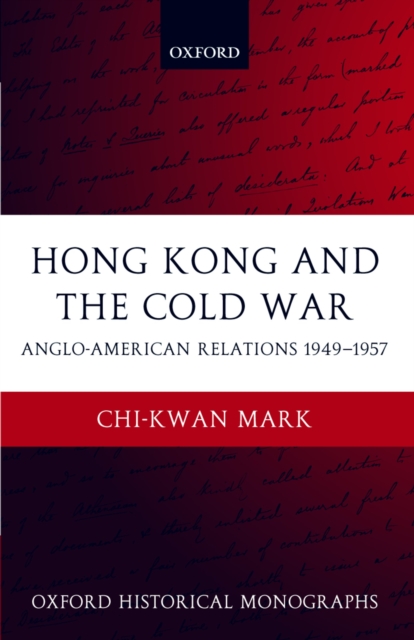
Hong Kong and the Cold War
After 1949, the British Empire in Hong Kong was more vulnerable than the lack of Chinese demand for return and the success of Hong Kong's economic transformations might have suggested. Its vulnerability stemmed as much from Britain's imperial decline and America's Cold War requirements as from a Chinese threat. It culminated in the little known ‘1957 Question’, a year when the British position in Hong Kong appeared more uncertain than any time since 1949. This is the first scholarly study that places Hong Kong at the heart of the Anglo–American relationship in the wider context of the Cold War in Asia. Unlike existing works, which tend to treat British and US policies in isolation, this book explores their dynamic interactions — how the two allies perceived, responded to, and attempted to influence each other's policies and actions. It also provides a major reinterpretation of Hong Kong's involvement in the containment of China. The author argues that, concerned about possible Chinese retaliation, the British insisted and the Americans accepted that Hong Kong's role should be as discreet and non-confrontational in nature as possible. Above all, top decision-makers in Washington evaluated Hong Kong's significance not in its own right, but in the context of the Anglo–American relationship: Hong Kong was seen primarily as a bargaining chip to obtain British support for US policy elsewhere in Asia. Using a variety of British and US archival material as well as Chinese sources, the author examines how the British and US government discussed, debated, and disagreed over Hong Kong's role in the Cold War, and reveals the dynamics of the Anglo–American alliance and the dilemmas of small allies in a global conflict.
eBook