
Catalogue Search | MBRL


Are you sure you want to remove the book from the shelf?

{{itemTitle}}
93
result(s) for
"Markowitz, Fran"
Sort by:

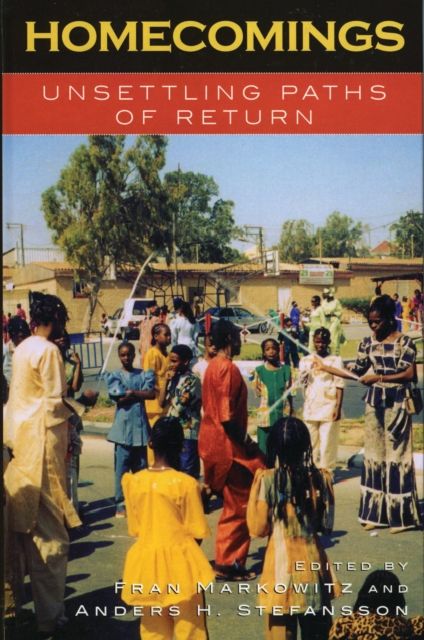
Homecomings
Despite the mass dislocation and repatriation efforts of the last century, the study of return movements still sits on the periphery of anthropology and migration research. Homecomings explores the forces and motives that drive immigrants, war refugees, political exiles, and their descendants back to places of origin. By including a range of homecoming experiences, Markowitz and Stefansson destabilize the key oppositions and the key terminologies that have vexed migration studies for decades, analyzing migration and repatriation; home and homeland; and host, returnee, and newcomer through a comparative ethnographic lens. The volume provides rich answers to the following questions: · Does group repatriation, sponsored and sometimes coerced by national governments or supranational organizations, create resettlement conditions more or less favorable than those experienced by individuals or families who made this journey alone? · How important are first impressions, living conditions, and initial reception in shaping the experience of home in the homeland? · What are the expectations that a mythologized homeland encourages in those who have left? Filling a conspicuous gap in the literature on migration in diverse fields such as anthropology, politics, international law, and cultural studies, Homecomings and the gripping ethnographic studies included in the volume demonstrate that a home and a homeland remain salient cultural imperatives that can inspire a call to political action.
eBook

Ethnographic Encounters in Israel
Israel is a place of paradoxes, a small country with a diverse population and complicated social terrain. Studying its culture and social life means confronting a multitude of ethical dilemmas and methodological challenges. The first-person accounts by anthropologists engage contradictions of religion, politics, identity, kinship, racialization, and globalization to reveal fascinating and often vexing dimensions of the Israeli experience. Caught up in pressing existential questions of war and peace, social justice, and national boundaries, the contributors explore the contours of Israeli society as insiders and outsiders, natives and strangers, as well as critics and friends.
eBook

Toward an Anthropology of Nation Building and Unbuilding in Israel
Toward an Anthropology of Nation Building and Unbuilding in Israelpresents twenty-two original essays offering a critical survey of the anthropology of Israel inspired by Alex Weingrod, emeritus professor and pioneering scholar of Israeli anthropology. In the late 1950s Weingrod's groundbreaking ethnographic research of Israel's underpopulated south complicated the dominant social science discourse and government policy of the day by focusing on the ironies inherent in the project of Israeli nation building and on the process of migration prompted by social change.
Drawing from Weingrod's perspective, this collection considers the gaps, ruptures, and juxtapositions in Israeli society and the cultural categories undergirding and subverting these divisions. Organized into four parts, the volume examines our understanding of Israel as a place of difference, the disruptions and integrations of diaspora, the various permutations of Judaism, and the role of symbol in the national landscape and in Middle Eastern studies considered from a comparative perspective. These essays illuminate the key issues pervading, motivating, and frustrating Israel's complex ethnoscape.
eBook

Census and Sensibilities in Sarajevo
During the latter part of the twentieth century, there was a country called Yugoslavia. Built on the ruins of the Kingdom of Yugoslavia, the post-World War II Socialist Federated Republic of Yugoslavia was an ethnically diverse state comprised of six republics, which, by the 1960s, was committed to a foreign policy of non-alignment and to the domestic programs of worker self–management and “brotherhood and unity” among its peoples (see, e.g., Banac 1984; P. Ramet 1985; Shoup 1968; Zimmerman 1987). Like most other European states, the decennial census became a defining feature of Yugoslavia's sovereignty and modernity (Kertzer and Arel 2002: 7).
Journal Article


Tales of Two Buildings: National Entanglements in Sarajevo's Pasts, Presents and Futures
RésuméCet article explore les histoires et héritages complexes et entremêlés de Sarajevo, à travers l’implantation respective de deux bâtiments qui datent du xix e siècle, le Vije?nica et le Inat Ku?a . L’analyse ethnographique montre que lire la ville comme un texte n’est simplement pas suffisant. Ce sont plutôt les constants changements de fonctions, d’usages (ou de non-usages) et le résumé des symboles qui leur sont attachés qui rendent visible un dialogue persistant entre passé, présent et imaginaires du futur. Le récit concernant ces deux bâtiments, tel que l’article le rapporte, installe l’histoire d’un processus en continu d’une nation qui se fait et se défait, après la guerre des Balkans, après les accords de Dayton, après la mise sous tutelle par l’Europe de la Bosnie-Herzégovine, tout en montrant que Sarajevo est une ville qui dispose de toutes les qualités pour se réaffirmer comme une communauté multiethnique. AbstractThis article explores the overlapping, convoluted histories and legacies of Sarajevo through the interrelated placement of two buildings dating from the nineteenth century, the Vije?nica and the Inat Ku?a. Through ethnographic analysis it demonstrates that a simple reading of the city-as-text is not enough. Rather, buildings’ changing conditions, uses (or non-use) and the ever-growing compendium of symbols that they impart, make public an ongoing dialogue between past and present, and imaginaries of the future. The tales of two buildings that this article tells establish an ongoing record of nation-building and un-building in post-war, eu -supervised Bosnia-Herzegovina, while positioning Sarajevo as a city richly equipped to reemerge as a multiethnic community.
Journal Article
Tales of Two Buildings: National Entanglements in Sarajevo’s Pasts, Presents and Futures
RésuméCet article explore les histoires et héritages complexes et entremêlés de Sarajevo, à travers l’implantation respective de deux bâtiments qui datent du xix e siècle, le Vijećnica et le Inat Kuća . L’analyse ethnographique montre que lire la ville comme un texte n’est simplement pas suffisant. Ce sont plutôt les constants changements de fonctions, d’usages (ou de non-usages) et le résumé des symboles qui leur sont attachés qui rendent visible un dialogue persistant entre passé, présent et imaginaires du futur. Le récit concernant ces deux bâtiments, tel que l’article le rapporte, installe l’histoire d’un processus en continu d’une nation qui se fait et se défait, après la guerre des Balkans, après les accords de Dayton, après la mise sous tutelle par l’Europe de la Bosnie-Herzégovine, tout en montrant que Sarajevo est une ville qui dispose de toutes les qualités pour se réaffirmer comme une communauté multiethnique. AbstractThis article explores the overlapping, convoluted histories and legacies of Sarajevo through the interrelated placement of two buildings dating from the nineteenth century, the Vijećnica and the Inat Kuća. Through ethnographic analysis it demonstrates that a simple reading of the city-as-text is not enough. Rather, buildings’ changing conditions, uses (or non-use) and the ever-growing compendium of symbols that they impart, make public an ongoing dialogue between past and present, and imaginaries of the future. The tales of two buildings that this article tells establish an ongoing record of nation-building and un-building in post-war, eu -supervised Bosnia-Herzegovina, while positioning Sarajevo as a city richly equipped to reemerge as a multiethnic community.
Journal Article

Race, color, identity
Advances in genetics are renewing controversies over inherited characteristics, and the discourse around science and technological innovations has taken on racial overtones, such as attributing inherited physiological traits to certain ethnic groups or using DNA testing to determine biological links with ethnic ancestry. This book contributes to the discussion by opening up previously locked concepts of the relation between the terms color, race, and \"Jews\", and by engaging with globalism, multiculturalism, hybridity, and diaspora. The contributors-leading scholars in anthropology, sociology, history, literature, and cultural studies-discuss how it is not merely a question of whether Jews are acknowledged to be interracial, but how to address academic and social discourses that continue to place Jews and others in a race/color category.
eBook

READING AND REDACTING NATIONAL LANDSCAPES
The processes of nation building and unbuilding are heavily dependent on frequent iterations of national narratives and public displays of their symbols. As Alex Weingrod has shown in “Changing Israeli Landscapes” (1993), the built environment is an effective site that links these phenomena by making them, and the constituencies that they represent, seem naturally part of the national terrain. In this chapter I join Weingrod in “reading” national messages from architectural structures by first reexamining the recently erected buildings in Israel that he analyzed and then moving to the everyday uses and meanings of two century-old edifices in Sarajevo, the
Book Chapter