
Catalogue Search | MBRL


Are you sure you want to remove the book from the shelf?

{{itemTitle}}
4
result(s) for
"Martel, James R., author"
Sort by:


Textual Conspiracies
\"This is a sophisticated and fascinating argument written in a very enjoyably entertaining style. It is hard for me to see how readers initially interested in these texts will not be 'swept off their feet' by the core assertions of this author, and the devastatingly comprehensive way in which he demonstrates those arguments.\"-Brent Steele, University of Kansas
InTextual Conspiracies,James R. Martel applies the literary, theological, and philosophical insights of Walter Benjamin to the question of politics and the predicament of the contemporary left. Through the lens of Benjamin's theories, as influenced by Kafka, of the fetishization of political symbols and signs, Martel looks at the ways in which various political and literary texts \"speak\" to each other across the gulf of time and space, thereby creating a \"textual conspiracy\" that destabilizes grand narratives of power and authority and makes the narratives of alternative political communities more apparent.
However, in keeping with Benjamin's insistence that even he is complicit with the fetishism that he battles, Martel decentralizes Benjamin's position as the key theorist for this conspiracy and contextualizes Benjamin in what he calls a \"constellation\" of pairs of thinkers and writers throughout history, including Alexis de Tocqueville and Edgar Allen Poe, Hannah Arendt and Federico García Lorca, and Frantz Fanon and Assia Djebar.
eBook
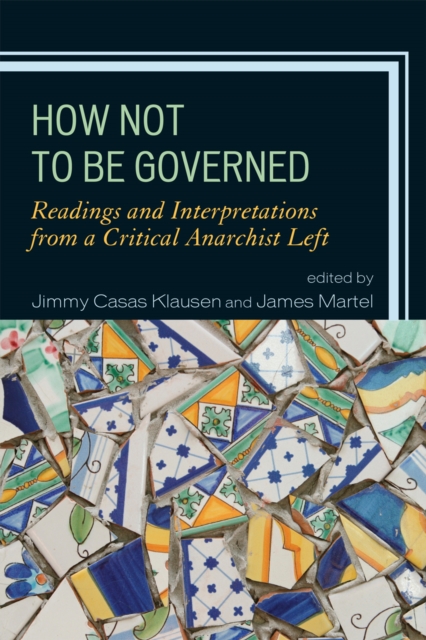
How not to be governed
How Not to Be Governed explores the contemporary debates and questions concerning anarchism in our own time. The authors address the political failures of earlier practices of anarchism, and the claim that anarchism is impracticable, by examining the anarchisms that have been theorized and practiced in the midst of these supposed failures. The authors revive the possibility of anarchism even as they examine it with a critical lens. Rather than breaking with prior anarchist practices, this volume reveals the central values and tactics of anarchism that remain with us, practiced even in the most unlikely and \"impossible\" contexts.
eBook

Textual awareness
Aware of the act of writing as a temporal process, many modernist authors preserved numerous manuscripts of their works, which themselves thematized time. Textual Awareness analyzes the writing processes in James Joyce's Finnegans Wake, Marcel Proust's À la recherche du temps perdu, and Thomas Mann's Doktor Faustus and relates these to Anglo-American, French, and German theories of text. By relating theory to practice, this comparative study reveals the links between literary and textual criticism.
A key issue in both textual criticism and the so-called crisis of the novel is the tension between the finished and the unfinished. After a theoretical examination of the relationship between genetic and textual criticism, Dirk Van Hulle uses the three case studies to show how?at each stage in the writing process?the text still had the potential of becoming something entirely different; how and why these geneses proceeded the way they did; how Joyce, Proust, and Mann allowed contingencies to shape their work; how these authors recycled the words of their critics in order to inoculate their works against them; how they shaped an intertextual dimension through the processing of source texts and reading notes; and how text continually generated more text.
Van Hulle's exploration of process sheds new light on the remarkable fact that so many modernist authors protected their manuscripts, implying both the authors' urge to grasp everything and their awareness of the dangers of their encyclopedic projects. Textual Awareness offers new insights into the artificiality of the artifact?the novel?that are relevant to the study of literary modernism in general and the study of James Joyce, Marcel Proust, and Thomas Mann in particular.
Dirk Van Hulle is Assistant Professor of English and German Literature, University of Antwerp.
eBook