
Catalogue Search | MBRL


Are you sure you want to remove the book from the shelf?

{{itemTitle}}
7
result(s) for
"Martin, Roger L., author"
Sort by:

Fixing the game : how runaway expectations broke the economy, and how to get back to reality
Using the National Football League as his primary example, Martin illustrates that it is possible to take a much more thoughtful and effective approach than we now do to the intersection of the real and the expectations markets and to governance in general in the capital markets. Martin shows how we can act to end the destructive cycle of increasing volatility, decreasing investor returns, and ongoing bad behavior by executives.
Book
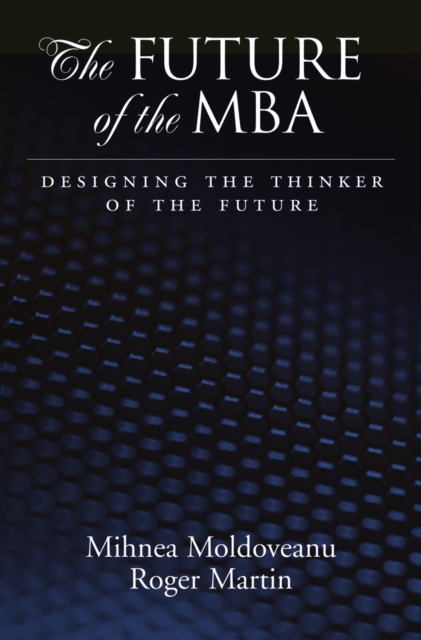
The Future of the MBA
The MBA is probably the hottest ticket among the current university graduate degree offerings—every year, more than 120,000 students enroll in MBA programs in the United States, and the estimates in Europe do not lag far behind. In addition, job prospects have never looked better for business-school graduates; corporations are hiring more business-school graduates every year, and compensating them more handsomely. This book is a review of the major contemporary debates on management education. At the same time, it makes a proposal that will certainly have an impact in business schools: that managers need to develop a series of qualitative tacit skills which could be appropriately developed by integrative curricula brought from different disciplines, including sociology, philosophy, and other social sciences. The book's authors, both involved in the integrative business-education program at the Rotheman School of Management, provide a guide on how to design a reliable integrated program for management students.
eBook

Creating great choices : a leader's guide to integrative thinking
\"Conventional wisdom--and business school curricula--teaches us that making trade-offs is inevitable when it comes to hard choices. But sometimes, accepting the obvious trade-off just isn't good enough: the choices in front of us don't get us what we need. In those cases, rather than choosing the least worst option, we can use the models in front of us to create a new and better answer. This is integrative thinking. First introduced by Roger Martin in The Opposable Mind, integrative thinking is an approach to problem solving that uses opposing ideas as the basis for innovation. Now, in Creating Great Choices, Martin and fellow Rotman expert Jennifer Riel vividly show how they have refined and enhanced the understanding and practice of integrative thinking through their work teaching the concept and its principles to business and nonprofit executives, MBA students, even kids. Integrative thinking has been embraced by organizations such as Procter & Gamble, Deloitte, Verizon, and the Toronto District School Board--all seeking a replicable, thoughtful approach to creating a \"third and better way\" to make important choices in the face of unacceptable trade-offs. The book includes new stories of successful integrative thinkers that will demystify the process of creative problem solving. It lays out the authors' practical four-step methodology, which can be applied in virtually any context: Articulating opposing models Examining the models Generating possibilities Assessing prototypes Stimulating and practical, Creating Great Choices blends storytelling, theory, and hands-on advice to help any leader or manager facing a tough choice\"-- Provided by publisher
Book


The Finance Crisis and Rescue
This compilation of expert views from the University of Toronto's Rotman School of Management navigates what went wrong, why, and the lessons that the global financial crisis can teach business people, policy makers, and interested observers alike.
eBook

Mental Disorder in Canada
Focusing specifically on Canadian scholarship, yet wide-reaching in scope,Mental Disorder in Canadais an important contribution to the dissemination and advancement of knowledge on psychiatric epidemiology.
eBook
