
Catalogue Search | MBRL


Are you sure you want to remove the book from the shelf?

{{itemTitle}}
260
result(s) for
"Maskin, Eric"
Sort by:


Sequential innovation, patents, and imitation
We argue that when innovation is \"sequential\" (so that each successive invention builds in an essential way on its predecessors) and \"complementary\" (so that each potential innovator takes a different research line), patent protection is not as useful for encouraging innovation as in a static setting. Indeed, society and even inventors themselves may be better off without such protection. Furthermore, an inventor's prospective profit may actually be enhanced by competition and imitation. Our sequential model of innovation appears to explain evidence from a natural experiment in the software industry.
Journal Article
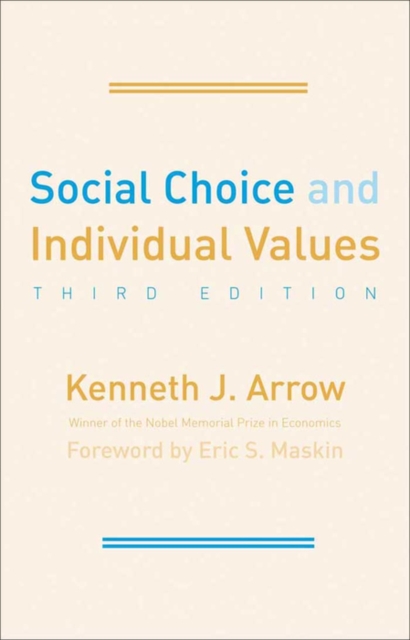
Social Choice and Individual Values: Third Edition
Originally published in 1951, Social Choice and Individual Values introduced \"Arrow's Impossibility Theorem\" and founded the field of social choice theory in economics and political science. This new edition, including a new foreword by Nobel laureate Eric Maskin, reintroduces Arrow's seminal book to a new generation of students and researchers.\"Far beyond a classic, this small book unleashed the ongoing explosion of interest in social choice and voting theory. A half-century later, the book remains full of profound insight: its central message, 'Arrow's Theorem,' has changed the way we think.\"-Donald G. Saari, author of Decisions and Elections: Explaining the Unexpected
eBook
The Politician and the Judge: Accountability in Government
We build a simple model to capture the major virtues and drawbacks of making public officials accountable {i.e., subjecting them to reelection): On the one hand, accountability allows the public to screen and discipline their officials; on the other, it may induce those officials to pander to public opinion and put too little weight on minority welfare. We study when decision-making powers should be allocated to the public directly (direct democracy), to accountable officials (called \"politicians\"), or to nonaccountable officials (called \"judges\").
Journal Article

The Economics of Kenneth J. Arrow: A Selective Review
This article reviews Kenneth Arrow's seminal work in economics, giving special emphasis to his contributions to social choice theory and general equilibrium theory.
Journal Article


The economics of malaria control in an age of declining aid
This article examines financing in the fight against malaria. After briefly describing malaria control plans in Africa since 2000, it offers a stylized model of the economics of malaria and shows how health aid can help escape the malaria trap.
Foreign aid is necessary to control tropical diseases in endemic countries. Here the authors outline the steps taken to control malaria in Africa since 2000 and present an economic model to propose that US$25−30 per capita will be needed to avoid a disease trap.
Journal Article

Friedrich von Hayek and mechanism design
I argue that Friedrich von Hayek anticipated some major results in the theory of mechanism design.
Journal Article

Efficient Auctions
We exhibit an efficient auction (an auction that maximizes surplus conditional on all available information). For private values, the Vickrey auction (for one good) or its Groves-Clarke extension (for multiple goods) is efficient. We show that the Vickrey and Groves-Clarke auctions can be generalized to attain efficiency when there are common values, if each buyer's information can be represented as a one-dimensional signal. When a buyer's information is multidimensional, no auction is generally efficient. Nevertheless, in a broad class of cases, our auction is constrained-efficient in the sense of being efficient subject to incentive constraints.
Journal Article