
Catalogue Search | MBRL


Are you sure you want to remove the book from the shelf?

{{itemTitle}}
11,637
result(s) for
"Mathews, Jay"
Sort by:

Question everything : the rise of AVID as America's largest college readiness program
\"How AVID levels the playing field, helping underserved students come out ahead In Question Everything, award-winning education writer Jay Mathews presents the stories and winning strategies behind the Advancement Via Individual Determination program (AVID). With the goal of preparing students for the future - whether that future includes college or not - AVID teaches students the personal management skills that will help them survive and thrive. Focused on time management, presentation, and cooperation, the AVID program leads not only to impressive educational outcomes, but also to young adults prepared for life after school. This book tells the stories of AVID educators, students, and families to illustrate how and why the program works, and demonstrates how teachers can employ AVID's strategies with their own students. Over the past thirty years, AVID has grown from a single teacher's practice to an organization serving 400,000 middle- and high-school students in 47 states and 16 countries. Question Everything describes the ideas and strategies behind the upward trajectory of both the program and the students who take part. Learn which foundational skills are emphasized for future success Discover how AVID teaches personal management skills in the academic context Contrast AVID student outcomes with national averages Consider implementing AVID concepts and techniques into current curricula As college readiness becomes a top priority for the Federal Government, the Gates Foundation, and other influential organizations, AVID's track record stands out as one of success. By leveling the playing field and introducing \"real-world\" realities early on, the program teaches students skills that help them in the workplace and beyond\"-- Provided by publisher.
Book

Room-temperature sub-band gap optoelectronic response of hyperdoped silicon
Room-temperature infrared sub-band gap photoresponse in silicon is of interest for telecommunications, imaging and solid-state energy conversion. Attempts to induce infrared response in silicon largely centred on combining the modification of its electronic structure via controlled defect formation (for example, vacancies and dislocations) with waveguide coupling, or integration with foreign materials. Impurity-mediated sub-band gap photoresponse in silicon is an alternative to these methods but it has only been studied at low temperature. Here we demonstrate impurity-mediated room-temperature sub-band gap photoresponse in single-crystal silicon-based planar photodiodes. A rapid and repeatable laser-based hyperdoping method incorporates supersaturated gold dopant concentrations on the order of 10
20
cm
−3
into a single-crystal surface layer ~150 nm thin. We demonstrate room-temperature silicon spectral response extending to wavelengths as long as 2,200 nm, with response increasing monotonically with supersaturated gold dopant concentration. This hyperdoping approach offers a possible path to tunable, broadband infrared imaging using silicon at room temperature.
Extending the optical response of silicon below the band gap towards infrared wavelengths is of interest for applications such as imaging. Here, Mailoa
et al
. achieve room-temperature infrared photoresponse from silicon doped with supersaturated concentrations of gold impurities.
Journal Article

Work hard. Be nice. : how two inspired teachers created the most promising schools in America
Washington Post education reporter Mathews delves into the Knowledge Is Power Program (KIPP) and follows the enterprise's founders, Mike Feinberg and Dave Levin, from their days as young educators in the Teach for America program to heading one of the country's most controversial education programs running today.
Book
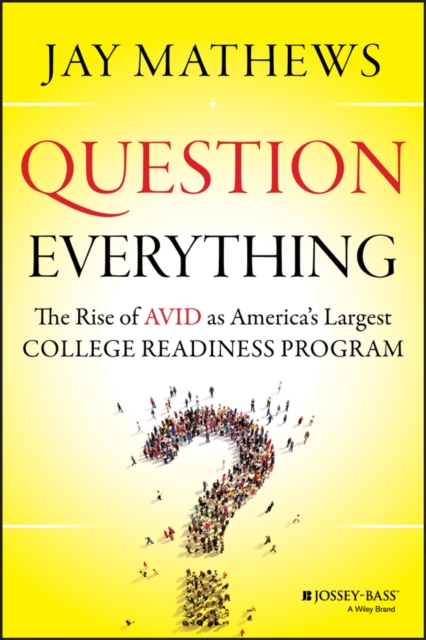
Question Everything
How AVID levels the playing field, helping underserved students come out ahead In Question Everything, award-winning education writer Jay Mathews presents the stories and winning strategies behind the Advancement Via Individual Determination program (AVID). With the goal of preparing students for the future – whether that future includes college or not – AVID teaches students the personal management skills that will help them survive and thrive. Focused on time management, presentation, and cooperation, the AVID program leads not only to impressive educational outcomes, but also to young adults prepared for life after school. This book tells the stories of AVID educators, students, and families to illustrate how and why the program works, and demonstrates how teachers can employ AVID's strategies with their own students. Over the past thirty years, AVID has grown from a single teacher's practice to an organization serving 400,000 middle- and high-school students in 47 states and 16 countries. Question Everything describes the ideas and strategies behind the upward trajectory of both the program and the students who take part. * Learn which foundational skills are emphasized for future success * Discover how AVID teaches personal management skills in the academic context * Contrast AVID student outcomes with national averages * Consider implementing AVID concepts and techniques into current curricula As college readiness becomes a top priority for the Federal Government, the Gates Foundation, and other influential organizations, AVID's track record stands out as one of success. By leveling the playing field and introducing \"real-world\" realities early on, the program teaches students skills that help them in the workplace and beyond.
eBook

Power-Dependent Investigation of Photo-Response from GeSn-Based p-i-n Photodetector Operating at High Power Density
We report an investigation on the photo-response from a GeSn-based photodetector using a tunable laser with a range of incident light power. An exponential increase in photocurrent and an exponential decay of responsivity with increase in incident optical power intensity were observed at higher optical power range. Time-resolved measurement provided evidence that indicated monomolecular and bimolecular recombination mechanisms for the photo-generated carriers for different incident optical power intensities. This investigation establishes the appropriate range of optical power intensity for GeSn-based photodetector operation.
Journal Article
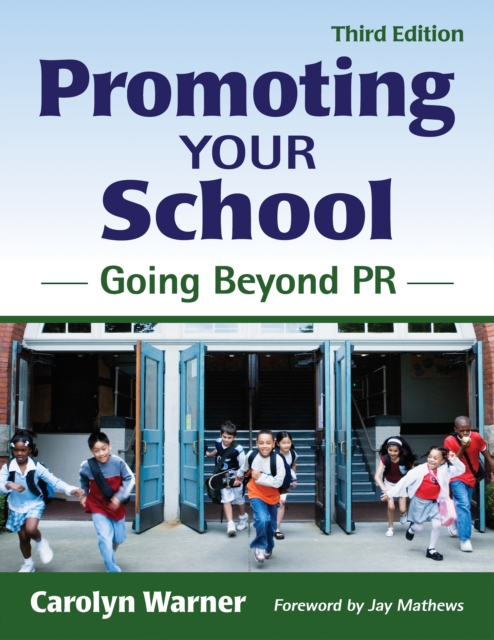
Promoting Your School
Administrators will find that this updated edition of the bestseller is packed with techniques for projecting a positive school image and strengthening the four-way partnership between schools, parents, community, and the private sector.
eBook


Work Hard. Be Nice
In 1994, fresh from a two-year stint with Teach for America, Mike Feinberg and Dave Levin inaugurated the Knowledge Is Power Program (KIPP) in Houston with an enrollment of 49 5th graders. By this Fall, 75 KIPP schools will be up and running, setting children from poor and minority families on a path to college through a combination of hard work, long hours, innovative teaching, and a \"no excuses\" school culture. Jay Mathews, education columnist at the \"Washington Post,\" has written for more than two decades about schools where children from low-income families succeed academically. His articles about mathematics teacher Jaime Escalante, whose disadvantaged East L.A. students regularly aced the AP calculus exam, inspired the film \"Stand and Deliver.\" Mathews also developed the Challenge Index for rating high schools according to their success in encouraging students to take college-level Advanced Placement and International Baccalaureate courses. Mathews' latest book, \"Work Hard. Be Nice: How Two Inspired Teachers Created the Most Promising Schools in America\" was published by Algonquin Books in January 2009 and chronicles how two young teachers created the most talked-about school reform in the U.S. today. This article presents excerpts that tell the story of how the KIPP network began and reveal why the KIPP model works so well. (Contains 3 figures.)
Journal Article