
Catalogue Search | MBRL


Are you sure you want to remove the book from the shelf?

{{itemTitle}}
12
result(s) for
"Matthee, Rudolph P"
Sort by:


Iran and the Surrounding World
These essays examine Iran’s place in the world--its relations and cultural interactions with its immediate neighbors and with empires and superpowers from the beginning of the Safavid period in 1501 to the present day. The book provides important historical background on recent political and social developments in Iran and on its contemporary foreign relations. The topics explored include Iranian influence abroad on political organization, religion, literature, art, and diplomacy, as well as Iran's absorption of foreign influences in these areas. A special focus is the prevailing political culture of Iran throughout its early modern and contemporary periods.The authors combine approaches from history, political science, anthropology, international relations, and culturalstudies. Some essays address Iran’s interactions with various Arab and Turkic ethnicities in the region stretching from India to Egypt. Others examine its relations with the West during the Qajar and Pahlavi eras, women's issues, culture inside Iran during the Islamic Republic, and the Shi`ite theocracy of Iran as compared with other Muslim states.
eBook


From Coffee to Tea: Shifting Patterns of Consumption in Qajar Iran
Introduced into Safavid Iran in the late 1500s, coffee and (to a lesser extent) tea soon found their way into the Iranian diet. By the early eighteenth century, however, the prolonged turmoil and impoverishment that followed the end of Safavid rule curtailed the consumption of these drinks in the public sphere. The reemergence of both beverages in the 1800s revealed regional differentiation and social stratification: tea became popular among the elite classes and dominated in the north, while coffee prevailed in the south. During the nineteenth century, tea began to supersede coffee everywhere in a process that involved status perceptions, the influence of tea-consuming England and Russia, and shifting trade routes.
Journal Article
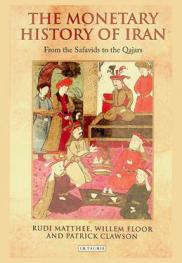
The monetary history of Iran : from the Safavids to the Qajars
This detailed study of Iran's monetary history, from the advent of the Safavid dynasty in 1501 to the end of Qajar rule in 1925, covers the of use of ready money and its circulation, the changing conditions of the country's mints, and the role of the state in managing money.
Book

Politics and trade in late Safavid Iran: Commercial crisis and government reaction under Shah Solayman (1666-1694)
This dissertation is concerned with the interaction between politics and trade in late Safavid Iran. It explores government reactions to the economic crisis that occurred in the reign of Shah Solayman (1666-1694). The dissertation's argument is informed by the conviction that Safavid commercial policy can be properly analyzed only if Iran is not viewed as a self-contained unit. The study thus views Safavid Iran as an early modern state embedded in a commercial network stretching from the Levant and the emerging Russian state to Mughal India. An introductory discussion reviews the political and economic underpinnings of late Safavid Iran. Safavid society is viewed as an arena of conflict between centrifugal and centripetal forces, in which environmental obstacles and fissiparous political tendencies were balanced by unifying social, political and ideological elements. Chapter two identifies the forces that caused the breakdown of this balance in the seventeenth century. The fragility of Safavid society is brought out in the chapters on government reactions to the economic crisis that began to paralyze its functioning after 1650. The career and reforms of the grand vazir Shaykh 'Ali Khan are the focus of chapter three. His policies are further discussed in two chapters on monetary issues. One considers the measures taken to prevent the perpetual currency flight to India. The other deals with the steady worsening of the country's currency and the role of the government in this development. The dissertation's main conclusion is that, in the absence of an economic policy beyond the short-term one of maximizing fiscal revenue, the state was incapable of taking adequate measures to reverse the economic crisis. As the final chapter points out, however, the dimensions of this crisis need to be evaluated carefully. That some commercial links withered while others endured suggests that decline was all but unilinear.
Dissertation


The Politics of Trade in Safavid Iran: Silk for Silver 1600-1730
\"The Politics of Trade in Safavid Iran: Silk for Silver 1600-1730\" by Rudolph P. Matthee is reviewed.
Book Review
