
Catalogue Search | MBRL


Are you sure you want to remove the book from the shelf?

{{itemTitle}}
78
result(s) for
"McCulloch, Margery"
Sort by:


Scottish Modernism and its Contexts 1918–1959
This innovative book proposes the expansion of the existing idea of an interwar Scottish Renaissance movement to include its international significance as a Scottish literary modernism interacting with the intellectual and artistic ideas of European modernism as well as responding to the challenges of the Scottish cultural and political context.
eBook

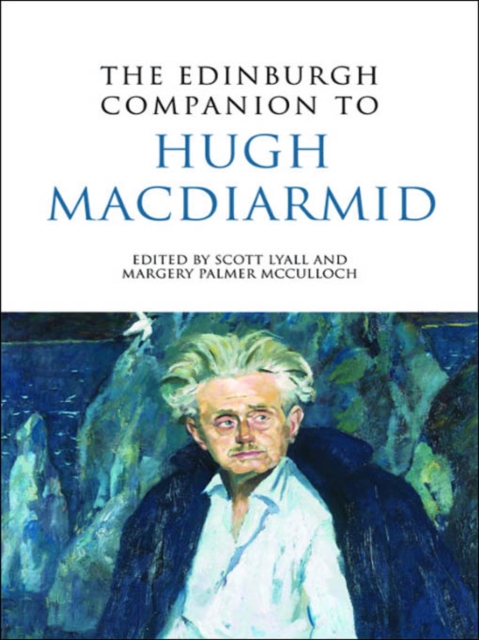
The Edinburgh Companion to Hugh MacDiarmid
The only full-length companion available to this distinctive and challenging Scottish poet
By using previously uncollected creative and discursive writings, this international group of contributors presents a vital updating of MacDiarmid scholarship. They bring fresh insights to major poems such asA Drunk Man Looks at the Thistle,To Circumjack CencrastusandIn Memoriam James Joyce, and offer new political, ecological and science-based readings in relation to MacDiarmid's work from the 1930s. They also discuss his experimental short fiction inAnnals of the Five Senses, the autobiographicalLucky Poet, and a representative selection of his essays and journalism. They assess MacDiarmid's legacy and reputation in Scotland and beyond, placing his poetry within the context of international modernism.
Key FeaturesLinks MacDiarmid's work and influence to recent writings on national identity, transnationalism, postcolonialism and modernity versus traditionProvides close readings of the formal detail of texts and new readings in ecological and science-based contextsContributes to a re-drawing of the map of literary modernism
Contributors include Louisa Gairn (Helsinki), Alan Riach (Glasgow University), Carla Sassi (Verona University), Jeffrey Skoblow (Southern Illinois University), and Michael H. Whitworth (Oxford University).
eBook

European Influences: Edwin Muir, Kafka, and the Spirit of Italy
Starting from Orkney-born Edwin Muir's article \"North and South,\" published in the American Freeman magazine in 1922, this essay will explore Muir's involvement with the life and thought of Europe throughout his life and his work as poet, novelist, translator, and critic; and his particular fascination with what he saw as the philosophical difference between the European peoples of the north and the south in relation to their contrasting perceptions of Time and the idea of Fate in human lives. The essay will discuss Muir's relationship with the work of Franz Kafka, whose novels Muir and his wife Willa were the first to translate into English, and the effect of this relationship with Kafka and the city of Prague on his own poetry. It will also explore the contrasting southern influence of Italy, and the city of Rome where Muir went as Director of the British Council Institute in 1949. The paper will conclude with a consideration of what it is in Muir's poetry and thought which marks him out as the European modernist poet the later Seamus Heaney considered him to be, and which also makes him a poet of continuing relevance to our own times.
Journal Article

Culture and the City: Poetry, Painting and Music in 1960s Glasgow
Alasdair Gray, for example, in a poem published in Lines Review in 1963, laments that 'Terrible structures have been erected on the skyline';7 structures characterised by Tom Wright in 1967 as 'the egg-boxes/that have replaced/the hated, loved, and lousy slums'.8 Kenneth White's 'Glasgow Night' (1966) ignores the rising new Glasgow, focusing instead on 'the cargo that Glasgow / unloads on my mind... the fog / the rain/the mud / the grease / the stench', while his speaker 'improvise[s] a lonely blues' taking him away from the city and the city away from itself 'to jazz with the sea'.9 In contrast, Adam McNaughtan seeks to diminish the impersonality of the new through humour in his ever-popular 'The Jeely Piece Song' (1967) with its repeated refrain: 'Oh ye cannae fling pieces oot a twenty storey flat'.10 Photographs in the 1960s by Oscar Marzaroli record objectively this movement from city tenement slum to technological tower block, but the rupture in the city's living patterns is nevertheless clear in his images of traditional communal backcourts and contrasting high-rise new buildings in Hutchesontown towering over the remains of the old Gorbals.11 Morgan has spoken of how he was introduced to technology through his father taking him on the Clyde steamers and explaining the workings of the engine room to him: Here the underlying leitmotiv is that of Glasgow's religious and football sectarianism, and the social comment is presented ironically through its implicit biblical references to the crucifixion of Christ. [...]the drama of the secular happening is communicated through the 'music' of the poem: the ebb and flow of the speaking human voice, its urgent questioning contrasted with slower reflection, with pauses between utterance, then with renewed urgency. The Glasgow Group as a whole, and individual members in one-person shows or in smaller groupings, soon extended their exhibiting beyond Scotland to London and other UK venues, as well as inclusion in important international exhibitions such as Three Centuries of Scottish Painting, arranged by and shown in the National Gallery of Canada in Ottawa in 1968.24 Another venture which greatly assisted young Glasgow artists by providing exhibition space was the founding of the New Charing Cross Gallery in 1963 by three Glasgow artists, Bet Low, Tom MacDonald and John Taylor, together with the businessman and art collector Cyril Gerber. Unlike Scottish literature, which has had much critical and historical documentation in books and journals from at least the mid-twentieth century, the story of Scotland's visual art over the centuries (and especially in the twentieth century) is still poorly documented, and the continuing hostility on the part of the Scottish art establishment to the idea of establishing a National Gallery of Scottish Art means that there is no place where one can study the history of Scottish art and trace the development of specific artists or movements at first hand through the works themselves (as can readily be done in the literary context through histories and anthologies of literature, as well as individual publications). [...]not only the contribution of the innovative visual artists of the 1960s to their own city of Glasgow is lost, but the wider contribution of Scottish art to its own culture, and its interaction with art outwith Scotland, cannot be properly examined and understood.
Journal Article