
Catalogue Search | MBRL


Are you sure you want to remove the book from the shelf?

{{itemTitle}}
153
result(s) for
"McLaughlin, Rob"
Sort by:


The Law of the Sea and PRC Gray-Zone Operations in the South China Sea
A growing number of incidents—particularly since 2009—highlight the South China Sea (SCS) as the preeminent venue for the People's Republic of China (PRC) maritime gray zone operations. “Gray zone operations” are, in essence, operations that are designed to exploit or create legal (and other) uncertainties for a military or strategic advantage. A prominent example is the way that China has used the so-called nine(ten)-dash line without fully explaining the legal basis for it. There are other examples, as well. China has deliberately cultivated uncertainty about the sovereign status of maritime militia vessels—and thus about whether and how the conduct of these vessels might be directly attributable to the PRC. It has harassed U.S. survey vessels seventy-five nautical miles (nm) south of Hainan Island in an effort to disrupt military survey operations that it claims are impermissible and has sunk a Philippine fishing vessel at Reed Bank in an effort to enforce Chinese claims to exclusive fisheries rights in this area. It has also asserted claims and enforcement rights in zones that clearly belong to other states—including actions against Indonesian fishing vessels in seas in the vicinity of the Natuna Islands, which are part of the Indonesian Exclusive Economic Zone (EEZ) (and Continental Shelf). And it has conducted operations on the basis of inapplicable maritime zone rights, such as by asserting a territorial sea and thus the right to control innocent passage around low-tide elevations with artificial installations built upon them—such as with Mischief Reef. The list goes on.
Journal Article

Authorizations for maritime law enforcement operations
Although there are areas of uncertainty and overlap, authorizations for maritime law enforcement operations are beholden to a different regime from that which governs the conduct of armed conflict at sea. This article seeks to briefly describe five regularly employed authorizations for maritime law enforcement operations at sea: flag State consent, agreed pre-authorization, coastal State jurisdiction, UN Security Council resolutions, and the right of visit.
Journal Article

THE FINAL FRONTIER OF CYBERSPACE: THE SEABED BEYOND NATIONAL JURISDICTION AND THE PROTECTION OF SUBMARINE CABLES
Cyberspace is now acknowledged not only as the newest domain of warfare, but also as a space vital to economic, educational and cultural development for all States. This thin consensus ignores the fundamental fact that the backbone of cyber infrastructure—submarine telecommunication cables—is not (for the large part) located within sovereign territorial jurisdiction. The radically increased reliance of States upon submarine data cables emphasises their vulnerability to damage by malicious acts, accidents, or natural phenomena. Faced with these problems, legal analysis has tended to identify gaps or deficiencies in the law, and propose the creation of new legal instruments. The contribution of this article is twofold. First, it expands the frame of analysis to include deliberate damage to cables not only in peacetime but under the law of armed conflict. Second, rather than treating the legal framework as inherently deficient, it considers the extent to which existing rules and principles can be progressively developed, interpreted, or creatively applied to close perceived gaps. This article surveys the existing law specific to the protection of submarine cables and assesses how general principles of the law of the sea, State responsibility, the law on the use of force, and the law of armed conflict apply to this problem. It thus considers in turn the applicable ‘law of peace’, the jus ad bellum and the jus in bello.
Journal Article
MARITIME AUTONOMOUS VEHICLES: NEW FRONTIERS IN THE LAW OF THE SEA
The ongoing development of diverse maritime autonomous vehicles for varied ocean activities—ranging from scientific research, security surveillance, transportation of goods, military purposes and commission of crimes—is prompting greater consideration of how existing legal frameworks accommodate these vehicles. This article brings together the core legal issues, as well as current developments in relation to commercial shipping, the law of naval warfare, and maritime security. This article captures how these issues are now being addressed and what other legal questions will likely emerge as the newest technology impacts on one of the oldest bodies of international law.
Journal Article

The Law of Armed Conflict and International Human Rights Law: Some Paradigmatic Differences and Operational Implications
Debate over the degree to which International Human Rights Law (IHRL) should legitimately inform and alter the interpretation of the Law of Armed Conflict (LOAC) is increasing in intensity. It is not a new debate—G.I.A.D. Draper was considering the issue in 1971, and there have been numerous general statements by the UN recognizing that there is indeed interplay between the two bodies of law. Yet despite a long formative period, the debate—which is now beginning to attract much greater attention jurisprudentially, operationally, and academically—is still being conducted in a procedurally flawed manner. This flawed procedure has two characteristics. First, it is characterized by a process of reverse engineering. By this I mean it is characterized by reasoning froma limited number of particular instances to arrive at a general thesis, followed by the subsequent re-application of this apparent general thesis to other instances. The second procedural characteristic is that the debate is substantially in the form of a one-way argument. I will briefly elaborate on both.
Journal Article

Legal-policy considerations and conflict characterisation at the threshold between law enforcement and non-international armed conflict
Determination of characteristics of international and non-international armed conflict and lower threshold internal hostilities or violence - options for a government faced with a threshold situation - elements of legal and policy discretion - jurisdiction - law enforcement - use of lethal force - Geneva Conventions - authorisation of intervention.
Journal Article
‘Terrorism’ as a Central Theme in the Evolution of Maritime Operations Law Since 11 September 2011
As DP O'Connell noted in a seminal 1970 article (‘International Law of Contemporary Naval Operations’) and in his equally seminal 1975 book The Influence of Law on Sea Power, maritime operations law is a constantly evolving discipline in both theory and practice—with law often lagging practice by a noticeable margin. One consequence of the (then) ‘Dreadnought era’ focus of much of the law of naval warfare was that ‘[I]f international law appears to the naval officer a tangle of uncertainties in which he is likely to be ensnared, the technology of naval warfare induces in the legal theorists perplexity and dismay’. However, for all of the sometimes haphazard and ‘catch-up’ nature of the relationship between law and practice in maritime operations, there are clearly a number of fundamental, normative, defining themes which have tended to play the dominant role in shaping and informing the evolution of maritime operations law over the last several decades (or, indeed, centuries). Pinpointing which themes come within this category is of course a matter for debate, but it would seem reasonably safe to assert that an indication as to their form and colour is evident in paradigmatic themes such as resource exploitation, maritime claims, technological advance, and freedom of navigation.
Journal Article
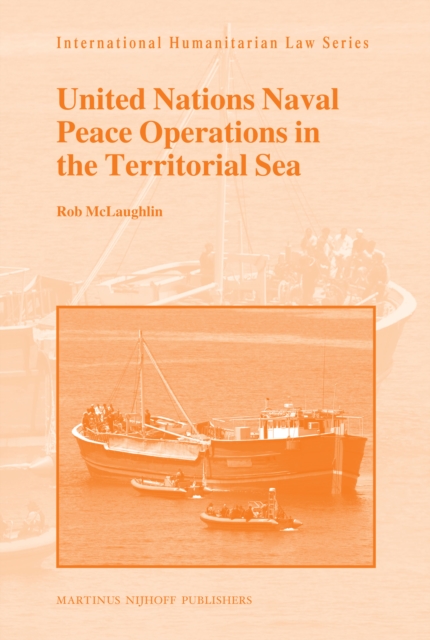
United Nations Naval Peace Operations in the Territorial Sea
This book examines UN naval peace operations, addressing the construction and assessment of authority with respect to a range of acts essential to the conduct of such operations. The focus is particularly upon operations as they relate to and impact upon the Territorial Sea. Within a conceptual approach emphasising the interaction of power and legitimation in the construction of authority, naval peace operations issues such as Innocent Passage, interdiction operations, and transitional administration are considered. The book concludes by proposing a conceptually and operationally sensitive approach to constructing authority for the conduct of UN naval peace operations in the Territorial Sea.
eBook

ARTICLE 110 OF THE LAW OF THE SEA CONVENTION 1982 AND JURISDICTION OVER VESSELS WITHOUT NATIONALITY
On 24 February 2018, a Japan Maritime Self-Defense Force (JMSDF) maritime patrol aircraft (MPA) observed a North Korean flagged vessel conducting a sanctions evading ship-to-ship at sea transfer with a vessel subsequently identified as the Maldivian registered Xin Yuan 18. The Diplomat reported, however, that there was an issue: \"the vessel was never registered by the Maldives.\"\"After cambodian authorities decided to close their registry, which had been used by North Korean-controlled vessels looking to evade U.N. sanctions, some of those vessels continued-in violation of national law-to fly the Cambodian flag.\" Indeed, all existing registrations under the Cambodian ship registry expired at the end of August 2016,4 and the Cambodian government strenuously rejected the use of the Cambodian flag by (in some reported cases) North Korean vessels as late as October 2017.5 Indeed, a North Korean vessel flying the Cambodian flag had been boarded and seized off the coast of Egypt in August 2017, carrying \"more than 30,000 rocket-propelled grenades hidden under iron ore\" in clear breach of the United Nations Security Council (UNSC) sanctions regime.6 In both cases, the vessel was not of the nationality claimed, so the obvious question that arises is: what nationality, if any, are they, and whose jurisdiction might they fall under?Despite a settled understanding that Article 110 of the Law of the Sea Convention 1982 (LOSC or LOSC 1982) permits a right of visit over a vessel suspected of being without nationality when encountered in international waters, there remains some opacity-even confusion-as to the degree and scope of subject matter jurisdiction8 which the boarding State warship (or other authorized vessel) may assert over the boarded vessel. This is counterintuitive for two reasons. First, as Robert Reuland has observed, is the significance of the proposition that \"[u]nless a ship lawfully sails under the flag of a recognized state, the elaborate system of rules established for the maintenance of order upon the high seas is meaningless\" and second, as Martin Fink has noted, is the fact that this authority (in a range of guises) is regularly and routinely employed. In this short Article, I will attempt to describe what I understand to be the current state of the law in relation to the assertion of jurisdiction over vessels without nationality.
Journal Article