
Catalogue Search | MBRL


Are you sure you want to remove the book from the shelf?

{{itemTitle}}
35
result(s) for
"McNevin, Aaron"
Sort by:


The contribution of fisheries and aquaculture to the global protein supply
The contribution of aquatic animal protein to the global, animal-source protein supply and the relative importance of aquaculture to capture fisheries in supplying this protein is relevant in assessments and decisions related to the future of aquatic food production and its security. Meat of terrestrial animals, milk, and eggs resulted in 76,966 Kt crude protein compared with 13,950 Kt or 15.3% from aquatic animals in 2018.While aquaculture produced a greater tonnage of aquatic animals, capture fisheries resulted in 7,135 Kt crude protein while aquaculture yielded 6,815 Kt. Capture fisheries production has not increased in the past two decades, and aquaculture production must increase to assure the growing demand for fisheries products by a larger and more affluent population. We estimated based on status quo consumption, that aquaculture production would need to increase from 82,087 Kt in 2018 to 129,000 Kt by 2050 to meet the demand of the greater population. About two-thirds of finfish and crustacean production by aquaculture is feed-based, and feeds for these species include fishmeal and fish oil as ingredients. Aquaculture feeds require a major portion of the global supply of fishmeal and fish oil. An estimated 71.0% of fishmeal and 73.9% of fish oil are made from the catch with the rest coming from aquatic animal processing waste. The catch of small, pelagic fish from the ocean is not predicted to increase in the future. Aquaculture should reduce its fishmeal and oil use to lessen its dependency on small wild fish important to the integrity of marine food webs and food security for the poor in many coastal areas. Fishmeal and fish oil shortages for use in aquaculture feed will result in a limit on production in the future if goals to lessen their use in feeds are not met.
Journal Article
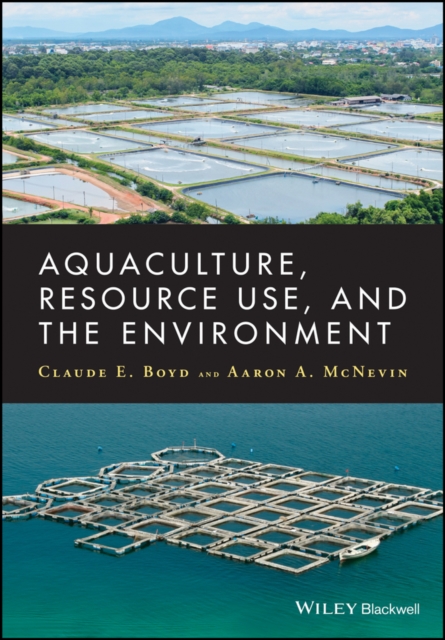
Aquaculture, Resource Use, and the Environment
Aquaculture, Resource Use, and the Environment places aquaculture within the larger context of global population growth, increased demand for sustainable, reliable sources of food, and the responsible use of natural resources.
eBook

Perspectives on the mangrove conundrum, land use, and benefits of yield intensification in farmed shrimp production: A review
Globally, shrimp farms occupied an estimated 3.490 million hectares (Mha) of land and operated 2.426 Mha of production ponds in 2018. Extensive shrimp farms used 1.804 Mha of farm area (1.377 Mha of production ponds), but produced 11.4% of global shrimp production. An estimated 1.718 Mha of land was required to produce ingredients for feeds used in semi‐intensive and intensive shrimp farming, bringing total land use to 5.160 Mha. Extensive production is located in the intertidal zone and much of this land formerly was or still is in mangrove areas. Expansion of shrimp farms into mangrove areas has slowed. Mangrove areas are inferior sites for shrimp farms, and governments have imposed stricter regulations to protect mangroves. Shrimp farming in mangrove areas is unnecessary to supply the global shrimp demand. Scenarios for increasing global shrimp production without further increase in shrimp farm area are presented. But, if the demand for shrimp continues to increase, it will be impossible to freeze the total land footprint for farmed shrimp, because the land needed for feed presently is roughly equal to the direct land use for shrimp farms. Direct land use for farms can be frozen through greater production pond yields.
Journal Article
Aerator energy use in shrimp farming and means for improvement
Estimates of aeration energy use in shrimp farming varied from 11.4 to 41.6 GJ/t shrimp (average = 19.8 GJ/t). Several opportunities for reducing energy use in aeration are available. Many farms adopt an excessive yield to installed aeration capacity ratio. Moreover, the proportion of installed aerator capacity in use and duration of aerator operation per day are often more than necessary during the initial two‐thirds of grow‐out, because adjustment is not made for the quantity of shrimp biomass. Farm‐made, long‐arm aerators used in Asia have several features leading to energy inefficiency and could be replaced by more efficient factory‐made, long‐arm aerators. Asian aquaculture aerator manufacturers should redesign aerators to include design features shown in research to improve efficiency. Dissolved oxygen concentration monitoring essential for verification of aeration performance is seldom performed by shrimp farmers. With good aeration technique, energy use for aeration should not exceed 10–15 GJ/t shrimp.
Journal Article

Comparison of resource use for farmed shrimp in Ecuador, India, Indonesia, Thailand, and Vietnam
The purpose of this study was to assess the amounts of land, water, energy in fuels, and wild fish for fishmeal and fish oil in feeds required per tonne of harvested, farmed shrimp in five countries producing most of the shrimp destined for the international market. Land use for whiteleg shrimp Litopenaeus vannamei production differed slightly between Indonesia (0.37 ha/t shrimp) and the other four, major shrimp exporting countries – Ecuador, India, Thailand, and Vietnam (0.42–0.46 ha/t shrimp). Total water use was greater in Ecuador (76,800 m3/t) and Indonesia (55,000 m3/t) than in the other three countries (14,000–45,500 m3/t), but most water was saline. Freshwater use was mainly embodied in feed, did not differ among countries, and averaged 6.3% of total water use. Energy use ranged from 56.0 GJ/t (Ecuador) to 98.8 GJ/t (Thailand). All Asian countries had energy use above 75 GJ/t. Wild fish use for fishmeal and fish oil in feeds was greatest in Ecuador (0.891 t/t) and similar in Asian countries (0.612–0.670 t/t). In terms of edible crude protein, whiteleg shrimp was similar to broiler chickens, but more efficient than pigs and beef cattle in land and freshwater use, but greater in energy use than were the three terrestrial meat sources. Compared to L. vannamei, black tiger shrimp Penaeus monodon required more land, a greater amount of water, but less energy per tonne of shrimp. Although comparatively small differences in average uses of these primary resources were found among countries, the large variation which was noted among farms in each country suggests that resource use could be improved considerably.
Journal Article
Resource use in whiteleg shrimp Litopenaeus vannamei farming in Ecuador
A survey of 101 shrimp farms in Ecuador revealed that the average annual shrimp yield based on production pond water surface area was 7.03 ± 0.93 (SE) t/ha/year. The range in annual yield among the five provinces with shrimp farms was 3.67 ± 0.71 to 11.95 ± 5.56 t/ha year, respectively. Averages for total land, water, and energy use were 0.54 ± 0.01 ha/t shrimp, 76,817 ± 6,330 m3/t shrimp, and 61.2 ± 4.2 GJ/t shrimp, respectively. Average wild fish use for fish meal and fish oil included in feed was 0.65 ± 0.02 t/t shrimp. One‐fourth of land use was land embodied in feed. Nearly 80% of total water use was incurred for exchanging water. Eighty‐seven of the farms practiced daily water exchange at an average rate of 8.5% pond volume per day (range 0.7–30%). Pumping water at all farms and mechanical aeration at 47 of the farms were the major direct energy uses. About half of the total energy use was embodied, and roughly half of the embodied energy was in feed.
Journal Article
Technical and financial feasibility for intensification of the extensive shrimp farming area in Mekong Delta, Vietnam
Engineering design studies and financial feasibility assessments were made for construction, maintenance, equipment, operations, loan requirement, shrimp sales and predicted cash flows for simulated transformations of extensive shrimp farms to intensive shrimp farms in the Mekong Delta, Vietnam. Farms with less than 2.8 ha of feed‐based, aerated production ponds would not be profitable at shrimp yields less than 5 t/ha/year. Profit projections increased in response to greater production area on farms and larger annual pond yields. Farms with 6 ha or more of production ponds and yields of 10 t/ha/year or more had the best profit potential. Greater profitability at higher production intensity resulted from a reduction in the labour cost/product weight ratio as yield per unit area increased. Transformation from extensive to intensive farms would allow greater shrimp production, increase worker income and lessen land and water use. Environmental benefits would include a reduction in sediment starvation of the Mekong Delta, and the option to restore some of the several hundred thousand hectares of mangrove area severely degraded by extensive shrimp farming. These two improvements would be of benefit in retarding erosion along the Mekong Delta coastline. The possibility of intensification and consolidation of the shrimp farming area in the Mekong Delta deserves further consideration. Extensive shrimp farms have resulted in the loss of a large amount of ecologically critical land within the intertidal zone. The technical feasibility of greatly reducing the area of shrimp farms in the intertidal zone is presented.
Journal Article

Sustainability and Global Seafood
Tight coupling to ecosystems and dependence on common-pool resources threaten fisheries and aquaculture. Although seafood is the most highly traded food internationally, it is an often overlooked component of global food security. It provides essential local food, livelihoods, and export earnings. Although global capture fisheries production is unlikely to increase, aquaculture is growing considerably. Sustaining seafood's contributions to food security hinges on the ability of institutions, particularly in developing countries, to protect and improve ecosystem health in the face of increasing pressures from international trade.
Journal Article

The role of species and geography in the elemental profiles of farm-raised shrimp from Indonesia
Elemental profiling is being explored as a traceability tool in many seafood products. However, the extent that elemental profiling can be used at finer geographical scales in cultured shrimp is unknown. Additionally, few studies have included multiple species in the same discriminant models, which would be useful in applications where one species is common, and the other is not. Here, elemental profiling was used to discern the provenance of black tiger shrimp
Penaeus monodon
and whiteleg shrimp
Litopenaeus vannamei
from the regions of North Kalimantan, Sulawesi Seletan, and Aceh in Indonesia. ICP-MS was used to determine elemental concentrations of 41 elements in shrimp muscle tissue and was the basis for multivariate and univariate statistical analyses. A MANOVA showed that multivariate differences exist in regions and between species of shrimp sampled. Univariate comparisons were utilized after the significance of the MANOVA and showed that 19 of the 24 elements above detection limits had significant differences. Classification via random forest was used to access the ability to discern, region, species, and region × species group combinations. The lowest model accuracy was the region × species combinations at 78.9%, while the highest accuracy was species irrespective of geographical origin at 93.59%. Elements that were routinely important in classification included As, B, Ba, Li, Na, Rb, Se, and Zn. Elemental profiles of white leg shrimp and black tiger shrimp are varied and potentially should not be used in the same classification models. Altogether, these results suggest that elemental profiling of farmed shrimp at finer geographic scales needs refinement as a traceability tool.
Journal Article