
Catalogue Search | MBRL


Are you sure you want to remove the book from the shelf?

{{itemTitle}}
237
result(s) for
"Mehran Kamrava"
Sort by:

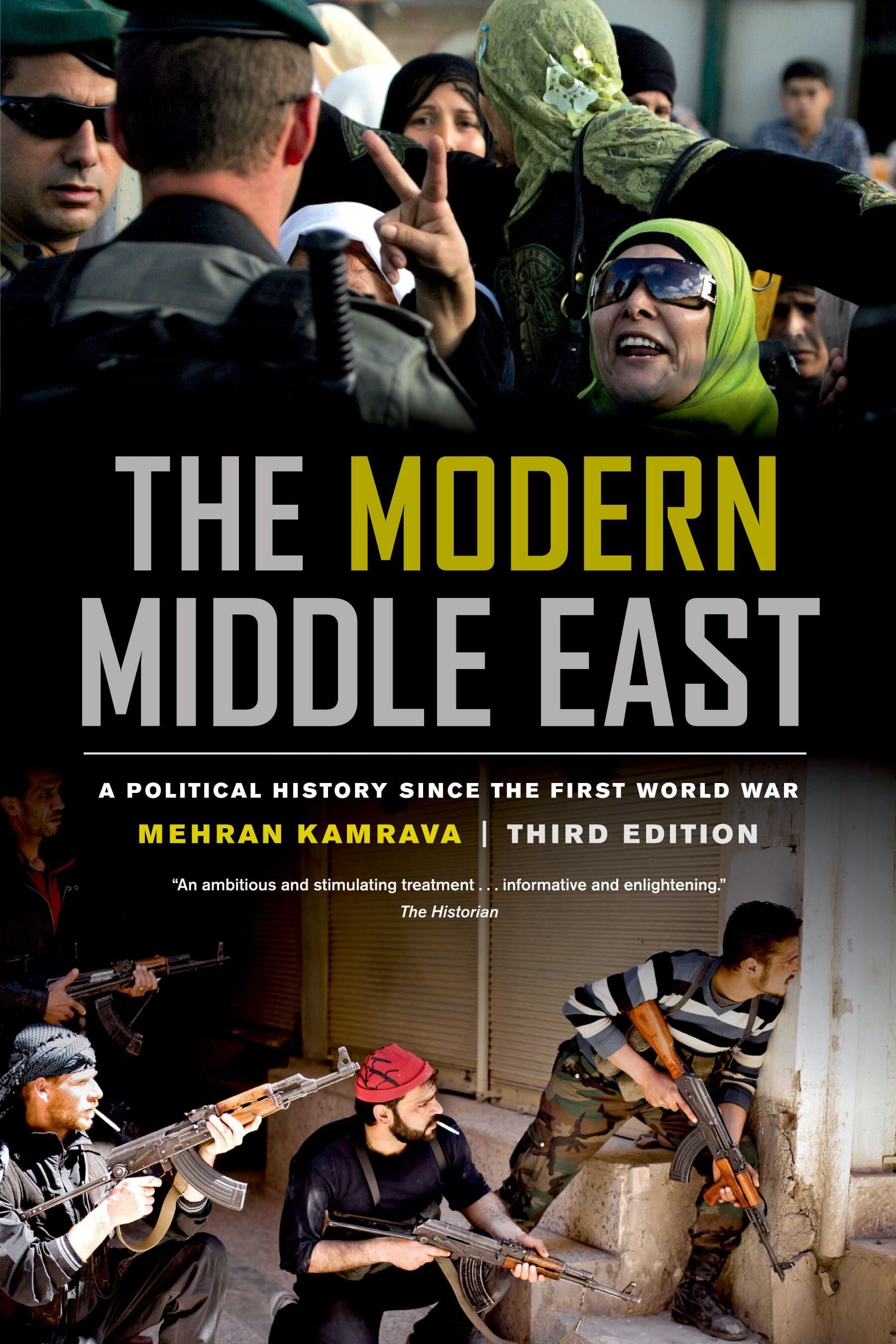
The Modern Middle East, Third Edition
From the fall of the Ottoman Empire through the Arab Spring, this completely revised and updated edition of Mehran Kamrava’s classic treatise on the making of the contemporary Middle East remains essential reading for students and general readers who want to gain a better understanding of this diverse region.
eBook

Inside the Arab State
An in-depth, comprehensive, and theoretically-informed examination of Arab politics of the last decade. The Arab Spring revolts of 2011 and the rise of ISIS in 2014, demand an updated analysis of the topic.
Book

Routledge Handbook Of Persian Gulf Politics
The Routledge Handbook of Persian Gulf Politics provides a comprehensive and up-to-date analysis of Persian Gulf politics, history, economics, and society.
The volume begins its examination of Ottoman rule in the Arabian Peninsula, exploring other dimensions of the region's history up until and after independence in the 1960s and 1970s. Featuring scholars from a range of disciplines, the book demonstrates how the Persian Gulf's current, complex politics is a product of interwoven dynamics rooted in historical developments and memories, profound social, cultural, and economic changes underway since the 1980s and the 1990s, and inter-state and international relations among both regional actors and between them and the rest of the world. The book comprises a total of 36 individual chapters divided into the following six sections:
Historical Context
Society and Culture
Economic Development
Domestic Politics
Regional Security Dynamics
The Persian Gulf and the World
Examining the Persian Gulf's increasing importance in regional politics, diplomacy, economics, and security issues, the volume is a valuable resource for scholars, students, and policy makers interested in political science, history, Gulf studies, and the Middle East.
eBook

A concise history of revolution
\"Presenting a new framework for the study of revolutions, this innovative exploration of French, Russian, Chinese, Vietnamese, Cuban, Iranian, South African, and more recent Arab revolutions, provides a theoretically grounded and empirically comprehensive demonstration of how revolutions mean more than mere state collapse and rebuilding. Through the examination of multiple historical case studies, and use of extensive historical examples to explore a range of revolutions, Mehran Kamrava reveals the range and depth of human emotion and motivations that are so prevalent and consequential in revolutions, from personal commitment to sacrifice, determination, leadership ability, charisma, opportunism, and avarice\"-- Provided by publisher.
Book

Troubled Waters
Troubled Waters looks at four dynamics in the Persian
Gulf that have contributed to making the region one of the most
volatile and tension-filled spots in the world. Mehran Kamrava
identifies the four dynamics as: the neglect of human dimensions of
security, the inherent instability involved in reliance on the
United States and the exclusion of Iraq and Iran, the international
and security policies pursued by inside and outside actors, and a
suite of overlapping security dilemmas. These four factors combine
and interact to generate long-term volatility and ongoing tensions
within the Persian Gulf.
Through insights from Kamrava's interviews with Gulf elites into
policy decisions, the consequences of security dilemmas, the
priorities of local players, and the neglect of identity and
religion, Troubled Waters examines the root causes of
conflicts and crises that are currently unfolding in the region. As
Kamrava demonstrates, each state in the region, including Saudi
Arabia, Iran, and Qatar, has embarked on vigorous
security-producing efforts as part of foreign policy, flooding the
area with more munitions-thereby increasing insecurity and causing
more mistrust in a part of the world that needs no more
tension.
eBook


Qatar
The Persian Gulf state of Qatar has fewer than 2 million inhabitants, virtually no potable water, and has been an independent nation only since 1971. Yet its enormous oil and gas wealth has permitted the ruling al Thani family to exert a disproportionately large influence on regional and even international politics. Qatar is, as Mehran Kamrava explains in this knowledgeable and incisive account of the emirate, a tiny giant: although severely lacking in most measures of state power, it is highly influential in diplomatic, cultural, and economic spheres.
Kamrava presents Qatar as an experimental country, building a new society while exerting what he calls subtle power. It is both the headquarters of the global media network Al Jazeera and the site of the U.S. Central Command's Forward Headquarters and the Combined Air Operations Center. Qatar has been a major player during the European financial crisis, it has become a showplace for renowned architects, several U.S. universities have established campuses there, and it will host the FIFA World Cup in 2022. Qatar's effective use of its subtle power, Kamrava argues, challenges how we understand the role of small states in the global system. Given the Gulf state's outsized influence on regional and international affairs, this book is a critical and timely account of contemporary Qatari politics and society.
eBook

Routledge handbook of Persian Gulf politics
\"The Routledge Handbook of Persian Gulf Politics provides a comprehensive and up-to-date analysis of Persian Gulf politics, history, economics, and society. The volume begins its examination of Ottoman rule in the Arabian Peninsula, exploring other dimensions of the region's history up until and after independence in 1970. Featuring scholars from a range of disciplines, the book demonstrates how the Persian Gulf's current, complex politics is a product of interwoven dynamics rooted in historical developments and memories, profound social, cultural, and economic changes underway since the 1980s and the 1990s, and inter-state and international relations among both regional actors and between them and the rest of the world. The book is comprised of a total of 36 individual chapters divided into the following six sections: Historical Context, Society and Culture, Economic Development, Domestic Politics, Regional Security Dynamics, The Persian Gulf and the World. Examining the Persian Gulf's increasing importance in regional politics, diplomacy, economics, and security issues, the volume is a valuable resource for scholars, students, and policymakers interested in political science, history, Gulf studies, and the Middle East\"-- Provided by publisher.
Book

Cities, Globalized Hubs, and Nationalism in the Persian Gulf
This article examines the three major cities of the Persian Gulf region - Doha, Abu Dhabi, and Dubai. At the regional level, all three cities have become transportation hubs, and Doha and Abu Dhabi have become educational and cultural centers. At the global level, however, only
Dubai has succeeded in becoming a key node in international networks of finance, commerce, services, tele communications, logistics, and transportation. The others' aspirations to become global cities are undermined by continued reliance on oil and gas revenues. On balance, while these cities
are comparatively successful regional hubs, their long-term position as global cities is far from certain.
Journal Article