
Catalogue Search | MBRL


Are you sure you want to remove the book from the shelf?

{{itemTitle}}
122
result(s) for
"Mehrling, Perry"
Sort by:


Financialization and its discontents
Finance is not something separate from society. It is neither a Marxian superstructure nor a monetarist veil, but rather the very substance of modern social relations, a web of time-dated promises to pay that stretches from now into the future, and from here around the globe. Financial relationships are not about mediating something else on the \"real\" side of the economy; they are the constitutive relationships of the whole system. Financial globalization and global financialization have produced a global Financial Society, hierarchical and inherently unstable. The problem confronting social analysts is not so much to find the social in the money grid - the money grid is already social - but rather to understand the dynamical operations of that grid on its own terms. This essay sketches the fundamental processes that produce and reproduce Financial Society - settlement and market-making - as an attempt to provide a realistic point of departure for any feasible project of reform.
Journal Article

Three Principles for Market-Based Credit Regulation
A key lesson of the financial crisis 2007-09 is that the Bagehot Rule, “lend freely but at a high rate,” needs to be updated for the emerging market-based credit system. A modern rule is suggested: Markets, not Banks; Outside spread, not Inside spread; Core, not Periphery.
Journal Article
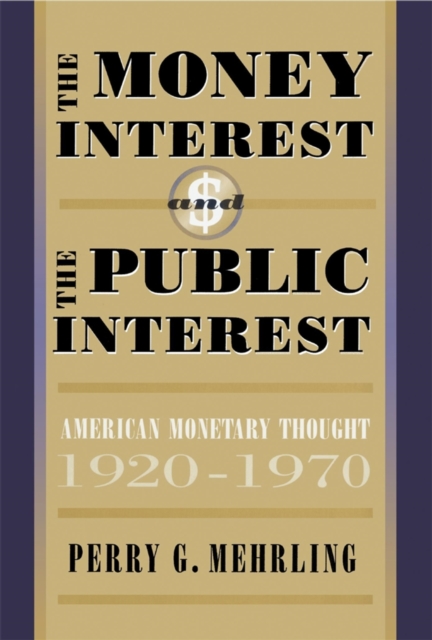
The money interest and the public interest : American monetary thought, 1920-1970
The years 1920–1970 saw revolutionary change in the character of the monetary system as a consequence of depression, war, and finally prosperity. The same years saw equally revolutionary change in the character of economic ideas as the rise of statistics, Keynesian economics, and then Walrasian economics transformed the style of economic explanation. The two lines of change reinforced one another, as monetary events posed new questions that required new conceptual approaches, and as monetary ideas suggested possible directions for monetary policy. Against this background of change, Perry Mehrling tells a story of continuity around the crucial question of the role of money in American democracy, a question associated generally with the Progressive tradition and its legacy, and more particularly with the institutionalist tradition in American economic thought. In this story, which he tells through the ideas and lives of three prominent institutionalists—Allyn Young, Alvin Hansen, and Edward Shaw—progress is measured not by the swings of fashion between two polar traditions of monetary thought—quantity theory and anti-quantity theory—but rather by the success with which each succeeding generation finds its footing on the shifting middle ground between the two extremes. More than a simple history of monetary doctrine, the book makes a case for the continuing influence of a distinctly American tradition on the evolution of economic thought in general. In this tradition, monetary and financial institutions are shaped by historical forces and adapt to the changing needs of the economy.
eBook

Elasticity and Discipline in the Global Swap Network
This article sketches the outlines of the new international monetary system that has emerged in the aftermath of the global financial crisis. At the center of the system, a network of central bank swaps between the six major central banks serves as an elastic backstop for private foreign exchange operations. Farther out on the periphery, an added network of central bank swaps operates to economize on scarce reserves of the major currencies. Meanwhile, in the private foreign exchange market, basis swaps are emerging as the central location where liquidity is explicitly priced, inside the bounds set by central bank swaps.
Journal Article

Money Interest and the Public Interest
Intro -- Contents -- Preface -- Acknowledgments -- Introduction -- I ALLYN ABBOTT YOUNG -- 1 Intellectual Formation -- 2 Early Monetary Ideas -- 3 War and Reconstruction -- 4 Monetary Management in the Twenties -- II ALVIN HARVEY HANSEN -- 5 Intellectual Formation -- 6 Depression -- 7 Stagnation -- 8 The Golden Age -- III EDWARD STONE SHAW -- 9 Intellectual Formation -- 10 From Money to Finance -- 11 Financial Structure and Economic Development -- Conclusion -- Notes -- Bibliography -- Index
Book
The Money Interest and the Public Interest
The years 1920-1970 saw revolutionary change in the character of the monetary system as a consequence of depression, war, and finally prosperity. The same years saw equally revolutionary change in the character of economic ideas as the rise of statistics, Keynesian economics, and then Walrasian economics transformed the style of economic explanation. The two lines of change reinforced one another, as monetary events posed new questions that required new conceptual approaches, and as monetary ideas suggested possible directions for monetary policy. Against this background of change, Perry Mehrling tells a story of continuity around the crucial question of the role of money in American democracy, a question associated generally with the Progressive tradition and its legacy, and more particularly with the institutionalist tradition in American economic thought. In this story, which he tells through the ideas and lives of three prominent institutionalists, Allyn Young, Alvin Hansen, and Edward Shaw, progress is measured not by the swings of fashion between two polar traditions of monetary thought--quantity theory and anti-quantity theory--but rather by the success with which each succeeding generation finds its footing on the shifting middle ground between the two extremes. More than a simple history of monetary doctrine, the book makes a case for the continuing influence of a distinctly American tradition on the evolution of economic thought in general. In this tradition, monetary and financial institutions are shaped by historical forces and adapt to the changing needs of the economy.
eBook