
Catalogue Search | MBRL


Are you sure you want to remove the book from the shelf?

{{itemTitle}}
214
result(s) for
"Meier, Deborah"
Sort by:

Differentiated assessment : how to assess the learning potential of every student
\"A comprehensive assessment system for working with underperforming students This book describes a comprehensive assessment system especially appropriate for multilingual and \"differentiated\" classrooms with large numbers of underperforming students. Drawing from Multiple Intelligences theory, the approach is specifically aimed at helping teachers understand how each student learns and how best to tailor instruction to serve individual students' needs. Although the program makes use of conventional standardized tests and disability screenings, it places special importance on two approaches in particular: Student Portfolio Assessments and Personalized Learning Profiles. Provides detailed guidance and practical tools (including a DVD) for implementing successful portfolio and \"profile\" practices in the classroom. Includes real-world examples of model assessment programs from five schools. Explains how to integrate assessment into the instructional process as well as how the portfolio program can be used. Formal profiles provide vital information about each student's cultural background, interests, strengths, and capabilities as well as their individual learning and language needs.\"-- Provided by publisher.
Book

Beyond Dyadic Coupling: The Method of Multivariate Surrogate Synchrony (mv-SUSY)
Measuring interpersonal synchrony is a promising approach to assess the complexity of social interaction, which however has been mostly limited to dyads. In this study, we introduce multivariate Surrogate Synchrony (mv-SUSY) to extend the current set of computational methods. Methods: mv-SUSY was applied to eight datasets consisting of 10 time series each, all with n = 9600 observations. Datasets 1 to 5 consist of simulated time series with the following characteristics: white noise (dataset 1), non-stationarity with linear time trends (dataset 2), autocorrelation (dataset 3), oscillation (dataset 4), and multivariate correlation (dataset 5). Datasets 6 to 8 comprise empirical multivariate movement data of two individuals (datasets 6 and 7) and between members of a group discussion (dataset 8.) Results: As hypothesized, findings of mv-SUSY revealed absence of synchrony in datasets 1 to 4 and presence of synchrony in dataset 5. In the empirical datasets, mv-SUSY indicated significant movement synchrony. These results were predominantly replicated by two well-established dyadic synchrony approaches, Surrogate Synchrony (SUSY) and Surrogate Concordance (SUCO). Conclusions: The study applied and evaluated a novel synchrony approach, mv-SUSY. We demonstrated the feasibility and validity of estimating multivariate nonverbal synchrony within and between individuals by mv-SUSY.
Journal Article

These schools belong to you and me : why we can't afford to abandon our public schools
\"A challenge to narrow, profit-driven conceptions of school success and an argument for protecting public education to ensure that all students become competent citizens in a vibrant democracy MacArthur award-winning educator, reformer, and author Deborah Meier draws on her fifty-plus years of experience in education to argue that the purpose of universal education is to provide young people with an \"apprenticeship for citizenship in a democracy.\" Through an intergenerational exchange with her former colleague and fellow educator Emily Gasoi, the coauthors share their experiences working in democratically governed schools and analyze the last several decades of education reform. Reflecting on the trajectory of education and social policies that are leading our country further from rule \"of, for, and by the people,\" the authors apply their extensive knowledge and years of research to address the question of how public education must change in order to counter the erosion of democratic spirit and practice in schools and in the nation as a whole\"-- Provided by publisher.
Book

Audience synchronies in live concerts illustrate the embodiment of music experience
A study of 132 audience members of three classical public concerts (all three staged the same chamber music pieces by Ludwig van Beethoven, Brett Dean, and Johannes Brahms) had the goal of analyzing the physiological and motor responses of audiences. It was assumed that the music would induce synchronous physiology and movement in listeners (induction synchrony). In addition to hypothesizing that such synchronies would be present, we expected that they were linked to participants’ aesthetic experiences, their affect and personality traits, which were assessed by questionnaires before and after the concerts. Clear evidence was found of physiological synchrony (heart rate, respiration rate, skin conductance response) as well as movement synchrony of the audiences, whereas breathing behavior was not synchronized. Thus the audiences of the three concerts resonated with the music, their music perception was embodied. There were links between the bodily synchrony and aesthetic experiences: synchrony, especially heart-rate synchrony, was higher when listeners felt moved emotionally and inspired by a piece, and were immersed in the music. Personality traits were also associated with the individual contributions to induction synchrony.
Journal Article

So What Does It Take to Build A School for Democracy? (2003)
In the 20 years since A Nation at Risk called for a major overhaul of our public schools, we have heard endless talk about standards, accountability, and \"toughness.\" But we have avoided an honest discussion of means and ends. Having that discussion would -- for all concerned -- force into the open some questions that we would apparently rather not. But the price for our silence is high. The most serious silence has to do with ends: What do we want schools to accomplish that is of sufficient public (not just personal) value to justify all the hullabaloo, not to mention expense?
Journal Article
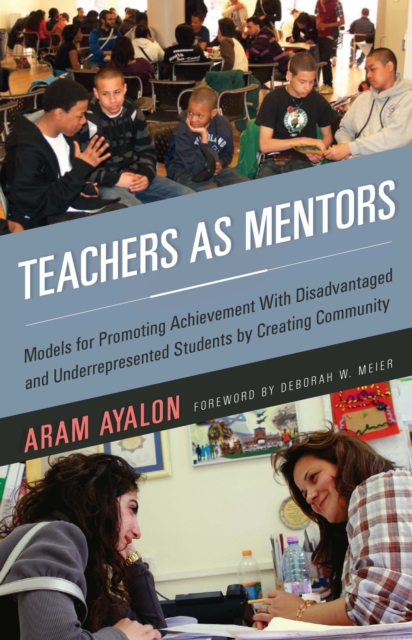
Teachers As Mentors
The book describes two similar and successful models of youth mentoring used by two acclaimed urban high schools that have consistently achieved exceptional graduation rates. Providing a detailed description of their methods - based upon extensive observation, and interviews with teachers, students, administrators, and parents - this book makes a major contribution to the debate on how to reduce the achievement gap.Using similar teacher-as-youth mentor and youth advising models, these two inner city schools - Fenway High School in Boston, Massachusetts; and the Kedma School in Jerusalem - have broken the cycle of failure for the student populations they serve-children from underrepresented groups living in poverty in troubled neighborhoods with few resources. Students in both schools have excelled academically, rarely dropout, and progress to college in significant numbers (Fenway has 90% graduation rate, with 95% of graduates going on to college. Kedma outperforms comparable urban schools by a factor of four). Both schools have won numerous awards, with Fenway High School gaining Pilot School status in Massachusetts, a recognition the state only awards to a few exemplary schools; and Kedma School being declared one of the 50 most influential educational endeavors in Israel.The success of both schools is directly attributable to their highly developed teacher-as-a-youth mentor programs that embody an ideology and mission that put students at the center of their programs and structures. The models are closely integrated with the curriculum, and support the social, emotional, cultural, and academic needs of students, as well as develop close mentor-student-parent relationships. The model furthermore includes extensive support for the mentors themselves. Apart from the potential of these models to narrow the achievement gap, these two schools have a record of creating a school climate that promotes safety, and reduces the incidence of bullying and violence. At the h
eBook

Differentiated Assessment
A comprehensive assessment system for working with underperforming students This book describes a comprehensive assessment system especially appropriate for multilingual and \"differentiated\" classrooms with large numbers of underperforming students.
eBook

The new American high school
\"The late Theodore Sizer's vision for a truly democratic public high school systemOur current high schools are ill-designed and inefficient. We have inherited a program of studies that in its overall structure has not changed in over a century. The question is What's next? Theodore Sizer, the founder of The Coalition of Essential Schools, was a passionate advocate for the American school system. In this, his last book, he offers a vision of what a future secondary education might look like. In a book that tells the story of his own odyssey, Sizer gives shape to a much-needed agenda for improving our high schools. Includes a vision for the future of our High Schools from one of America's greatest leaders of educational reform Written by Theodore Sizer founder of The Coalition of Essential Schools and author of landmark book Horace's Compromise This final book from the late Theodore Sizer reveals the man and his vision for our secondary education system\"--
eBook
Teaching matters most
A laser-beam focus on improving instruction to improve learningSaying “teaching matters most” is easy, and seems obvious. Making it the top priority for school leaders and staff is not so easy—in fact, it's messy. If we want to change how students write, compute, and think, then teachers must change how they teach. They must transform the old “assign-and-assess” model into engaging, compassionate, coherent, and rigorous instruction. The authors show school leaders how to make this happen amidst myriad distractions, initiatives, and interruptions.Unlike other books that stop at evaluating teachers and instruction, this work demonstrates how to grow schools' instructional capacities with a three-step process that involves: 1. Envisioning what good teaching looks like; 2. Measuring the quality of current instruction against this standard; 3. Working relentlessly to move the quality of instruction closer and closer to the idealThe authors provide helpful guidance on issues such as hiring, induction, professional development, mentoring, and teacher evaluation. Each chapter offers specific action steps toward building the blueprint for improvement. Also included are frameworks for completing instructional audits in schools, and probes, instruments, and protocols for measuring and tracking the quality of instruction. Leaders will find excellent guidance for spearheading and sustaining a focused and aligned effort to improve the quality of teaching to impact all learners.
eBook

What's Democracy Got to Do with Teaching?
What's democracy got to do with teaching? To answer this question, the author recollects the personal experiences through which she came to understand the connections between democracy and teaching. Sustaining democracy requires its citizens--teachers, parents, and students, in the case of schooling--to fight for it intelligently. The way teachers are educated, like the way K-12 students are educated, will have a great impact on whether efforts for greater voice and influence in government are productive. Unionization was a critical, if petty, first step in that direction--one that took courage and risk, and remains vulnerable. But there's the next step, and it can't be accomplished unless students and novice teachers at some time \"see what democracy looks and sounds like.\" Schools of education, as well as schools themselves, must become communities that introduce the next generation to the democracy project.
Journal Article