
Catalogue Search | MBRL


Are you sure you want to remove the book from the shelf?

{{itemTitle}}
34
result(s) for
"Merleaux, April"
Sort by:

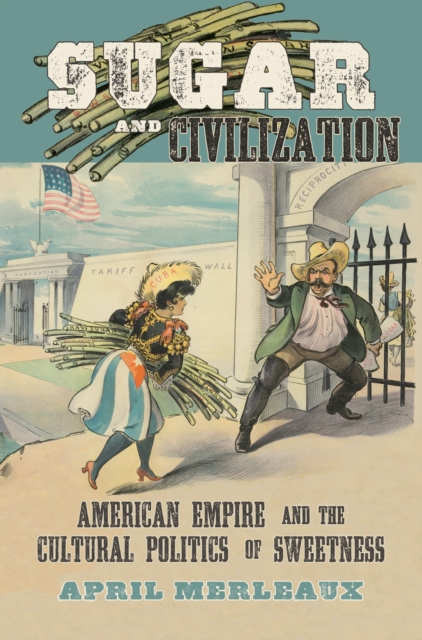
Sugar and Civilization
In the weeks and months after the end of the Spanish-American War, Americans celebrated their nation's triumph by eating sugar.Each of the nation's new imperial possessions, from Puerto Rico to the Philippines, had the potential for vastly expanding sugar production.
eBook


The Political Culture of Sugar Tariffs: Immigration, Race, and Empire, 1898–1930
This article contends that the chronology of popular and legislative movements for restrictive tariffs and immigration exclusion in the United States ran parallel courses between 1898 and the 1930. Those who spoke for and against such policies did so using the rhetoric of race, labor, and empire. The article analyzes the career of Nevada Senator Francis G. Newlands in order to show how the sugar industry and Asian immigration were intrinsic to debates over imperial policy between 1898 and the First World War. The article then describes policy changes during the First World War. The war set the stage for renewed debates over immigration and the sugar trade in the 1920s as the newly formed Tariff Commission attempted to grapple with an oversupplied world sugar market. Their work ultimately reinforced the old associations among race, labor, and trade policy and did little to improve the global sugar crisis.
Journal Article

DRUGS, EMPIRE, AND U.S. FOREIGN POLICY
A central paradox animates the history of U.S. international drug policy. Though there is strong international consensus around a rigorous drug‐control regime, it has failed to slow drug production, trafficking, and consumption. Despite countless bilateral agreements and U.N. drug treaties, more land is dedicated to drug crops, more resources are spent in interdiction, more violence is committed as part of the drug wars, and more people use drugs than at any point in the past. Historians' recent findings suggest that drug policies have in fact exacerbated the problem. This chapter tracks three major themes in recent historical scholarship. First, drug history should be studied in the contexts of liberalism, colonialism, and neoliberalism. Second, since the early 1900s, the United States has used drug policy to project its power internationally. Third, discourses of morality and political control, together with racial stereotypes, have bolstered policies even when they are failing.
Book Chapter

Sugar and Civilization: Race, Empire, and the Cultural Politics of Sweetness in the United States, 1898–1939
\"Sugar and Civilization\" explores the connections among racialized and gendered consumers, producers, and cultural workers during a critical period in U.S. and global history. As a study of U.S empire, this work reckons with the United States' acquisition of many tropical sugar-producing regions after 1898, and how their incorporation into the nation reconfigured understandings of how territorial sovereignty would be exercised through migration and trade policies. Since sugar could be produced either from cane raised on those newly-acquired islands, or from sugar beets grown in domestic temperate climates, policymakers began from the early-1900s forward to consider the relative merits of Puerto Rico, the Philippines, Hawaii, Cuba, Colorado, California, and Louisiana. In describing and representing sugar and the workers who produced it, leaders in the U.S. accordingly mapped the spatial logic of production and consumption in ways that defined their nation's imperial vision. I show how the movements of both commodities and laborers—in and outside the boundaries of the nation—shaped understandings of race and nation during a time when sugar production and consumption were increasing exponentially. Tariff making, in particular the sugar tariff alongside immigration policy, was thus a site for an emerging imperial racial formation as policymakers, workers, and consumers sought to influence how U.S. sovereignty would be exercised in the movement of commodities and people across borders. In order to understand the lives and perspectives of workers in many locations my dissertation illustrates that the Mexican, Cuban, Puerto Rican, Filipino, Chinese, Japanese, African American and Anglo workers who tended sugar cane and beets also ate sugar and candy. As they did so, they spun their own stories about how they fit into the global sugar economy. By following a range of historical actors in multiple locations, this dissertation documents that sugar created spaces of resistance to global capitalism as consumers both internalized and contested their longings for sweetness. I argue that sweetness cannot be understood merely as a natural human desire, but was constructed from a shifting set of cultural longings and production imperatives, often organized around notions of race, gender, and civilization. Powerful businesses, in conjunction with the state, used new technologies and economic practices to foster what I term cultures of craving among U.S. laborers and consumers. Such cravings were reinforced through songs on the radio and in the parlor, in kitchens and candy shops, and in the fields and factories where sugar was produced. When, in 1934, New Deal policymakers renegotiated a new system for protecting the U.S. sugar market, they did so with these consumers in mind. As they reformulated policies to maintain U.S. global hegemony in the world of sugar, policymakers in the 1930s brought about the culmination of decades of debate over how to balance exclusion and expansion in U.S. American democracy.
Dissertation