
Catalogue Search | MBRL


Are you sure you want to remove the book from the shelf?

{{itemTitle}}
228
result(s) for
"Meyer, Doris"
Sort by:

This America of ours : the letters of Gabriela Mistral and Victoria Ocampo
Gabriela Mistral and Victoria Ocampo were the two most influential and respected women writers of twentieth-century Latin America. Mistral, a plain, self-educated Chilean woman of the mountains who was a poet, journalist, and educator, became Latin America’s first Nobel Laureate in 1945. Ocampo, a stunning Argentine woman of wealth, wrote hundreds of essays and founded the first-rate literary journal Sur. Though of very different backgrounds, their deep commitment to what they felt was “their” America forged a unique intellectual and emotional bond between them. This collection of the previously unpublished correspondence between Mistral and Ocampo reveals the private side of two very public women. In these letters (as well as in essays that are included in an appendix), we see what Mistral and Ocampo thought about each other and about the intellectual and political atmosphere of their time (including the Spanish Civil War, World War II, and the dictatorships of Latin America) and particularly how they negotiated the complex issues of identity, nationality, and gender within their wide-ranging cultural connections to both the Americas and Europe.
eBook
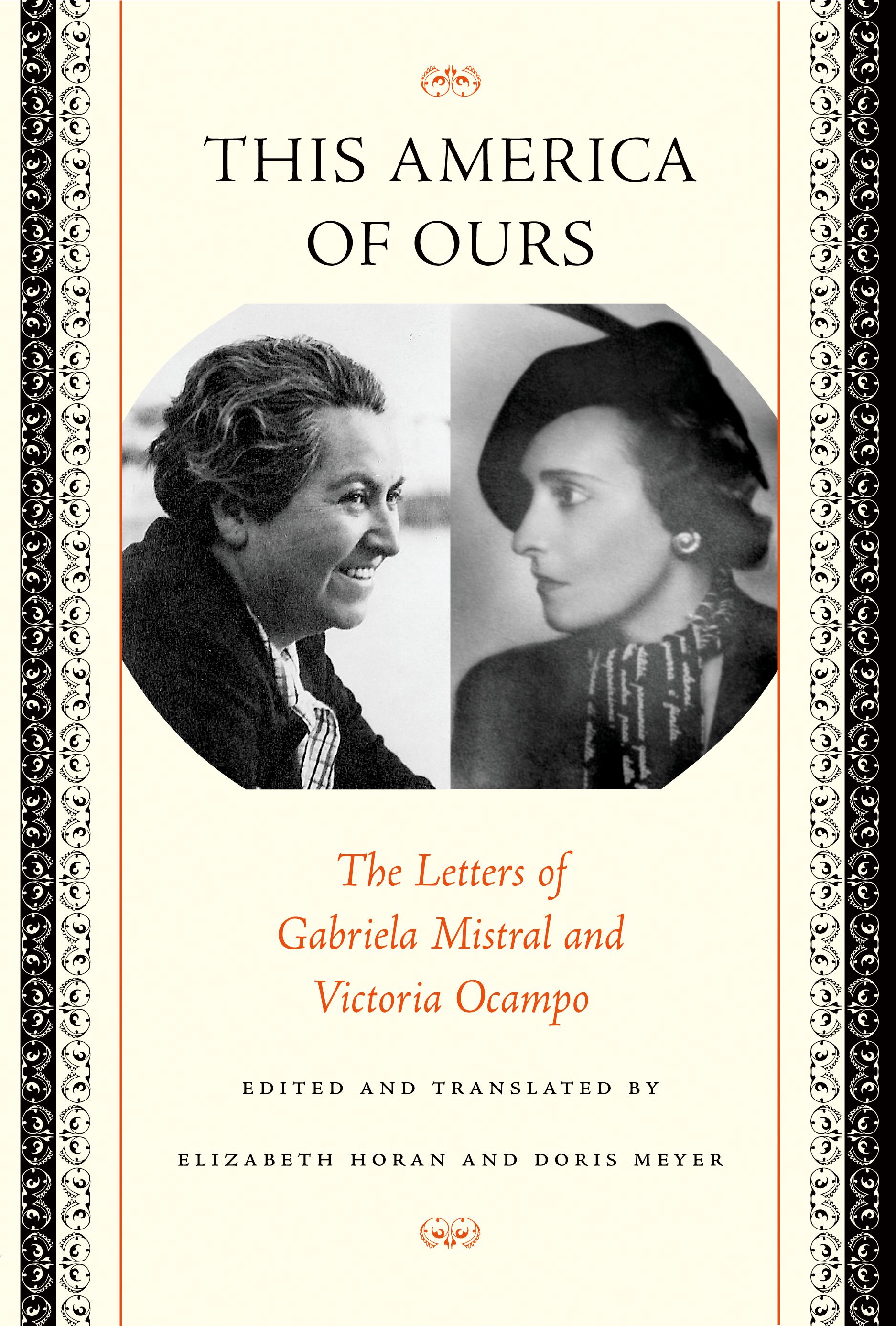
This America of Ours
2005 — Best Book Translation Prize – New England Council of Latin American Studies Gabriela Mistral and Victoria Ocampo were the two most influential and respected women writers of twentieth-century Latin America. Mistral, a plain, self-educated Chilean woman of the mountains who was a poet, journalist, and educator, became Latin America's first Nobel Laureate in 1945. Ocampo, a stunning Argentine woman of wealth, wrote hundreds of essays and founded the first-rate literary journal Sur. Though of very different backgrounds, their deep commitment to what they felt was \"their\" America forged a unique intellectual and emotional bond between them. This collection of the previously unpublished correspondence between Mistral and Ocampo reveals the private side of two very public women. In these letters (as well as in essays that are included in an appendix), we see what Mistral and Ocampo thought about each other and about the intellectual and political atmosphere of their time (including the Spanish Civil War, World War II, and the dictatorships of Latin America) and particularly how they negotiated the complex issues of identity, nationality, and gender within their wide-ranging cultural connections to both the Americas and Europe.
eBook

VICTORIA OCAMPO AND THE CINEMA
Argentina was one of the first countries to show works produced by Edison's kinetiscope in 1894 and by the Lumiere brothers in 1896; by 1900 national news reels were being filmed on location and porteños could see them at the first movie hall right in the heart of the city, not far from the Ocampo family residence. The conclusion of her essay expresses once again the hope that Argentine cinema might be transformed by a new aesthetic vision: iCuán de desear es que esta película nazca en nuestro suelo! iCuánto nos aliviaría! iCómo nos sentiríamos reflejados por fin en ella! iY qué necesidad tenemos de olvidar, de lavarnos de las grotescas caricaturas cinematográficas de la Argentina cuya persistencia resulta verdaderamente desoladora! (\"A propósito\" 96) The fact is that in 1935 the Argentine movie industry had followed Hollywood's lead and become more a commercial than an artistic venture, reflecting the tastes of the growing middle class and its passion for tango, sports and melodrama. Meredith was excited by the idea; he intended to direct and star in the film and asked Victoria to work on the script with him. Since they were in England at that time, she arranged for him to meet T. E.'s brother, A.W. Lawrence, after which Meredith sent her a handwritten note from New York in May 1948: A great deal more could be said about how Victoria viewed the art of the cinema through a lens that always privileged the human factor, especially films by Italian directors like Vittorio De Sica and Roberto Rossellini, whose Mediterranean perspective on life reminded her so much of Argentine culture.7 Any reader of her Testimonios or her Autobiografía will find abundant evidence of her lifelong fascination with films and their impact on her writing.
Journal Article


Nellie Campobello's \Las manos de mamá\: A Rereading
According to Chodorow: Women and men grow up with personalities affected by different boundary experiences and differently constructed and experienced inner object-worlds, and are preoccupied with different relational issues. By portraying the multidimensionality of the female psyche and the strength of the bond between self (daughter) and the other (mother), Campobello writes a very female biography of her mother, one that does not conform to traditional patterns of biographical (or autobiographical) linearity, unity, and chronology.12 Where critics have previously seen lack of unity and development in Las manos de mamá, one now glimpses the uniqueness of a female creative imagination. Because she is a woman, the psychological development of self-her own as well as her mother's, by projection-involves an \"ongoing process of attachment\" rather than a male's common experience of \"separation as it defines and empowers the self\" (Gilligan 156). [...]critical reaction is strangely silent about this incident, as if disconcerted or embarrassed by its moral implications. According to Gardiner, in the same article, \"Discussion of female identity thus inevitably returns to the special nature of the motherdaughter bond\" (342).
Journal Article

THE LANGUAGE ISSUE IN NEW MEXICO, 1880-1900: MEXICAN-AMERICAN RESISTANCE AGAINST CULTURAL EROSION
Public education in New Mexico in the late 1800s was affected by the passage in 1891 of a comprehensive school bill. This bill was partly directed at decreasing the Catholic Church's influence & imposing the use of English as the dominant lang. Despite some opposition, the bill was supported in the Mexican-American press because the learning of English was viewed as a necessary means to preserving cultural identity & the rights of Mexican-Americans under the Treaty of Guadalupe Hidalgo. Other arguments were adduced supporting the establishment of bilingual programs to preserve cultural heritage, increase literacy, & to emphasize the importance of Sp as a language of business. The right to bilingual education was established in the New Mexico constitution of 1910. B. Annesser
Journal Article

ANONYMOUS POETRY IN SPANISH-LANGUAGE NEW MEXICO NEWSPAPERS (1880-1900)
A small sample of the numerous anonymous Spanish poems found in New Mexico newspapers between 1880 & 1900 is presented. The examples discussed represent basic motives, themes, & stylistic patterns. The amount of this poetry from newspapers, together with folk poetry which has been preserved in New Mexico, further confirms the fact that versifying is a cultural trait among Hispanos. Further, these selections demonstrate that the Hispano was aware of the identity-threatening forces of political maneuvers, linguistic contaminations, nonsectarian education, & social restrictions. J. Schwarz
Journal Article

The Critical Nature of Language of Instruction Compared to Observed Practices and High-Stakes Tests in Transitional Bilingual Classrooms
[...]among the many challenges of bilingual education are limitations of observational research reporting (a) teachers' language of instruction, (b) teachers' perceived language of instruction, and (c) the relationships among teachers' language of instruction, teachers' perceived language of instruction, and students' academic achievement on high-stakes tests. According to Ramirez et al., this is due to the fact that students provided with extensive first language instruction acquire content area knowledge as fast as or faster than their peers who are mainstreamed without enough exposure to first language. If the third grade students were to remain in a fourth grade bilingual program, the language split at the time of our study was expected by the district to be 60% English and 40% Spanish. [...]students in our sample would have needed their language of instruction in English to have been increased by 15% in order to align with the district fourth grade bilingual model. [...]of our suggestions, district personnel altered the time frame for the transitional bilingual program moving children to 50% English and 50% Spanish by the second semester of second grade.
Journal Article