
Catalogue Search | MBRL


Are you sure you want to remove the book from the shelf?

{{itemTitle}}
26,728
result(s) for
"Michael, D G"
Sort by:


Exploring nuclear motion through conical intersections in the UV photodissociation of phenols and thiophenol
High-resolution time-of-flight measurements of H atom products from photolysis of phenol, 4-methylphenol, 4-fluorophenol, and thiophenol, at many UV wavelengths (λphot), have allowed systematic study of the influence of ring substituents and the heteroatom on the fragmentation dynamics. All dissociate by XFormula H (X = O, S) bond fission after excitation at their respective S₁(¹ππ*)-S₀ origins and at all shorter wavelengths. The achieved kinetic energy resolution reveals population of selected vibrational levels of the various phenoxyl and thiophenoxyl coproducts, providing uniquely detailed insights into the fragmentation dynamics. Dissociation in all cases is deduced to involve nuclear motion on the ¹πσ* potential energy surface (PES). The route to accessing this PES, and the subsequent dynamics, is seen to be very sensitive to λphot and substitution of the heteroatom. In the case of the phenols, dissociation after excitation at long λphot is rationalized in terms of radiationless transfer from S₁ to S₀ levels carrying sufficient OFormula H stretch vibrational energy to allow coupling via the conical intersection between the S₀ and ¹πσ* PESs at longer OFormula H bond lengths. In contrast, H + C₆H₅O(X²B₁) products formed after excitation at short λphot exhibit anisotropic recoil-velocity distributions, consistent with prompt dissociation induced by coupling between the photoprepared ¹ππ* excited state and the ¹πσ* PES. The fragmentation dynamics of thiophenol at all λphot matches the latter behavior more closely, reflecting the different relative dispositions of the ¹ππ* and ¹πσ* PESs. Additional insights are provided by the observed branching into the ground (X²B₁) and first excited (²B₂) states of the resulting C₆H₅S radicals.
Journal Article


Full Recovery from a Potentially Lethal Dose of Mercuric Chloride
Introduction
Mercuric chloride poisoning is rare yet potentially life-threatening. We report a case of poisoning with a potentially significant amount of mercuric chloride which responded to aggressive management.
Case Report
A 19-year-old female presented to the Emergency Department with nausea, abdominal discomfort, vomiting of blood-stained fluid, and diarrhea following suicidal ingestion of 2–4 g of mercuric chloride powder. An abdominal radiograph showed radio-opaque material within the gastric antrum and the patient’s initial blood mercury concentration was 17.9 μmol/L (or 3.58 mg/L) at 3 h post-ingestion. Given the potential toxicity of inorganic mercury, the patient was admitted to the intensive care unit and chelation with dimercaprol was undertaken. Further clinical effects included mild hemodynamic instability, acidosis, hypokalemia, leukocytosis, and fever. The patient’s symptoms began to improve 48 h after admission and resolved fully within a week.
Discussion
Mercuric chloride has an estimated human fatal dose of between 1 and 4 g. Despite a reported ingestion of a potentially lethal dose and a high blood concentration, this patient experienced mild to moderate poisoning only and she responded to early and appropriate intervention. Mercuric chloride can produce a range of toxic effects including corrosive injury, severe gastrointestinal disturbances, acute renal failure, circulatory collapse, and eventual death. Treatment includes close observation and aggressive supportive care along with chelation, preferably with 2,3-dimercapto-1-propane sulfonate or 2,3-meso-dimercaptosuccinic acid.
Journal Article

Enabling the Global Response Force : access strategies for the 82nd Airborne Division
\"The Global Response Force (GRF) is built for rapid response to unforeseen or, more specifically, unplanned operations. Selected Army airborne forces provide a large portion of the GRF and are dependent on joint concepts for deployment and access. This study illustrates a method for determining the best access strategies given constraints in aircraft, intermediate staging bases, operational capabilities, and other factors. The study applies this method to each geographic combatant command and develops specific, tailored strategies for each. The access strategies are built from multiple analytic techniques: historical aircraft data and platform specifications to determine capabilities and limitations of the air fleet; several airfield databases, site reports, and expert judgments to determine probable intermediate staging base locations and their likely capabilities; multiple deployment concepts for access to minimize operational risks; and detailed geographic and operational analysis to determine global coverage and reach. In the end, we were able to deduce a preferred strategy for each of the combatant commands. Global access for the GRF is provided partially through the use of well-established staging bases but will necessarily rely on austere basing and complex deployment concepts for particular locations in multiple combatant commands. The study concludes with several recommendations to close those risks, which span the services, combatant commands, and joint staff\"--Back cover.
BOOK

Specialist medical toxicologist consultations provided by the New Zealand National Poisons Centre, 2018–2020
Characterises the extent and content of National Poisons Centre (NPC) specialist medical toxicologist consultations sought by healthcare professionals regarding the clinical management of poisoning cases. Source: National Library of New Zealand Te Puna Matauranga o Aotearoa, licensed by the Department of Internal Affairs for re-use under the Creative Commons Attribution 3.0 New Zealand Licence.
Journal Article
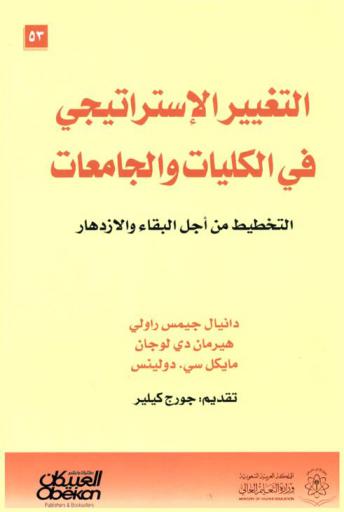
التغيير الاستراتيجي في الكليات والجامعات : التخطيط من أجل البقاء والازدهار
يقوم المؤلفون في هذا الكتاب بدراسة عملية التخطيط الاستراتيجي من وجهات نظر متعددة، يعرضون من خلالها النظريات و النماذج الإدارية ويقدمون نصائحهم في التخطيط الاستراتيجي بناء على دراسة متعمقة، للوصول إلى إدارة استراتيجية فعالة تواكب التطور والتغير في العالم من حولنا وهذه الإرشادات والملاحظات بمنزلة منارة تضيء الطريق لمن يقتحم مجال العمل في سلك التعليم العالي.
BOOK

Infrared and Raman spectroscopy in forensic science
This book will provide a survey of the major areas in which information derived from vibrational spectroscopy investigations and studies have contributed to the benefit of forensic science, either in a complementary or a unique way. This is highlighted by examples taken from real case studies and analyses of forensic relevance, which provide a focus for current and future applications and developments.
eBook

New Zealand's venomous creatures
Describes NZ's venomous creatures, including their habitats and distribution, the clinical effects of envenoming, and appropriate first aid and definitive medical treatment. Covers katipo and redback spiders, white tailed spider, jellyfish, stingrays, scorpion fish and other venomous fish and sea urchins, and sea snakes. Source: National Library of New Zealand Te Puna Matauranga o Aotearoa, licensed by the Department of Internal Affairs for re-use under the Creative Commons Attribution 3.0 New Zealand Licence.
Journal Article
Ciguatera poisoning: an increasing occurrence in New Zealand
[...]a greater focus on prevention is required. Practitioners, for example, should consider including a discussion of the hazards of ciguatera prior to travel. [...]there is a reliable, widely used method of detecting ciguatoxins in fish, people should be warned to avoid ingestion of large piscivorous fish taken from reef waters in tropical or subtropical regions of the world.
Journal Article