
Catalogue Search | MBRL


Are you sure you want to remove the book from the shelf?

{{itemTitle}}
41
result(s) for
"Michelakis, Pantelis"
Sort by:

The ancient world in silent cinema
\"In the first four decades of cinema, hundreds of films were made that drew their inspiration from ancient Greece, Rome, Egypt and the Bible. Few of these films have been studied, and even fewer have received the critical attention they deserve. The films in question, ranging from historical and mythological epics to adaptations of ancient drama, burlesques, cartoons and documentaries, suggest a fascination with the ancient world that competes in intensity and breadth with that of Hollywood's classical era. What contribution did antiquity make to the development of early cinema? How did early cinema's representations affect modern understanding of antiquity? Existing prints as well as ephemera scattered in film archives and libraries around the world constitute an enormous field of research. This extensively illustrated edited collection is a first systematic attempt to focus on the instrumental role of silent cinema in twentieth-century conceptions of the ancient Mediterranean and Middle East\"-- Provided by publisher.
Book

NAMING THE PLAGUE IN HOMER, SOPHOCLES, AND THUCYDIDES
This article focuses on the language used to describe the plague, and more specifically on the oscillation of its vocabulary between literal and figurative meaning, in Homer’s Iliad (1.1–487), Sophocles’Oedipus the King (1–215), and Thucydides’History of the Peloponnesian War (esp. 2.47.3–2.54). It is argued that the plague spreads in the language of the three narratives by association or contiguity, exploiting existing links with related words, most notably the broader vocabulary of disease and calamity, but it also spreads by analogy, comparison, or similarity, establishing links with other domains such as famine, blight, war and destruction.
Journal Article

The Ancient World in Silent Cinema
In the first four decades of cinema, hundreds of films were made that drew their inspiration from ancient Greece, Rome, Egypt and the Bible. Few of these films have been studied, and even fewer have received the critical attention they deserve. The films in question, ranging from historical and mythological epics to adaptations of ancient drama, burlesques, cartoons and documentaries, suggest a fascination with the ancient world that competes in intensity and breadth with that of Hollywood's classical era. What contribution did antiquity make to the development of early cinema? How did early cinema's representations affect modern understanding of antiquity? Existing prints as well as ephemera scattered in film archives and libraries around the world constitute an enormous field of research. This extensively illustrated edited collection is a first systematic attempt to focus on the instrumental role of silent cinema in twentieth-century conceptions of the ancient Mediterranean and Middle East.
eBook

Theater festivals, total works of art, and the revival of Greek tragedy on the modern stage
The last 150 years have seen a revival of performance of Greek tragedy, and theatre festivals have played an important role in this; especially important were the festivals which began in the last two decades of the 19C and continued up to World War 2. The paper investigates ideological and aesthetic influences on this revival, which does not fit the dominant categories of theatre practice, and argues that such theatre festivals embody political contradictions. There is unresolved tension between festivals' preoccupation with the cultural past and their orientation to the future of the community, and between aspiration to artistic autonomy and embodiment of sociopolitical strategies. The focus is the Bayreuth festival inaugurated in 1876 by Richard Wagner as a modern communal counterpart to the drama of classical Athens, and his \"The Ring of the Nibelungs\" a total work of art akin to Oedipus ; other festivals include that at Syracuse after 1914.
Journal Article


Greece and Rome on Screen
The emergence of cinema creates new possibilities for the representation and conceptualization of Greece and Rome. This chapter concentrates on a small selection of color films produced by the French companies Pathe and Gaumont, and more specifically on the stencil effects used in these films. The chapter discusses small and diverse sample of films that allows us to trace a development in the use of film color from novelty to accepted norm within a relatively short period of intense artistic and technological experimentation with a specific coloring technique. The oscillation between and within different types of polychromy and monochromy informs cinematic representations of antiquity throughout cinema's history. A persistent narrative about early cinema spectatorship focuses on a very different kind of spectator, the naive spectator who runs away in panic from the fast‐approaching train on the screen or who runs towards the screen in an attempt to save the heroine in danger.
Book Chapter
Greek Tragedy
The term ‘Greek tragedy’ is shorthand for a type of theatrical performance most commonly associated with fifth-century Athens. Its golden age roughly overlaps with that of the city, covering the period from the start of the Persian Wars at the beginning of the fifth century to the very end of the Peloponnesian War in the late 400s. Tragedy is the product of a social, political and intellectual milieu associated with the birth of democracy and the political and military supremacy of Athens over the Greek world. Yet tragedy also had a tremendous impact outside Athens and, in the modern world,
Book Chapter
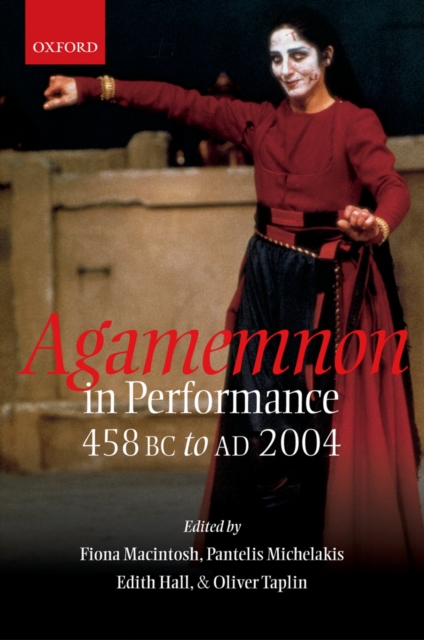
Agamemnon in Performance 458 BC to AD 2004
Aeschylus’ Agamemnon, the first play in the Oresteia trilogy, is one of the most influential theatrical texts in the global canon. In performance, translation, adaptation, along with sung and danced interpretations, it has been familiar in the Greek world and the Roman empire, and from the Renaissance to the contemporary stage. It has been central to the aesthetic and intellectual avant-garde as well as to radical politics of all complexions and to feminist thinking. Contributors to this interdisciplinary collection of eighteen essays on its performance history include classical scholars, theatre historians, and experts in English and comparative literature. All Greek and Latin has been translated; the book is generously illustrated, and supplemented with the useful research aid of a chronological appendix of performances.
eBook