
Catalogue Search | MBRL


Are you sure you want to remove the book from the shelf?

{{itemTitle}}
73
result(s) for
"Millgram, Elijah"
Sort by:


Practical Nihilism
Nihilism about practical reasoning is the thesis that there is no such thing as practical rationality—as rationally figuring out what to do. While other philosophers have defended a theoretically oriented version of the thesis, usually called “error theory”, a case is made for a fully practical version of it: that we are so bad at figuring out what to do that we do not really know what doing it right would so much as look like. In particular, much of our control of instrumental (or means-end) rationality is illusory, and we are almost entirely incompetent at managing the defeating conditions of our practical inferences—that is, of knowing when not to draw an apparently acceptable conclusion. If that is right, then instead of trying to reason more successfully, we should be trying to make failure pay.
Journal Article
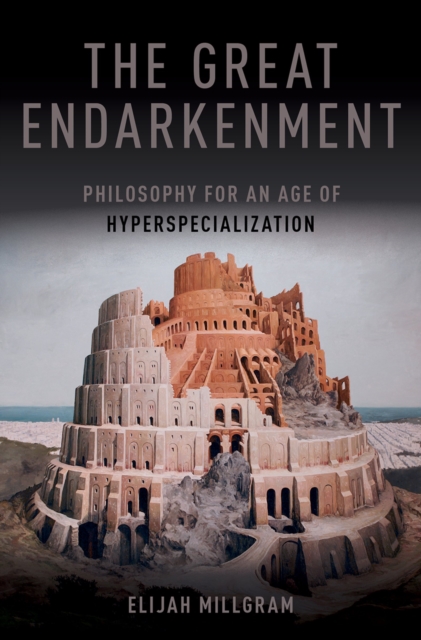
The Great Endarkenment
Philosophers have not appreciated how pervasive and deep division of labor is, and consequently they have not noticed the many intellectual devices deployed in managing it. The Great Endarkenment makes the case that those devices are central pieces of puzzles that have traditionally been on philosophers' agendas.
eBook

HYPOPHILOSOPHY
The more obvious forms of corruption are often preceded and explained by the etiolation of a practice: as its participants lose track of the point of their activities, their moral immune system is disabled. The argument is developed via a case study, philosophy itself. After advancing the hypothesis that philosophy is in the first instance the machine tool industry of the intellect—that its task is making the intellectual tools that make the intellectual tools—we consider what becomes of such an enterprise when this objective slips out of focus.
Journal Article


LIBERTY, THE HIGHER PLEASURES, AND MILL'S MISSING SCIENCE OF ETHNIC JOKES
Aggregation-friendly moral theories such as classical utilitarianism are forced to invest a great deal of ingenuity in damping out and modulating the effects of welfare aggregation. In Mill's treatment, the problem famously appears as the puzzle of how the Principle of Liberty is meant to be compatible with the Principle of Utility, and there have been a great many attempted interpretations of his solution, all, in my view, unsatisfactory. I will first reconstruct Mill's generally unnoticed account of the psychological implementation of higher pleasures; this will allow me to explain what the distinction between higher and lower pleasures was, and how Mill was introduced lexical preference orderings into his theory. Then I will show how the underlying psychological theory permits Mill to argue for the lexical priority of liberty over the goods which liberty allows us to obtain. Finally, I will turn to the Millian considerations omitted from the argument I will have reconstructed. By way of explaining why they are so difficult to accommodate, I will consider why Mill might have abandoned his projected sciences of character. I will take my leave by asking what Mill's failure to turn his implementation analysis of the higher pleasures into an argument expressing the importance of individuality and originality means for us.
Journal Article

On Being Bored out of Your Mind
The contemporary philosophical debate over practical reasoning-over how one ought to figure out what to do-has been almost entirely focused on whether there is more to it than means-ends reasoning. But a prior and very difficult question has to do with why instrumental deliberation is so important an aspect of our cognitive life (regardless of whether there is anything else). I consider an answer broached by Harry Frankfurt, that having ends is the alternative to being literally bored out of one's mind, and adapt an argument from John Stuart Mill's political and psychological writings to show what more there is to not being bored than just having something to aim for.
Journal Article

Relativism, Coherence, and the Problems of Philosophy
The eventual topic of this paper is the perhaps grandiose question of whether we have any reason to think that philosophical problems can be solved. Philosophy has been around for quite some time, and its record is cause for pessimism: it is not, exactly, that there are no established results, but that what results there are, are negative (such-and-such is false, or will not work) or conditional (as Ernest Nagel used to say, “If we had ham, and if we had eggs, then we’d have ham and eggs”).¹ I hope in what follows, first of all, to explain the record.
Book Chapter

Kantian Crystallization
Millgram comments on J. David Velleman's view on Kantian crystallization. Velleman has produced an account, while announcing itself as an appropriation of Murdoch, and denying that it is advocating 'overevaluation and transference,' ends up as Kantian crystallization, that is, treating empirical persons as the occasions for fantasies of Kantian practical rationality.
Journal Article