
Catalogue Search | MBRL


Are you sure you want to remove the book from the shelf?

{{itemTitle}}
50
result(s) for
"Mitrani, Judith L"
Sort by:

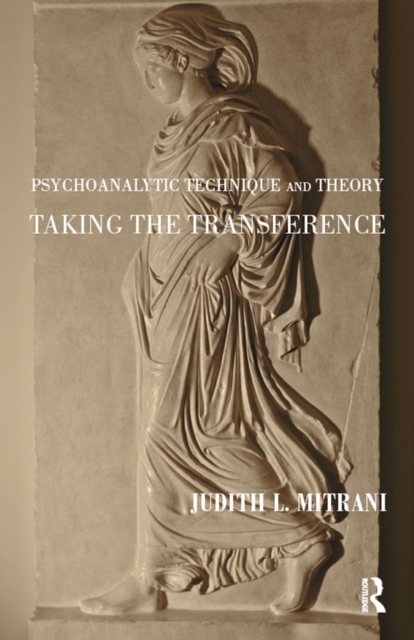
Psychoanalytic Technique and Theory
This volume consists of a series of essays inspired by Freud's paper on Jensen's novel Gradiva - \"she who steps along.\" In the story a young archaeologist, Norbert Hanold, suffers from delusions but is able to unravel the mysteries of his emotional life and mind with the aid of a woman who does not challenge these delusions, but rather \"steps along\" with Hanold, gradually helping him to disentangle truth from fantasy, through what Freud called \"cure by love\". Gradiva, originally felt to be the source of Hanold's malady, eventually becomes the agent of its resolution and of his return to health. This extraordinary tale formed the basis for the author's concept of \"taking the transference\". Through clinical vignettes, various aspects of psychoanalytic technique - useful from the first encounter between patient and analyst and throughout the process of the development of mind to termination - are illustrated in detail.
eBook

A framework for the imaginary
An extraordinary depiction of one analyst's efforts to receive and respond to the vivid impressions of her patients raw and sometimes even unmentalized experiences as they are highlighted in the transference-countertransference connection. Mitrani attempts to feel, suffer, mentally transform, and, finally, verbally construct for and with the patient possible meanings for those immediate versions of lifes earliest experiences as they are re-enacted in the therapeutic relationship.She uses insights from this therapeutic work to contribute to the metapsychology of British and American object relations as well as to the psychoanalytic theory of technique. In these eleven essays, Dr Mitrani masterfully integrates the work of Klein, Winnicott, Bion and Tustin as she leads us on an expedition through primitive emotional territories. She clears the way toward detecting and understanding the survival function of certain pathological manoeuvres deployed by patients when confronted by unthinkable anxieties. In her vivid accounts of numerous clinical cases, she provides and demonstrates the tools needed to effect a transformation of unmentalized experiences within the context of the therapeutic relationship.
eBook

Trying to enter the long black branches: Some technical extensions of the work of Frances Tustin for the analysis of autistic states in adults
The author suggests a number of technical extensions/clinical applications of Frances Tustin's work with autistic children, which are applicable to the psychoanalysis of neurotic, borderline and psychotic adults. These are especially relevant to those individuals in whom early uncontained happenings (Bion) have been silently encapsulated through the use of secretive autosensual maneuvers related to autistic objects and shapes. Although such encapsulations may constitute obstacles to emotional and intellectual development, are consequential in both the relational and vocational spheres for many analysands and present unending challenges for their analysts, the author demonstrates ways in which it may be possible to detect and to modify these in a transference-centered analysis. A detailed process of differential diagnosis between autistic states and neurotic/narcissistic (object-related) states in adults is outlined, along with several clinical demonstrations of the handling of a variety of elemental terrors, including the 'dread of dissolution.' The idiosyncratic and perverse use of the analytic setting and of the analyst and issues of the analysand's motivations are considered and illustrated. A new model related to 'objects in the periphery' is introduced as an alternative to the more classical Kleinian models regarding certain responses and/or non-responses to transference interpretation. Issues a propos the countertransference are also taken up throughout.
Journal Article
Some technical implications of Klein's concept of 'premature ego development'
In this paper, the author revisits the problem of 'premature ego development' first introduced by Melanie Klein in 1930. She also highlights several developments in post-Kleinian thinking since the publication of that paper, which can be seen as offshoots of or complements to Klein's work. The author proposes a link between this category of precocious development and the absence of the experience of what Bion termed the 'containing object.' She puts forward several technical considerations relevant to analytic work with patients who suffer as a result of early developmental failures and presents various clinical vignettes in order to demonstrate the ways in which these considerations take shape in the analytic setting.
Journal Article
Bodily centered protections in adolescence: An extension of the work of Frances Tustin
In this paper, the author discusses the recurrence of infantile, proto-mental functioning in adolescence mainly in the context of the work of Frances Tustin. She demonstrates, through clinical example, how the tendency to resort to bodily centered and sensation-dominated protections is reactivated on a grand scale when the internal and external physical and psychological changes, brought on in puberty, are felt to be potentially overwhelming. She also demonstrates how, when the capacity for adequate mental and emotional development is stultified, sensation and action once again come to the rescue as the adolescent's way of attenuating anxieties unconsciously experienced as resonating with those unmentalized happenings of early infancy and how the psychoanalytic relationship may be pivotal in setting previously derailed mental and emotional growth back on track.
Journal Article

Minding the gap between neuroscientific and psychoanalytic understanding of autism
The Rome studies attest to thepossibility that neural as well as emotional and mental development that has been thwarted, stagnated, and distorted on all scales and measures can be stimulated and supported through psychoanalytic therapy. In this chapter, the author demonstrates how the findings of one group of neuroscientists in Parma, Italy regarding a special class of brain cells called \"mirror neurons,\" and the work of researchers at the University of California in San Diego have been applied to the problem of autism. She believes these might intersect with Frances Tustin's discoveries about the nature, function, and meaning of psychogenic autism in children and even autistic states in neurotic adults. F. Tustin underscored the fact that the protective shell of autism constitutes a barrier to the potentially healing effects of human relationships and what W. R. Bion called \"learning from experience.\" The author concludes with a coherent picture of various dimensions of autistic phenomenon and points toward new areas for discussion and study.
Book Chapter
The past presented: bodily centered protections in puberty and adolescence
This chapter focuses on the reoccurrence of infantile proto-mental functioning that can be observed in some patients in puberty and in adolescence. It demonstrates how the infantile tendency to resort to bodily centered protections is reactivated at a time when the enormous internal and external physical and psychological changes brought on in puberty once more threaten the individual with catastrophe. The tendency to resort to bodily centered protections seems often to be reactivated on a grand scale when the enormous internal and external physical and psychological changes brought on in puberty are felt as catastrophic. In the case of the patient Cathy, the chapter demonstrates how, when the capacity for adequate mental and emotional development is stultified, sensation and action one again come to the rescue as the young adult's way of attenuating the nameless dreads of adolescence, heaped upon and resonating with those happenings from earlier developmental times.
Book Chapter
Surviving unthinkable trauma: dissociation, delusion, and hallucination in Life of Pi
In this chapter, the author suggests that Pi's elaborate hallucination begins to break down as he slumbers and perhaps dreams in safety, high in the trees surrounded by \"mere\" cats. Investigators from the Japanese shipping company interviewed Pi while he recovered in the Mexican hospital. Amidst the chaos on deck, Pi is hurled into a lifeboat that drops like a stone into the storm-tossed sea as the freighter begins to founder. However, when traumatic happenings occur during adolescence, the ascendance of the \"psychotic part of the personality\" may reach extremes. Like the novelist in the film, some may choose the conclusion drawn by the Japanese investagators and written in the shipping company's final report: as improbable and fantastic as the story of the animals and the island seem to them, they opt for this tale when the truth of the loss and lonliness bourn by Pi are truly unthinkable.
Book Chapter
\Trying to Enter The Long Black Branches\: some technical extensions for the analysis of autistic states in adults from the work of Frances Tustin
This chapter outlines some criteria to keep in mind while discriminating autistic states from those more truly object-related states. A familiarity with the concepts of autistic objects and autistic shapes is helpful in this effort as is our sensitivity to the existential terrors inherent in both the pre-mature awareness of two-ness and the ecstasy of at-one-ment. The chapter demonstrates some of the ways in which Frances Tustin's innovations have and are continuing to open up new possibilities for deepening the analyst's comprehension of those persons in whom unmentalized happenings have been silently encapsulated through the use of autosensual maneuvers. Tustin discovered that autistic children use ordinary objects not in the course of child's play as a mode of communication, but for the sensations that these objects engender on the surface of their skin. In contrast, in an autistic state, normal \"flickering states of awareness of otherness\" are unable to be endured.
Book Chapter