
Catalogue Search | MBRL


Are you sure you want to remove the book from the shelf?

{{itemTitle}}
32
result(s) for
"Molineux, Matthew"
Sort by:

Professional identity measures for student health professionals – a systematic review of psychometric properties
Background
Professional identity is critical to the safe and effective clinical practice of all health professions. University programs play an important role in the formation of professional identity of students, and so it essential to understand professional identity at this stage of students’ development. However, the majority of research into professional identity has been conducted using the qualitative paradigm so further quantitative analysis through the use of psychometrically-sound professional identity measures is required. This study aimed to identify professional identity measures used with university students enrolled in health programs and synthesise the evidence of their psychometric properties.
Methods
The systematic review was conducted in two phases. Phase 1 involved searching five online databases for studies that used professional identity measures with student health professionals. These studies were assessed against a priori criteria for inclusion and a list of measures was identified. Phase 2 involved searching the same databases for psychometric evidence of the measures identified in Phase 1. The psychometric properties of each measure were compared against the Consensus-based standards for the Selection of Health Measurement Instruments (COSMIN) checklist. Data were narratively synthesised, and comparisons were made between measures.
Results
Phase 1 identified eight professional identity measures. Phase 2 identified a total of 15 studies that evaluated the psychometric properties of at least one of the professional identity measures. There was a paucity of psychometric evidence for the measures. The revised Nurses’ Professional Values Scale and Macleod Clark Professional Identity Scale had the greatest volume of psychometric evidence. None of the measures fulfilled all criteria in the COSMIN checklist.
Conclusion
There is a paucity of evidence underpinning the psychometric of professional identity measures. Evidence which uses these measures should be interpreted with caution. Further research is warranted to ensure that the results of quantitative professional identity studies are valid and reliable.
Journal Article

Refining a capability development framework for building successful consumer and staff partnerships in healthcare quality improvement: A coproduced eDelphi study
Background The capability of consumers and staff may be critical for authentic and effective partnerships in healthcare quality improvement (QI). Capability frameworks describe core knowledge, skills, values, attitudes, and behaviours and guide learning and development at individual and organizational levels. Objective To refine a capability framework for successful partnerships in healthcare QI which was coproduced from a scoping review. Design A two‐round eDelphi design was used. The International Expert Panel rated the importance of framework items in supporting successful QI partnerships, and suggested improvements. They also rated implementation options and commented on the influence of context. Participants Seven Research Advisory Group members were recruited to support the research team. The eDelphi panel included 53 people, with 44 (83%) and 42 (77. 8%) participating in rounds 1 and 2, respectively. They were from eight countries and had diverse backgrounds. Results The Research Advisory Group and panel endorsed the framework and summary diagram as valuable resources to support the growth of authentic and meaningful partnerships in QI across healthcare contexts, conditions, and countries. A consensus was established on content and structure. Substantial rewording included a stronger emphasis on growth, trust, respect, inclusivity, diversity, and challenging the status quo. The final capability development framework included three domains: Personal Attributes, Relationships and Communication, and Principles and Practices. The Equalizing Decision Making, Power, and Leadership capability was foundational and positioned across all domains. Ten capabilities with twenty‐seven capability descriptions were also included. The Principles and Practices domain, Equalizing Decision Making, Power, and Leadership capability, and almost half (44.4%) of the capability descriptions were rated as more important for staff than consumers (p < .01). However, only the QI processes and practices capability description did not meet the inclusion threshold for consumers. Thus, the framework was applicable to staff and consumers. Conclusion The refined capability development framework provides direction for planning and provision of learning and development regarding QI partnerships. Patient or Public Contribution Two consumers were full members of the research team and are coauthors. A Research Advisory Group, inclusive of consumers, guided study execution and translation planning. More than half of the panel were consumers.
Journal Article

‘Making little ethical decisions all the time’: examining an ethical framework for consumer and community involvement in research, a co-produced ethnographic study
Background
Consumer and community involvement (CCI) is widely recognised as an ethical imperative in health and biomedical research. However, there is a lack of evidence and guidance regarding ethical approaches. The aim of this research was to test and refine an existing ethical framework for consumer partnerships in research to enhance understanding of ethical issues and approaches to CCI in research.
Methods
A sub-analysis of a co-produced ethnographic study which explored the processes and outcomes of consumer engagement over three and a half years in a PhD research partnership, was conducted against an existing ethical framework for CCI. The framework included organisational ethics, research integrity, relational ethics, and research ethics. Participants included four consumers, two academics, and a PhD candidate in an Australian capital city. Two consumer co-researchers collaborated in this study across the research cycle. Data were obtained over three and a half years from six interviews, six focus groups, monthly online logs, field notes, and a reflexive diary. Descriptive statistics and qualitative content analysis were used to analyse 2035 units of data.
Findings
A total of 1911 (93.9%) units of data aligned to an ethical category. Hence, the research team were constantly encountering ethical decision-making. A combination of organisational ethics and relational ethics was most frequently coded (30.1%,
n
= 576), followed by relational ethics alone (24.3%,
n
= 465), and research integrity and relational ethics (
n
= 229, 12.0%). Qualitative analysis identified some ethical tensions and many more practical and planned ethical approaches to support meaningful research partnership and positive research processes and outcomes. Examples and quotes are provided against each of the four ethical categories to illustrate and expand on the framework. An update to the framework is provided.
Conclusions
The updated framework highlighted the complexities of CCI and focused beyond traditional research ethics to include relationships, organisational factors, and research integrity. The narrative of ethical issues being a challenge to overcome in CCI, needs to change. An emphasis on adopting a proactive approach to promote ethical and authentic team power sharing, reflection, and active communication is needed.
Journal Article

Collective occupation in public spaces and the construction of the social fabric
Background. Contemporary research is expanding understandings of occupation beyond that of the individual's doing, including the shared and social nature of occupation. The concept of collective occupation has been introduced to capture this broader understanding. Purpose. This study aimed to explicate the concept of occupation in a Greek town. Method. Ethnographic methodology was used and primary data were collected through observation, participation, and informal interviews. Analysis involved a hermeneutic process to develop a narrative of occupation in the town, including action, setting, and plots. Findings. Occupation, a dynamic and multidimensional process, served to maintain the self, family, and social fabric and balance between and within them. Collective occupation maintained the social fabric through three forms: informal daily encounters in public spaces, organization and associations, and celebration and commemoration. Implications. Occupational therapists may consider engaging with the potential power of such collective occupation when working toward social change to enable just and inclusive societies.
Journal Article

Flipped classroom experiences: student preferences and flip strategy in a higher education context
Despite the popularity of the flipped classroom, its effectiveness in achieving greater engagement and learning outcomes is currently lacking substantial empirical evidence. This study surveyed 563 undergraduate and postgraduate students (61 % female) participating in flipped teaching environments and ten convenors of the flipped courses in which the student sample was enrolled. Results suggest that higher education students can be differentiated based on their preferences for elements of a flipped classroom, resulting in two clusters of students: those who embrace most aspects of a flipped classroom environment as well as prefer it (labelled \"Flip endorsers\") and those who are close to neutral on some elements of a flipped classroom environment but who especially do not endorse the pre-learning aspects (labelled \"Flip resisters\"). Flip endorsers were found to have more positive attitudes towards the course activities (both pre-class and in-class) and to have felt more involved and engaged in the content. These findings shed some light on the types of students who might prefer flipped classrooms, but more importantly identify those who are likely to resist a change to a flipped classroom environment. The findings also suggest that although students may find the flipped classroom more difficult, student outcomes and active participation in class activities do improve when course convenors (a) use a theoretical perspective to inform their flipped teaching strategy, (b) integrate assessment into the design of their flipped classroom, and (c) flip the entire course. (HRK / Abstract übernommen).
Journal Article

‘Learning and growing together’: exploring consumer partnerships in a PhD, an ethnographic study
Background
Consumer and community involvement (CCI) in health research is increasingly recognised as best practice and is closely linked with calls for epistemic justice and more transparent university collaborations with consumers. Given doctoral candidates play a key role in the future of co-production, examination of consumer partnerships in PhDs is important. This study aimed to describe and evaluate consumer partnerships in a PhD from the perspective of the consumer co-researchers, the PhD candidate, and the academic supervisors including optimal approaches, impacts, and benefits and challenges.
Methods
This prospective, co-produced ethnographic study was conducted over 33 months. Data collection included field notes, a monthly online log of partnership experiences and time spent, interviews or a focus group every six months, and a PhD student reflexive diary. Qualitative data were analysed using reflexive thematic analysis.
Results
The student, two academics, and four consumer co-researchers were involved. A mean of 11.10 h per month were spent on CCI. The student spent the most time (mean 15.86 h per month). Preparation for dissemination of findings was the most frequent partnership activity. The two overarching themes emphasised that a PhD promotes a rich partnership ethos with the student at the centre and that the partnership was a worthwhile but challenging process. The four sub-themes highlighted that developing a collegial and supportive environment with regular meetings combined with a multi-faceted and responsive co-learning approach were core to success. Additionally, there were benefits for individuals, research processes and outcomes, and for driving change in consumer-academic research partnerships. Recruiting to and forming the partnership, maintaining the collaboration through inevitable changes and challenges, and an ethical and supportive closure of the research team were critical.
Conclusions
This longitudinal ethnographic study demonstrated that doctoral research can create a rich ethos for research and knowledge co-production which evolved over time. Equalising power dynamics through relationship building and co-learning was critical. Additionally, a focus on supportively ending the partnership was essential, and CCI may reduce PhD student isolation and procrastination. Enhanced university incentivisation of co-production in health research is recommended to address gaps in consumer remuneration and student support.
Plain Language summary
Partnering with people who use health services, their families, and the community (consumers) to do research is ethically the right thing to do and leads to better research. Unfortunately, it often does not happen, and researchers are not sure how to do it. To change this, we want researchers to partner with consumers early in their research career, when they are doing a PhD. However, there is limited evidence about this topic. This study described and evaluated a partnership from the viewpoints of the PhD student, the university supervisors (academics), and the consumer co-researchers over 33 months. We found that the whole team learned and grew together, and that the longer-term learning environment of a PhD helped foster a more equal partnership. The partnership was enjoyable and provided many benefits to those involved and to the studies. Much time was spent sharing research in ways that were better for consumers such as social media, newsletters, and presentations. At the start of the partnership, it was important to set up the team for success and there were many challenges along the way which needed flexibility. It was important to prepare for the ending of the PhD so that everyone felt supported to move on. Two big challenges were that the university did not have resources such as templates or courses to help the student learn about partnerships and did not have dedicated funding to pay the consumers for their time.
Journal Article

Experiences of occupational therapy education: contexts, communities and social occupational therapy
[...]occupational therapy educators have been challenged to create curricula that meet the profession's social responsibility by preparing students to practice with communities and populations in a contextualised way. The courses include topics such as: working in micro to macro contexts, working with communities and populations, collective occupation, politics and advocacy, social justice, occupational justice, social security and others. Palavras-chave: Formação, Terapia Ocupacional/Tendencias, Meio Social, Papel Profissional. 1Introduction The education of occupational therapists has been changing around the world, with a push for new-graduates to emerge with a strong sense of social responsibility, responsiveness to contextual determinants of occupational performance and engagement, and the ability to apply this knowledge to promote social justice, occupational justice (Townsend & Marval, 2013; Sakellariou & Pollard, 2013), and citizenship (Lopes, 2016). The courses \"Understanding the Context of Occupation\" and \"Occupation, Health and Participation - Communities and Populations\" at Griffith University, Australia; and the course \"Social Occupational Therapy\", at Federal University of Sao Carlos, Brazil, are presented with the central goal of providing some insights into how these occupational therapy courses are integrating the exploration of contextual factors from the macro to the micro into occupational therapy education.
Journal Article

Co-produced capability framework for successful patient and staff partnerships in healthcare quality improvement: results of a scoping review
BackgroundInternationally, patient and public involvement (PPI) is core policy for health service quality improvement (QI). However, authentic QI partnerships are not commonplace. A lack of patient and staff capability to deliver successful partnerships may be a barrier to meaningful QI collaboration.ObjectivesThe research questions for this scoping review were: What is known regarding the capabilities required for healthcare staff and patients to effectively partner in QI at the service level?; and What is known regarding the best practice learning and development strategies required to build and support those capabilities?MethodsA six-stage scoping review was completed. Five electronic databases were searched for publications from January 2010 to February 2020. The database searches incorporated relevant terms for the following concepts: capabilities for PPI in healthcare QI; and best practice learning and development strategies to support those capabilities. Data were analysed using descriptive statistics and qualitative content analysis.ResultsForty-nine papers were included. Very little peer-reviewed literature focused explicitly on capabilities for QI partnerships and thus implicit paper content was analysed. A Capability framework for successful partnerships in healthcare quality improvement was developed. It includes knowledge, skills and attitudes across three capability domains: Personal Attributes; Relationships and Communication; and Philosophies, Models and Practices, and incorporates 10 capabilities. Sharing power and leadership was discussed in many papers as fundamental and was positioned across all of the domains. Most papers discussed staff and patients’ co-learning (n=28, 57.14%). Workshops or shorter structured training sessions (n=36, 73.47%), and face-to-face learning (n=34, 69.38%) were frequently reported.ConclusionThe framework developed here could guide individualised development or learning plans for patient partners and staff, or could assist organisations to review learning topics and approaches such as training content, mentoring guidelines or community of practice agendas. Future directions include refining and evaluating the framework. Development approaches such as self-reflection, communities of practice, and remote learning need to be expanded and evaluated.
Journal Article

Standing Firm on Shifting Sands
This article is an edited transcript of an invited keynote presentation at the New Zealand Association of Occupational Therapists Conference on Friday, 10 September, 2010. It draws on material presented as a keynote presentation entitled 'Reconnecting with occupation: Now or never?' at the OT Australia Western Australia Conference, Perth, Australia on Friday, 30 July, 2010 and develops ideas published as Molineux, M. (2004). Occupation in occupational therapy: A labour in vain? In M. Molineux (Ed.), Occupation for Occupational Therapists (pp. 1-14). Oxford: Blackwell Publishing.
Journal Article
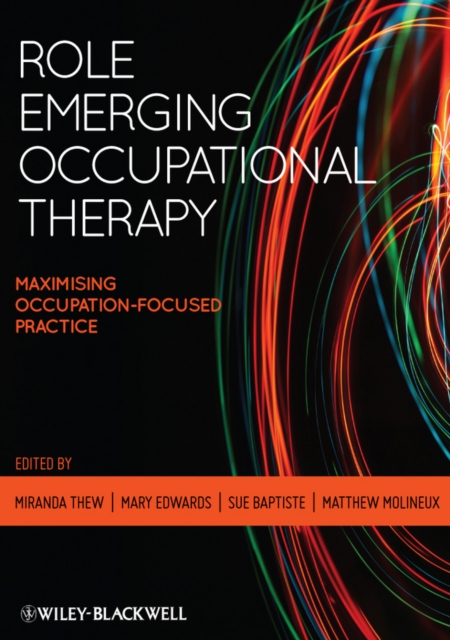
Role emerging occupational therapy
Role Emerging Occupational Therapy: Maximising Occupation Focused Practice is written for an audience of occupational therapy practitioners, educators and students.
This text offers an exploration of emerging innovative directions for the profession of occupational therapy with a focus upon the theory and application of role emerging placements.
The book affords the reader an opportunity to explore how occupation focused practice can be applied to a wide variety of settings and circumstances in order to improve the health and well-being of a diverse range of people. Chapters cover relevant theory as well as offering practical guidance with examples drawn from the experiences of university educators, occupational therapists, setting/service providers and students.
The book describes, explores and discusses both the potential and ramifications of role emerging practice on the occupational therapy profession and offers a vision for the future of the profession that reflects current occupational, social and health needs.
eBook