
Catalogue Search | MBRL


Are you sure you want to remove the book from the shelf?

{{itemTitle}}
53
result(s) for
"Monforte, Sergio"
Sort by:

Syntactic analyses of discourse particles through the microvariation of Basque ote
In this article I look into dialectal data related to Basque discourse particles and I provide evidence that topics discussed in the literature on discourse particles can also be addressed within Basque microvariation. Four syntactically different types of the particle ote are examined: first, the general pattern found in all dialects where ote functions as a head and occupies a position in the TP-domain; second, the use typical of the eastern dialects where ote behaves as a maximal projection and is located in the CP-domain; furthermore, the configuration formed by wh-words and the discourse particle ote only found in the North-Eastern Basque; and, finally, a novel type of ote only used in the far east of the Eastern Basque (included the Souletin Basque, Amikuze’s variety and also the disappeared variety from the Roncalese valley) which functions as a sentence final particle occurring after all constituents of the clause and, apparently, conveying an intersubjective interpretation, unlike its canonical behaviour. Along with the syntactic data, phonological-prosodic and interpretational evidence also point to the same direction, i.e. to differentiate those four types of ote. This microvariation displayed by the particle ote allows us to compare the different syntactic statuses and positions claimed for discourse particles side by side in the same language; thus, the analysis of their separate properties attains a significant improvement.
Journal Article

Question particles in Basque
This article proposes separate analyses for the question particles -a and al in Basque, which occur only in polarity questions, within the framework of Generative Grammar. I will propose that the former one, used in the eastern dialects, is the head of FiniteP and that the latter one, used in the central dialects, occupies the head of Particle Phrase located between TP and the CP field. I provide the following evidence in support of this dual analysis: 1) -a can be used with ote but no other particle can appear at the same time with al; 2) al is compatible with allocutivity but -a is not; 4) and, finally, al can be used in embedded clauses, whereas -a cannot. The fact that -a is not allowed to occur in indirect questions and that it is incompatible with the allocutive verbal paradigm shows that it is in complementary distribution with the head of CP and, therefore, that -a occupies such a head; on the other hand, the impossibility of al to appear with other particles suggest that they must occur in the same position and, since it can appear in embedded questions and with allocutive forms, it does not occupy the head of the CP, but the head of a phrase below.
Journal Article

Euskarazko galderen analisi berri baterantz
Gramatika-lanetan galderek arreta berezia jaso dute, hizkuntzarik hizkuntza parametroak eta mugimenduak edo mugimendurik eza aztertzeko bidea eman dutelako. Euskalaritzan ere ikertu da galderen sintaxia; hala ere, galdera motei batera begiratuz gero, desadostasunak geratzen dira agerian analisien artean. Artikulu honen helburua da galderei analisi bateratua eskaintzea. Horretarako, datu tipologikoetan ez ezik, gramatika sortzaileak eskaintzen dituen baliabideetan ere oinarrituko naiz, eta proposatuko dut perpaus mota Indar eta Jokatutasun buruen artean ezartzen dela, baina galdera mota, ordea, galderetan zehazteko eskatzen den aldagaiaren [nz] edo [pol] tasunek ezartzen dutela.
Journal Article
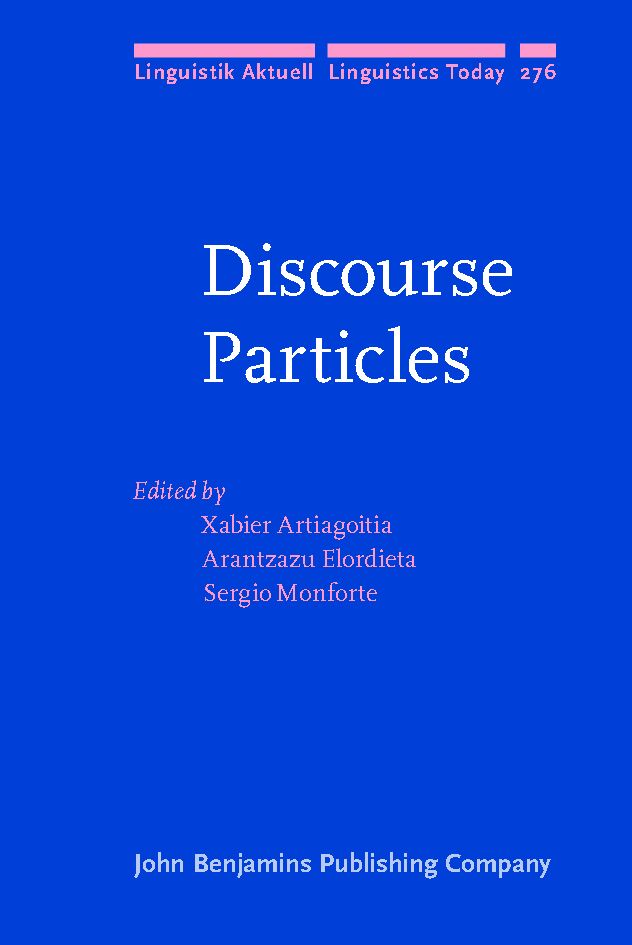
Discourse Particles
Discourse particles have often been treated as a phenomenon restricted to Germanic languages (Abraham 2020) and they still raise questions about their nature as an independent category. This book reveals that this phenomenon exists in other languages as well, and provides evidence for their nature as a separate category.
eBook
Question particles in Basque
This article proposes separate analyses for the question particles -a and al in Basque, which occur only in polarity questions, within the framework of Generative Grammar. I will propose that the former one, used in the eastern dialects, is the head of FiniteP and that the latter one, used in the central dialects, occupies the head of Particle Phrase located between TP and the CP field. I provide the following evidence in support of this dual analysis: 1) -a can be used with ote but no other particle can appear at the same time with al; 2) al is compatible with allocutivity but -a is not; 4) and, finally, al can be used in embedded clauses, whereas -a cannot. The fact that -a is not allowed to occur in indirect questions and that it is incompatible with the allocutive verbal paradigm shows that it is in complementary distribution with the head of CP and, therefore, that -a occupies such a head; on the other hand, the impossibility of al to appear with other particles suggest that they must occur in the same position and, since it can appear in embedded questions and with allocutive forms, it does not occupy the head of the CP, but the head of a phrase below.
Journal Article


Geophysical reconnaissance of the western basin of the Plaine du Nord aquifer, Haiti
A geophysical reconnaissance was conducted to support aquifer characterization and evaluate groundwater potential in the western portion of the Plaine du Nord aquifer to provision the growing water demands of the city of Cap-Haitien in the Republic of Haiti. Hybrid-source audio-magnetotelluric (HSAMT) soundings and gravity measurements were collected to support the Government of Haiti in sourcing additional water supplies for the city. The Plaine du Nord aquifer is poorly characterized considering it is one of Haiti’s largest aquifers, few drilling logs are available, and only one borehole has investigated the deeper extents of the aquifer. HSAMT supports depth profiling of subsurface resistivity, which supports interpretations of geological strata and groundwater conditions. Gravity measurements allow for complementary mapping of Earth density anomalies and contrasts, which assist in interpreting aquifer thicknesses or depth to bedrock. Pairing HSAMT and gravity methods permitted both an estimation of aquifer thickness and relative changes in sediment characteristics. Gravity results allowed for the mapping of aquifer thickness across the study area, with interpreted thickness greater than 300 m in the coastal zone. HSAMT results cross correlated with available well records and enabled the delineation of zones with increased groundwater potential. The results of the combined methods indicate groundwater storage potential of freshwater in deeper alluvium and emphasize the importance of strengthening resource characterization, modelling and monitoring to guide sustainable resource development and management.
Journal Article
Significance of river infiltration to the Port-au-Prince metropolitan region: a case study of two alluvial aquifers in Haiti
Mountain block recharge (MBR) mechanisms are an important component of the water budget for many alluvial aquifers worldwide. The MBR dynamics are complex, difficult to constrain, and quantification is highly uncertain. These challenges are magnified in data-scarce study areas, including the Cul-de-Sac and Leogane plains, two of Haiti’s largest alluvial aquifers, which are flanked by the Massif de la Selle mountain block. The associated groundwater supplies the regional metropolitan area of Port-au-Prince (RMPP) and it is facing increasing pressure, requiring improved understanding of the aquifer system to guide management and protection. This report introduces the aquifers and investigates the significance of river infiltration from flows originating from the mountain block. The approach to derive important insight on recharge included analysis of broad datasets on piezometry, isotopes, hydrochemistry, and streamflow. The findings indicate that river infiltration is a major source of recharge to the alluvial aquifers. Grise and Blanche river infiltration may account for >80% of recharge to the Cul-de-Sac aquifer, exhibiting temporal variation correlated to climate events such as cycles of the El Niño/La Niña Southern Oscillations. Momance and Rouyone river infiltration may account for >50% of recharge to the Leogane aquifer. The results direct attention to the Massif de la Selle carbonate aquifer system, where bulk recharge is estimated to be four times greater than both alluvial aquifers. The Massif not only supplies the RMPP with ~65% of its water supply from karst springs, but its streamflow also recharges the alluvial aquifers that supply the balance of RMPP supply.
Journal Article
Topical Collection: Advancements in hydrogeological knowledge of Haiti for recovery and development
Haiti’s groundwater resources are poorly understood and scarcely researched, despite their importance as the principal source for water supply. The knowledge gap and its role of inhibiting informed relief, recovery and investments in development are described, along with an update on progress towards the UN Sustainable Development Goals. This essay leads a topical collection of seven articles that advance hydrogeological knowledge of Haiti. Additional data, research and monitoring are identified as urgently needed for the nation’s sustainable development.
Journal Article