
Catalogue Search | MBRL


Are you sure you want to remove the book from the shelf?

{{itemTitle}}
27
result(s) for
"Mooney, Gavin H"
Sort by:


The Health of Nations
Why, despite vast resources being expended on health and health care, is there still so much ill health and premature death? Why do massive inequalities in health, both within and between countries, remain? In this devastating critique, internationally renowned health economist Gavin Mooney places the responsibility for these problems firmly at the door of neoliberalism. Mooney analyses how power is exercised both in health-care systems and in society more generally. In doing so, it reveals how too many vested interests hinder efficient and equitable policies to promote healthy populations, while too little is done to address the social determinants of health. Instead, Mooney argues, health services and health policy more generally should be returned to the communities they serve. Taking in a broad range of international case studies - from the UK to the US, South Africa to Cuba - this provocative book places issues of power and politics in health care systems centre stage, making a compelling case for the need to re-evaluate how we approach health care globally.
eBook
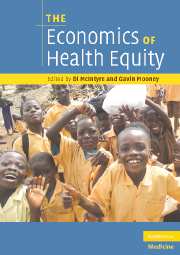
The Economics of Health Equity
This book is about equity in health and health care. It explores why, despite being seen as an important goal, health equity has not made more progress within countries and globally, and what needs to change for there to be greater success in delivering fairness. An international team of eminent experts from primarily the field of health economics describe how equity in health and health care might develop over the next decade. They examine existing and past barriers to promoting equity, citing case examples, and covering issues including access to health services and inequalities between and within countries. The analyses are detailed, but the issues are approached in an accessible fashion, highlighting the factors of common international relevance. This book provides a manifesto for achieving health equity for the future. It will be essential reading for health and social policy makers, and health academics nationally and internationally.
eBook

Claims on health care: a decision-making framework for equity, with application to treatment for HIV/AIDS in South Africa
Trying to determine how best to allocate resources in health care is especially difficult when resources are severely constrained, as is the case in all developing countries. This is particularly true in South Africa currently where the HIV epidemic adds significantly to a health service already overstretched by the demands made upon it. This paper proposes a framework for determining how best to allocate scarce health care resources in such circumstances. This is based on communitarian claims. The basis of possible claims considered include: the need for health care, specified both as illness and capacity to benefit; whether or not claimants have personal responsibility in the conditions that have generated their health care need; relative deprivation or disadvantage; and the impact of services on the health of society and on the social fabric. Ways of determining these different claims in practice and the weights to be attached to them are also discussed. The implications for the treatment of HIV/AIDS in South Africa are spelt out.
Journal Article

Whose health service is it anyway?
Many Australian citizens seem to want more health services than are currently available. There may well be many other 'stakeholders' -- politicians, doctors, nurses, patients, patient advocacy groups, or the media -- who agree with this wish, but this doesn't stop governments holding a tight rein on health spending. Furthermore, healthcare spending decisions made within budgetary constraints are not generally made in close consultation with the community. Here the authors examine the arguments for drawing the community into the decision-making process. Citizens' juries are one way of introducing greater democracy into health service decision making. In 2000 and again in 2001, under the auspices of the Medical Council of Western Australia, citizens' juries were trialled in Western Australia (Medical Council of Western Australia 2000, 2001).
Journal Article

The economics of health equity
This book is about equity in health and health care. It explores why, despite being seen as an important goal, health equity has not made more progress within countries and globally, and what needs to change for there to be greater success in delivering fairness. An international team of eminent experts from primarily the field of health economics describe how equity in health and health care might develop over the next decade. They examine existing and past barriers to promoting equity, citing case examples, and covering issues including access to health services and inequalities between and within countries. The analyses are detailed, but the issues are approached in an accessible fashion, highlighting the factors of common international relevance. This book provides a manifesto for achieving health equity for the future. It will be essential reading for health and social policy makers, and health academics nationally and internationally
Book

Is it not time for health economists to rethink equity and access?
This article considers two key issues in health economics regarding the question of equity. First, why have health economists not resolved better the issue of what are equity and access? Second, the paper draws attention to the relative lack of analyses of equity concerns outside of health care. The question of whose values should prevail in equity is also addressed. On the first issue, there is an obsession with quantification in economics with the result that in analysing equity, in practice often ‘use’ has been substituted for ‘access’. The problem of defining access has thereby been by-passed. This has taken the pressure off trying to research access per se. Second, what is meant by equity and access are in part culturally determined. The continued efforts of health economists to treat equity as some universal construct are misplaced. The lack of effort on the part of health economists to look at equity more broadly than health care equity is concerning. Certainly, to be pursued in practice, equity in both health and health care need a shift in resources, which will be opposed by those who exercise power over decision making in health care and in society more generally. Currently health economists’ analyses say all too little about power and property rights in health care and in society. It is argued that the relevant citizens or communities which a health service serves are best placed to judge the access barriers they face and their relative heights. A useful definition of equity established by a citizens’ jury in Perth, Australia is used to exemplify this point. It is concluded that the often all too simplistic equity goals adopted in health economics (and sometimes public health discourse) need to be challenged. For health economists, there is a need for more of us to get involved in the issues around inequalities, class and power and the impact of these on health.
Journal Article


Cost-benefit analysis and medical ethics
The issue of assessing priorities is one that has become the subject of much debate in the National Health Service particularly in the wake of various documents on priorities from central Government. It has become even more so with the prospect of real cuts in expenditure. Economists claim that their science, or perhaps more accurately art can assist in determining not only how best to achieve various ends but also whether and to what extent competing objectives should be pursued. Such choices cannot be made in the absence of some ethical considerations and it is important that health service decision makers (and in particular the medical profession) are aware if the relationship between economics (and especially cost-benefit analysis) and medical ethics.
Journal Article