
Catalogue Search | MBRL


Are you sure you want to remove the book from the shelf?

{{itemTitle}}
167
result(s) for
"Moreira, Artur"
Sort by:

Integra Project: strengthening social participation in the agenda of health policies, services, and technologies
The 16th National Health Conference illustrated the interest of health councils to intervene in public policies in order to guarantee the right to health technologies. The INTEGRA project (Integration of policies for Health Surveillance, Pharmaceutical Care, Science, Technology, and Innovation in Health) is a partnership among the National Health Council, the National School of Pharmacists, and the Oswaldo Cruz Foundation (Fiocruz), with support from the Pan American Health Organization (PAHO), with the goal of strengthening participation and social engagement in the theme, as well as the integration of health policies and practices within different sectors of society (social movements, health councils, and health professionals), with the various stages related to the access to medicines (research, incorporation, national production, and services) being the main theme in the context of the COVID-19 pandemic. It seeks to offer training for leadership groups in the health regions and activities with a broad national and political scope, and it hopes to establish an intersectorial and integrated network of leaders capable of acting collaboratively to defend the development of science, public policies, national sovereignty, and social control of health.The 16th National Health Conference illustrated the interest of health councils to intervene in public policies in order to guarantee the right to health technologies. The INTEGRA project (Integration of policies for Health Surveillance, Pharmaceutical Care, Science, Technology, and Innovation in Health) is a partnership among the National Health Council, the National School of Pharmacists, and the Oswaldo Cruz Foundation (Fiocruz), with support from the Pan American Health Organization (PAHO), with the goal of strengthening participation and social engagement in the theme, as well as the integration of health policies and practices within different sectors of society (social movements, health councils, and health professionals), with the various stages related to the access to medicines (research, incorporation, national production, and services) being the main theme in the context of the COVID-19 pandemic. It seeks to offer training for leadership groups in the health regions and activities with a broad national and political scope, and it hopes to establish an intersectorial and integrated network of leaders capable of acting collaboratively to defend the development of science, public policies, national sovereignty, and social control of health.
Journal Article
SFML game development
SFML Game Development is a fast-paced, step-by-step guide, providing you with all the knowledge and tools you need to create your first game using SFML 2.0.SFML Game Development addresses ambitious C programmers who want to develop their own game. If you have plenty of ideas for an awesome and unique game, but don’t know how to start implementing them, then this book is for you. The book assumes no knowledge about SFML or game development, but a solid understanding of C is required.
eBook
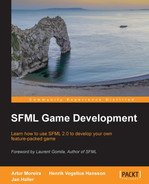
SFML Game Development
SFML Game Development is a fast-paced, step-by-step guide, providing you with all the knowledge and tools you need to create your first game using SFML 2.0.SFML Game Development addresses ambitious C++ programmers who want to develop their own game. If you have plenty of ideas for an awesome and unique game, but don't know how to start implementing them, then this book is for you. The book assumes no knowledge about SFML or game development, but a solid understanding of C++ is required.
eBook

Economic Sustainability Models for Land Uses on Rural Territory – The Case of Cork Oak
This thesis evaluates the economic viability of five land-use systems - maritime pine, eucalyptus, cork oak, olive groves, and solar panels - through growth, financial, and geospatial modelling. For forestry cultures, APIs linked to StandsSIM and SUBER 5.0 simulators were used to simulate and assess profitability of Mação’s management approach and provide recommendations. The case of the cork oak is included in this section and is the main focus of this document. The remaining work was conducted by other group members as part of the common group component. Olive groves were assessed across three cultivation systems to balance profitability and sustainability. Solar farms were evaluated using GIS and financial models, identifying optimal sites based on socio-environmental, location and climate. Findings highlight strategies for sustainable resource use, improved land-use practices, and renewable energy development in Mação.
Dissertation

EVIDENCIAÇÃO DO ESTADO DA ARTE DA AVALIAÇÃO DA SEGURANÇA DO TRABALHO EM EMPREENDIMENTOS DA CONSTRUÇÃO CIVIL
The construction industry is characterized as an important source of investment and high labor absorption. However, limited standardization of work associated with frequent improvisation and timing of decision making in this activity has generated a number of injuries incompatible with other productive activities in Brazil. This perverse environment led to the establishment in Brazil, in the 1970's, of mandatory Professional Security Experts to mitigate the damages resulting from accidents. The authors identified 21 articles in line with the topic of interest. Then, through bibliometric analysis, this portfolio showed that: 1. The most relevant publication was the Journal of Construction Engineering and Management, although not the highest impact factor. 2. The article Mohamed S (2003) Scorecard approach to benchmarking organizational safety culture in construction J. Constr. Eng. Manag. 129: 80-88 showed the highest scientific recognition. 3. The authors Fang and Hinze were highlighted in the portfolio and its references, respectively. 4. The most frequent keywords found were \"security\" and \"construction industry\" and \"construction.\"
Journal Article

Science Popularization as a Pedagogical Strategy for Food Security, Biodiversity and Socioterritorial Inclusion in the State of Rio De Janeiro
Objective: This study analyzes the popularization of science as a pedagogical strategy for food security, biodiversity, and socioterritorial inclusion in traditional and vulnerable communities of the state of Rio de Janeiro, Brazil. Theoretical Framework: Grounded in the pedagogy of Paulo Freire, the agroecology of Miguel Altieri, and the concept of development as freedom by Amartya Sen, the framework articulates ethnoscience, food sovereignty, the ecology of knowledges of Boaventura de Sousa Santos, and the critical environmental education of Isabel Cristina de Moura Carvalho, fostering social technologies. Method: A qualitative and participatory methodology was employed, including diagnosis, workshops, and practical activities. The initiative involved quilombola communities, artisanal fishers, women artisans’ groups, and vulnerable urban residents. Data were collected through observation and discussion circles. Results and Discussion: Strengthening of community autonomy, improvements in food security, and sustainable income generation were observed. Technologies such as micro-sprinkler irrigation optimized water use and supported learning. The discussion validates the pedagogical approach and its social impact. Research Implications: Practical implications highlight pathways for inclusion, income generation, and quality of life. Theoretically, the study validates the integration of knowledge for critical environmental education and territorial development. Originality/Value: This research innovates by integrating science popularization, social technologies, and participatory pedagogies to foster community empowerment. It demonstrates the role of science in promoting sustainable practices that are replicable and capable of driving social transformations in vulnerable territories.
Journal Article

Projeto Integra: fortalecimento da participação social na agenda das políticas, serviços e tecnologias em saúde
Resumo A 16ª Conferência Nacional de Saúde demonstrou o interesse do controle social em intervir sobre as políticas públicas a fim de garantir o direito às tecnologias de saúde. O projeto Integra - Integração das Políticas de Vigilância em Saúde, Assistência Farmacêutica, Ciência, Tecnologia e Inovação em Saúde -, nasce da parceria entre o Conselho Nacional de Saúde, a Escola Nacional dos Farmacêuticos e a Fundação Oswaldo Cruz (Fiocruz), com apoio da Organização Pan-Americana de Saúde (OPAS) com objetivo de fortalecimento da participação e engajamento social na temática e a integração das políticas e práticas de saúde em diferentes setores da sociedade (movimentos sociais, controle social e profissionais de saúde), tendo as diversas etapas relacionadas ao acesso aos medicamentos (pesquisa, incorporação, produção nacional e serviços) como mote principal, no cenário da pandemia de COVID-19. Oferta-se, neste projeto, capacitação para grupos de lideranças nas regiões de saúde e atividades de grande abrangência nacional e política. Espera-se alcançar o estabelecimento de uma rede intersetorial, integrada de lideranças capazes de atuar colaborativamente para a defesa do desenvolvimento da ciência, das políticas públicas, da soberania nacional e do controle social da saúde. Abstract The 16th National Health Conference illustrated the interest of health councils to intervene in public policies in order to guarantee the right to health technologies. The INTEGRA project (Integration of policies for Health Surveillance, Pharmaceutical Care, Science, Technology, and Innovation in Health) is a partnership among the National Health Council, the National School of Pharmacists, and the Oswaldo Cruz Foundation (Fiocruz), with support from the Pan American Health Organization (PAHO), with the goal of strengthening participation and social engagement in the theme, as well as the integration of health policies and practices within different sectors of society (social movements, health councils, and health professionals), with the various stages related to the access to medicines (research, incorporation, national production, and services) being the main theme in the context of the COVID-19 pandemic. It seeks to offer training for leadership groups in the health regions and activities with a broad national and political scope, and it hopes to establish an intersectorial and integrated network of leaders capable of acting collaboratively to defend the development of science, public policies, national sovereignty, and social control of health.
Journal Article

EVIDENCIACAO DO ESTADO DA ARTE DA AVALIACAO DA SEGURANCA DO TRABALHO EM EMPREENDIMENTOS DA CONSTRUCAO CIVIL
The construction industry is characterized as an important source of investment and high labor absorption. However, limited standardization of work associated with frequent improvisation and timing of decision making in this activity has generated a number of injuries incompatible with other productive activities in Brazil. This perverse environment led to the establishment in Brazil, in the 1970's, of mandatory Professional Security Experts to mitigate the damages resulting from accidents. The authors identified 21 articles in line with the topic of interest. Then, through bibliometric analysis, this portfolio showed that: 1. The most relevant publication was the Journal of Construction Engineering and Management, although not the highest impact factor. 2. The article Mohamed S (2003) Scorecard approach to benchmarking organizational safety culture in construction J. Constr. Eng. Manag. 129: 80-88 showed the highest scientific recognition. 3. The authors Fang and Hinze were highlighted in the portfolio and its references, respectively. 4. The most frequent keywords found were \"security\" and \"construction industry\" and \"construction.\"
Journal Article