
Catalogue Search | MBRL


Are you sure you want to remove the book from the shelf?

{{itemTitle}}
68
result(s) for
"Morin, Karen M."
Sort by:
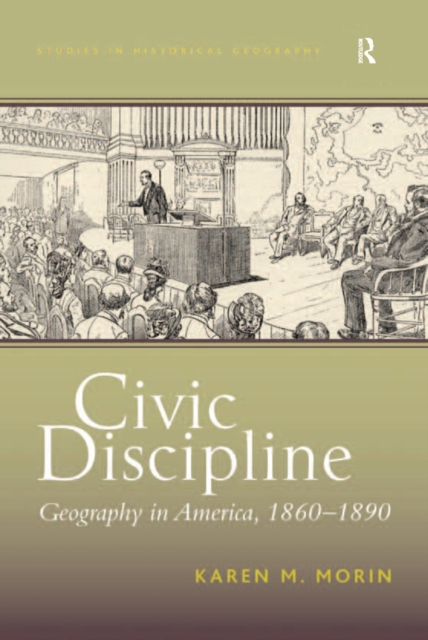
Civic Discipline
The American Geographical Society (AGS) is the oldest professional geographical organization in the United States (established in 1851), and was the pre-eminent such society in the 19th century. This project explores how geographical knowledge and practices were understood, took shape, and made publicly available via the AGS and Charles P. Daly, the Society's president for 35 years (1864-1899).
eBook

The late-modern American jail: epistemologies of space and violence
One of the most troubling aspects of current trends in American mass incarceration is the extent to which 'criminality' is produced within prison walls, primarily in the form of inmate–inmate or inmate–staff assaults. Most methods of prison or jail control have the adverse, and perverse, effect of increasing inmates' levels of fear, terror, and ultimately violence – with stabbings, beatings, and other types of assaults common occurrences. The design of podular 'direct supervision' jails and their accompanying philosophies of punishment aspire to change these conditions. Direct supervision features correctional officers inside each housing unit with no physical barriers impeding supervision, and is intended to create a safe, more humane, stress-free environment for both inmates and staff. This study draws on ethnographic evidence of inmate experiences with direct supervision at Douglas County Department of Corrections in Omaha, Nebraska (USA). The respondents generally do feel safe in this jail environment, for a combination of reasons, some of which are related to spatial design. Inmates identified a number of implications – gains and losses – of this more 'humane' form of incarceration in terms of power and empowerment. The study also documents the potential for inmate activism on their own behalf through this design.
Journal Article

Geographical literacies and their publics
Morin examines how Americans' geographic ignorance presents a problem for studies of American geographical literacy and awareness, and raises serious questions about relationships between academic geography and various publics. She also draws attention to the fact that such discussions around geographical literacy carry significant implications beyond American borders, specifically in how arguments for tackling illiteracy are often associated with particular pro-American narratives and ambitions.
Journal Article

Paradigm Dramas in American Geography
The author wants to first offer a sincere thanks to all the commentators for taking the time to read her book and for providing such collegial and provocative comments about it. She did not intend to write a biography of Charles Daly, nor did she intend to write a history of the American Geographical Society. Her interest began with what she saw as a missing piece, a relatively unstudied period in the history of American geography before it was codified as an academic discipline and before the National Geographic Society and later the Association of American Geographers came on the scene. The research took shape then around the nodal figure of Daly as one very powerful influence on nineteenth-century geography. It became a story about how Daly's geographical sensibility and imagination, situated within other social parameters -- American expansionism, industrialization, and urbanization -- manifested in social and commercial projects, at home and abroad.
Journal Article

Charles P. Daly's Gendered Geography, 1860-1890
The American Geographical Society (AGS) serves as a case study for considering the nature of \"gendered geography\" in the nineteenth-century United States. This article links the ideals and programmatic interests of the society-which were fundamentally commercial in nature-with the personal subjectivity of its chief protagonist, Charles P. Daly, AGS president from 1864 until his death in 1899. Daly is presented as an \"armchair explorer\" who shifted the focus of the society away from statistical representations of the world toward the action-packed narrative descriptions of the world supplied by embodied explorers in the field. The gender dynamics associated with the center versus the field provide a useful way to contrast both sides of Daly's persona-as a scholar performing detached, careful study yet someone who also derived a great deal of personal authority by staging popular and dramatic spectacles in New York City, speechifying and presenting himself on stage at geographical society meetings with returning heroic explorers. Daly not only served as New York's most influential access point to the Arctic at the time, he also served as an important node in the reproduction of masculine culture in promotion of a particularly masculinist commercial geography.
Journal Article
The late‐modern A merican jail: epistemologies of space and violence
One of the most troubling aspects of current trends in A merican mass incarceration is the extent to which ‘criminality’ is produced within prison walls, primarily in the form of inmate–inmate or inmate–staff assaults. Most methods of prison or jail control have the adverse, and perverse, effect of increasing inmates' levels of fear, terror, and ultimately violence – with stabbings, beatings, and other types of assaults common occurrences. The design of podular ‘direct supervision’ jails and their accompanying philosophies of punishment aspire to change these conditions. Direct supervision features correctional officers inside each housing unit with no physical barriers impeding supervision, and is intended to create a safe, more humane, stress‐free environment for both inmates and staff. This study draws on ethnographic evidence of inmate experiences with direct supervision at D ouglas County Department of Corrections in O maha, N ebraska ( USA ). The respondents generally do feel safe in this jail environment, for a combination of reasons, some of which are related to spatial design. Inmates identified a number of implications – gains and losses – of this more ‘humane’ form of incarceration in terms of power and empowerment. The study also documents the potential for inmate activism on their own behalf through this design.
Journal Article
Peak Practices: Englishwomen's \Heroic\ Adventures in the Nineteenth-Century American West
Many Englishwomen explored the mountainous regions of the American West in the 1870s, 1880s, and 1890s, hiking and taking excursions into popular tourist destinations such as the Rocky Mountains and Yosemite Valley. This paper examines the writings of seven women who toured these regions and published accounts of their journeys. These elite international travelers produced a complex array of gendered subjectivities in their writings. They represented themselves as actively \"conquering\" mountain peaks as well as passively waiting for the men to do it, as fearing danger and fatigue but also ridiculing the incompetency of local male guides, and as \"resisting\" adventure, yet expressing female empowerment and abandonment in it. The paper problematizes \"feminine\" codes of behavior, first-wave feminism, and convergence of these within nineteenth-century British imperialism and narratives of adventure, to show how conventional as well as more transgressive discourses of Victorian womanhood worked with imperialist, nationalist, and class discourses. I examine what the women wrote about both the indoor spaces of mountainous landscapes and their outdoor mountaineering adventures. In many ways, the women reinscribed themselves as feminine domestic subjects in wilderness environments, yet they also explored and contested the powerful inscriptions of conventional Victorian womanhood.
Journal Article

British Women Travellers and Constructions of Racial Difference Across the Nineteenth-Century American West
At a time coinciding historically with the height of the British Empire, the immigrants' rush to occupy American West lands and the wholesale removal of Native Americans onto reservations, encounters between Native peoples and British women travellers became emblematic of a whole range of socio-spatial relationships of domination, subordination and resistance. In this paper, I examine representations of western Native Americans in the travelogues of ten British women travellers to the late nineteenth-century American West, produced primarily during encounters at sites along the western rail lines. Constructions of racial and gender differences in the texts can be tied to British colonial discourses, as well as to the social relations inherent in the multiple contact zones within which the encounters took place.
Journal Article
New York City's Friend of Labor: Geography and Urban Social Reform
Charles Daly's work occupies a unique place in the annals of New York City as he combined his vision for social reform within early urban geography and city planning. His leadership in an eclectic array of civic and reform causes coalesced with his work in geography. Particularly with respect to city improvement in street sanitation and tenement housing Daly attempted to direct and improve the lives of target groups largely by improving the spaces they inhabited. Yet Daly also aligned himself with a number of civic organizations whose ambitions focused on improving the workplaces and neighborhoods of the laboring classes and immigrants. The legitimacy Daly enjoyed as a friend of labor derived from his own background as a former laborer, and from the fact that he advanced into the professional class. In many speeches and interviews Daly referred to the importance of his background as a carpenter and mechanic's apprentice for his self-development.
Book Chapter
Charles P. Daly's Gendered Geography
This chapter examines the relationship between statistics and geography, as perceived by American Geographical and Statistical Society (AGS) men. Daly's AGS presidency that the official orientation of the society moved away from its statistical focus. His quick ascension from member of the AGS in 1855, to councilor three years later, and to President until his death, says much about his personal appeal to AGS men. When the AGS and Charles Daly came onto the scene, the country was just beginning to recover from the devastations of the Civil War and the militaristic mindset it engendered. It argues that the content of the knowledge they produced was shaped at least in part by the social contours of masculinity and manhood inherent within their milieu. Many scholars of masculinity point to the importance of the Civil War in shaping American men's notions of manliness in the second half of the nineteenth century.
Book Chapter