
Catalogue Search | MBRL


Are you sure you want to remove the book from the shelf?

{{itemTitle}}
147
result(s) for
"Moser, Robert G."
Sort by:


Electoral Systems and Political Context
Electoral Systems and Political Context illustrates how political and social context conditions the effects of electoral rules. The book examines electoral behavior and outcomes in countries that use 'mixed-member' electoral systems – where voters cast one ballot for a party list under proportional representation (PR) and one for a candidate in a single member district (SMD). Based on comparisons of outcomes under the two different rules used in mixed-member systems, the book highlights how electoral systems' effects – especially strategic voting, the number of parties and women's representation – tend to be different in new democracies from what one usually sees in established democracies. Moreover, electoral systems such as SMDs are usually presumed to constrain the number of parties irrespective of the level of social diversity, but this book demonstrates that social diversity frequently shapes party fragmentation even under such restrictive rules.
eBook

Electoral systems and political context : how the effects of rules vary across new and established democracies
\"This book highlights how new and established democracies differ from one another in the effects of their electoral rules\"-- Provided by publisher.
Book

Is Democracy Exportable?
Can democratic states transplant the seeds of democracy into developing countries? What have political thinkers going back to the Greek city-states thought about their capacity to promote democracy? How can democracy be established in divided societies? This books answers these and other fundamental questions behind the concept known as 'democracy promotion.' Following an illuminating concise discussion of what political philosophers from Plato to Montesquieu thought about the issue, the authors explore the structural preconditions (culture, divided societies, civil society) as well as the institutions and processes of democracy building (constitutions, elections, security sector reform, conflict, and trade). Along the way they share insights about what policies have worked, which ones need to be improved or discarded, and, more generally, what advanced democracies can do to further the cause of democratization in a globalizing world. In other words, they seek answers to the question, Is democracy exportable?
eBook
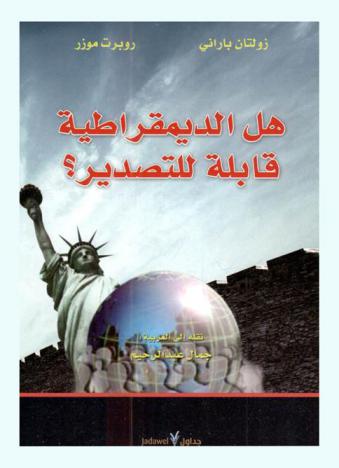
هل الديمقراطية قابلة للتصدير ؟
هو عبارة عن جهد قامت به مجموعة من علماء السياسة، وهم زولتان باراني، شيري بيرمان، نانسي بيرميو، جون م. كاري، دانيال تشيروت، ستيفن إ. فينكل، م. ستيفن فيش، إدوارد د مانسفيلد، روبرت موزر، توماس ل. بانغل أنيبال بيريز- لينيان، مارك ف. بلاتنر، آدم ب. سيليغمان، ميتشيل أ. سليغسون وجاك سنايد، حرر الكتاب زولتان باراني - روبرت موزر ونقله إلى العربية جمال عبد الرحيم؟ حمل الكتاب مجموعة من الأسئلة المهمة، أبرزها هل بإمكان الدول الديمقراطية ازدراع بذور الديمقراطية في الدول النامية؟.
Book

Electoral Systems and the Representation of Ethnic Minorities: Evidence from Russia
Does proportional representation produce greater minority representation than single member districts? This question can be studied through the ethnic background of legislators elected in the two tiers of the mixed electoral system in Russia. In general, there is no significant difference
in the level of minority representation in proportional representation and single member district contests. However, electoral systems have different effects for different ethnic groups. Proportional representation does not provide increased minority representation in party systems devoid
of ethnic parties. Moreover, the relationship between minority representation and electoral system is conditioned by the minorities' demographic and cultural characteristics.
Journal Article

Between Science and Engineering: Reflections on the APSA Presidential Task Force on Political Science, Electoral Rules, and Democratic Governance
Political scientists have contributed to the world of electoral systems as scientists and as engineers. Taking stock of recent scientific research, we show that context modifies the effects of electoral rules on political outcomes in specific and systematic ways. We explore how electoral rules shape the inclusion of women and minorities, the depth and nature of political competition, and patterns of redistribution and regulation, and we consider institutional innovations that could promote political equality. Finally, we describe the diverse ways that political scientists produce an impact on the world by sharing and applying their knowledge of the consequences of electoral rules and global trends in reform.
Journal Article

Electoral Systems and the Number of Parties in Postcommunist States
Scholars studying electoral systems have consistently found that single-member plurality elections tend to constrain the number of parties operating in a polity to a much greater extent than multimember proportional representation systems. This article tests this hypothesis in the post-communist context by examining the effects of proportional representation and single-member district elections on the number of parties in five postcommunist states. It is shown that some postcommunist states, most notably Poland and Hungary, have followed the standard pattern of party consolidation over time in reaction to incentives of electoral systems, while others, most notably Russia and Ukraine, have not. The author argues that the different effects of electoral systems can be attributed to different levels of party institutionalization found in postcommunist states. These findings have policy implications. Under conditions of extreme party underdevelopment, the electoral system that promotes the use of party labels—proportional representation—may be more effective than the plurality system in constraining the number of parties, provided a legal threshold is used. This runs counter to the conventional wisdom that plurality elections offer the greatest constraint on the number of parties.
Journal Article

Strategic Ticket Splitting and the Personal Vote in Mixed-Member Electoral Systems
This article examines ticket splitting in five different mixed-member electoral systems--Germany, New Zealand, Japan, Lithuania, and Russia--and indicates the shortcomings inherent in any analysis of such ticket splitting that does not take into account the presence of the personal vote. We find that the personal vote plays a central part in shaping ticket splitting in all of our cases except for Germany, a heavily party-oriented system in which we find evidence of only a weak personal vote but evidence of substantial strategic voting.
Journal Article
Independents and Party Formation: Elite Partisanship as an Intervening Variable in Russian Politics
The development of Russian parties is more dependent on institutions and elite actions than on social cleavages, and, despite being generally weak, parties can play a significant role in Russia's postcommunist transition. It was hypothesized that elite partisanship varies with the level of urbanization and candidates' electoral resources. As an independent variable, elite partisanship was expected to have a positive influence on voter turnout. In an analysis of Russia's 1993 and 1995 single member district elections, elite partisanship was not strongly related to the level of urbanization but was affected by candidates' occupational backgrounds, and elite partisanship had a positive effect on voter turnout after controlling for urbanization.
Journal Article