
Catalogue Search | MBRL


Are you sure you want to remove the book from the shelf?

{{itemTitle}}
5
result(s) for
"Moser, Robert G., 1966-"
Sort by:


Electoral Systems and Political Context
Electoral Systems and Political Context illustrates how political and social context conditions the effects of electoral rules. The book examines electoral behavior and outcomes in countries that use 'mixed-member' electoral systems – where voters cast one ballot for a party list under proportional representation (PR) and one for a candidate in a single member district (SMD). Based on comparisons of outcomes under the two different rules used in mixed-member systems, the book highlights how electoral systems' effects – especially strategic voting, the number of parties and women's representation – tend to be different in new democracies from what one usually sees in established democracies. Moreover, electoral systems such as SMDs are usually presumed to constrain the number of parties irrespective of the level of social diversity, but this book demonstrates that social diversity frequently shapes party fragmentation even under such restrictive rules.
eBook

Electoral systems and political context : how the effects of rules vary across new and established democracies
\"This book highlights how new and established democracies differ from one another in the effects of their electoral rules\"-- Provided by publisher.
Book

Is Democracy Exportable?
Can democratic states transplant the seeds of democracy into developing countries? What have political thinkers going back to the Greek city-states thought about their capacity to promote democracy? How can democracy be established in divided societies? This books answers these and other fundamental questions behind the concept known as 'democracy promotion.' Following an illuminating concise discussion of what political philosophers from Plato to Montesquieu thought about the issue, the authors explore the structural preconditions (culture, divided societies, civil society) as well as the institutions and processes of democracy building (constitutions, elections, security sector reform, conflict, and trade). Along the way they share insights about what policies have worked, which ones need to be improved or discarded, and, more generally, what advanced democracies can do to further the cause of democratization in a globalizing world. In other words, they seek answers to the question, Is democracy exportable?
eBook
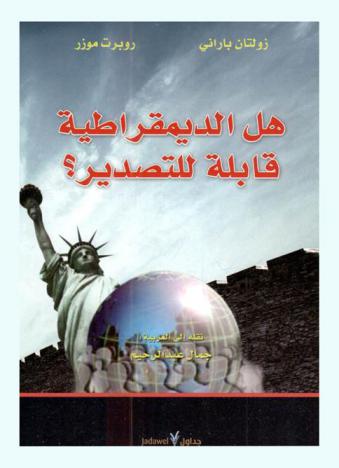
هل الديمقراطية قابلة للتصدير ؟
هو عبارة عن جهد قامت به مجموعة من علماء السياسة، وهم زولتان باراني، شيري بيرمان، نانسي بيرميو، جون م. كاري، دانيال تشيروت، ستيفن إ. فينكل، م. ستيفن فيش، إدوارد د مانسفيلد، روبرت موزر، توماس ل. بانغل أنيبال بيريز- لينيان، مارك ف. بلاتنر، آدم ب. سيليغمان، ميتشيل أ. سليغسون وجاك سنايد، حرر الكتاب زولتان باراني - روبرت موزر ونقله إلى العربية جمال عبد الرحيم؟ حمل الكتاب مجموعة من الأسئلة المهمة، أبرزها هل بإمكان الدول الديمقراطية ازدراع بذور الديمقراطية في الدول النامية؟.
Book