
Catalogue Search | MBRL


Are you sure you want to remove the book from the shelf?

{{itemTitle}}
38
result(s) for
"Moskalenko, Sophia"
Sort by:


Pastels and pedophiles : inside the mind of QAnon
A NEW YORK TIMES EDITORS' PICK / TOP 10 RECOMMENDED READ
Two experts of extremist radicalization take us down the QAnon rabbit hole, exposing how the conspiracy theory ensnared countless Americans, and show us a way back to sanity.
In January 2021, thousands descended on the U.S. Capitol to aid President Donald Trump in combating a shadowy cabal of Satan-worshipping pedophiles. Two women were among those who died that day. They, like millions of Americans, believed that a mysterious insider known as \"Q\" is exposing a vast deep-state conspiracy. The QAnon conspiracy theory has ensnared many women, who identify as members of \"pastel QAnon,\" answering the call to \"save the children.\"
With Pastels and Pedophiles, Mia Bloom and Sophia Moskalenko explain why the rise of QAnon should not surprise us: believers have been manipulated to follow the baseless conspiracy. The authors track QAnon's unexpected leap from the darkest corners of the Internet to the filtered glow of yogi-mama Instagram, a frenzy fed by the COVID-19 pandemic that supercharged conspiracy theories and spurred a fresh wave of Q-inspired violence.
Pastels and Pedophiles connects the dots for readers, showing how a conspiracy theory with its roots in centuries-old anti-Semitic hate has adapted to encompass local grievances and has metastasized around the globe—appealing to a wide range of alienated people who feel that something is not quite right in the world around them. While QAnon claims to hate Hollywood, the book demonstrates how much of Q's mythology is ripped from movie and television plot lines.
Finally, Pastels and Pedophiles lays out what can be done about QAnon's corrosive effect on society, to bring Q followers out of the rabbit hole and back into the light.
eBook

The marvel of martyrdom : the power of self-sacrifice in a selfish world
\"This text examines the psychological effects of martyrdom and martyrs across the world. The authors discuss martyrdom and martyrs through the lens of current events, iconic historical figures, and popular culture\"-- Provided by publisher.
Book

QAnon
QAnon is a baseless and debunked conspiracy theory propagated through Internet social media, with bizarre beliefs that are nevertheless shared by millions of Americans. After the 1/6/2021 Capitol Hill riot, QAnon followers were identified among those breaching the Capitol Hill building, spurring comparisons with ISIS and debates about how to deradicalize QAnon followers. Using the Two-Pyramids model of radicalization in conjunction with polling data, this Research Note highlights the relatively small threat of radical action from QAnon. We argue that deradicalization efforts aimed at QAnon opinions are a waste of resources and potentially dangerous in exaggerating the QAnon threat and increasing Right-Wing perception of government over-reach.
Journal Article

A Formula for Love: Partner Merit and Appreciation Beget Actor Significance
We offer a novel motivational account of romantic love, which portrays it as a means to the end of feeling significant and worthy. According to the model, falling in love with a partner depends on the actor's perceptions that (1) the partner possesses meritorious characteristics, and (2) that they appreciate the actor and view them as significant. We assume that these two factors multiplicatively combine with the magnitude of actor's quest for significance to determine the likelihood of actor becoming enamored with partner. The multiplicative model has two major implications: 1. If any one of the partner's merit , appreciation , or actor's significance quest factors falls below its respective threshold of acceptability (such that it is subjectively non-existent), the likelihood of falling in love will be negligible. 2. Above their acceptability thresholds, levels of (partner's) merit , appreciation and (actor's) significance quest factors compensate for one another. A partner's lower standing on merit or appreciation is compensated in its impact on falling in love by the partner's higher standing on the remaining dimension. Furthermore, lower levels of either or both of these factors are compensated for by the actor's higher level of significance quest. Our model affords a broad account of diverse love phenomena, allows the derivation of several specific hypotheses supported by prior close-relations research as well as new data, and it offers novel avenues for further research on classic issues in romantic love. The discussion considers our model's unique implications and examines its relation to other theories of love.
Journal Article
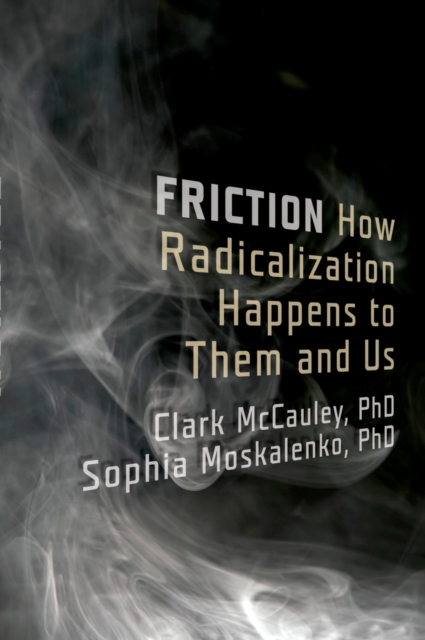
Friction : how radicalization happens to them and us
Friction: How Radicalization Happens to Them and Us identifies the 12 mechanisms of political radicalization that move individuals, groups, and mass publics to increased sympathy and support for political violence. Written by two psychologists who are acknowledged radicalization experts and consultants to the Department of Homeland Security and other government agencies, Friction draws on a pattern of terrorism that played out over a century ago in imperial Russia to illustrate the 12 mechanisms of radicalization and illuminate the strikingly similar patterns of group and individual behavior unfolding today. Taken together, the case histories from the past and present eras show how unexceptional people are moved to exceptional violence in the conflict between states and non-state groups. This sweeping, absorbing narrative provides the context, depth, and insight needed to recognize the psychology behind radicalization, with hope for those working towards peace.
eBook

Characteristics of Lone-Wolf Violent Offenders
This article is based on the idea that lone-wolf terrorists may have characteristics in common with two other types of lone-actor violent offenders: assassins and school attackers. We used data from U.S. Government-sponsored reports to compare the characteristics of these two groups. Despite obvious demographic differences, results indicate four characteristics common for both school attackers and assassins: perceived grievance, depression, a personal crisis (‘unfreezing’), and history of weapons use outside the military. These characteristics may be useful in distinguishing lone-wolfs from group-based terrorists.
Journal Article

Group Identification under Conditions of Threat: College Students' Attachment to Country, Family, Ethnicity, Religion, and University Before and After September 11, 2001
Three classes of introductory psychology students at the University of Pennsylvania completed a survey including several measures of group identification on 20 March 2001, 15 September 2001, and 24 March 2003. Importance of country and university were rated higher four days after the 9/11 terrorist attacks than six months before or 18 months after. Scores on a 9-item scale of identification with country were higher immediately after 9/11 than at the other two assessments. Four theories (group dynamics, CORFing, TMT, SIT) are considered; none predicts the whole pattern of results observed. Discussion highlights group dynamics theory for understanding the increase in identification with country and introduces the possibility that the increase in identification with university might have been a response to experiencing 9/11 as loss of control. Discussion also highlights the value of assessing level of identification with multiple identity groups in order to see the complexity of identity dynamics.
Journal Article
Tracking Radical Opinions in Polls of U.S. Muslims
This Research Note examines two telephone polls (2007, 2011) and three Internet polls (2016) to track opinions of U.S. Muslims relating to the war on terrorism. Results indicate that a small but consistent minority (five to ten percent) justify suicide bombing of civilians in defense of Islam, while those seeing the war on terrorism as a war on Islam have declined from more than half to about a third. This decline coincided with a decline in perception of discrimination against Muslims in the U.S., and correlational results confirm that perceived discrimination is one source of seeing the war on terrorism as a war on Islam. Other results from both the Pew and Internet polls show that disapproval of U.S. foreign policies affecting Muslims also contributes to seeing a war on Islam. Discussion emphasizes the value of Internet polling for tracking shifts in the opinions of U.S. Muslims, but acknowledges that polling has not yet discovered what is different about the small minority who justify suicide bombing.
Journal Article