
Catalogue Search | MBRL


Are you sure you want to remove the book from the shelf?

{{itemTitle}}
6,877
result(s) for
"Most, Glenn W"
Sort by:

Early Greek philosophy
\"The works of the early Greek philosophers are not only a fundamental source for understanding archaic Greek culture and the whole of ancient philosophy, but also a perennially fresh resource that has stimulated Western thought until the present day. This nine-volume edition presents all the major fragments from the sixth to the fourth centuries BC.\"-- Provided by publisher.
BOOK

History of Science and History of Philologies
While both the sciences and the humanities, as currently defined, may be too heterogeneous to be encompassed within a unified historical framework, there is good reason to believe that the history of science and the history of philologies both have much to gain by joining forces. This collaboration has already yielded striking results in the case of the history of science and humanist learning in early modern Europe. This essay argues that first, philology and at least some of the sciences (e.g., astronomy) remained intertwined in consequential ways well into the modern period in Western cultures; and second, widening the scope of inquiry to include other philological traditions in non-Western cultures offers rich possibilities for a comparative history of learned practices. The focus on practices is key; by shifting the emphasis from what is studied to how it is studied, deep commonalities emerge among disciplines—and intellectual traditions—now classified as disparate.
Journal Article


Caligula
The infamous emperor Caligula ruled Rome from A.D. 37 to 41 as a tyrant who ultimately became a monster. An exceptionally smart and cruelly witty man, Caligula made his contemporaries worship him as a god. He drank pearls dissolved in vinegar and ate food covered in gold leaf. He forced men and women of high rank to have sex with him, turned part of his palace into a brothel, and committed incest with his sisters. He wanted to make his horse a consul. Torture and executions were the order of the day. Both modern and ancient interpretations have concluded from this alleged evidence that Caligula was insane. But was he? This biography tells a different story of the well-known emperor. In a deft account written for a general audience, Aloys Winterling opens a new perspective on the man and his times. Basing Caligula on a thorough new assessment of the ancient sources, he sets the emperor's story into the context of the political system and the changing relations between the senate and the emperor during Caligula's time and finds a new rationality explaining his notorious brutality.
eBook

Hesiod
\"This volume, which completes the new Loeb Classical Library edition of Hesiod, contains The Shield and extant fragments of other poems, including the Catalogue of Women, that were attributed to Hesiod in antiquity. None of these is now thought to be by Hesiod himself, but all have considerable literary and historical interest. The Catalogue of Women is a systematic presentation in five books of a large number of Greek legendary heroes and episodes, organized according to the genealogy of the heroes' mortal mothers. The Shield provides a Hesiodic counterpoint to the shield of Achilles in the Iliad, with Heracles as the protagonist. The volume concludes with a comprehensive index to the complete edition.\" --Book jacket.
BOOK


\What Is a Classic Text?\
The question “What is a classic text?” combines in a single formulation what are in fact two distinct questions: a more general one, “What is a text?”, and a more specific one, “What is a classic text?” My remarks consider first the former question and then the latter one. They are personal in nature, based as they are upon my reflection and reading, and upon my practice over the course of many years as a textual philologist specializing in the Western Greco-Roman tradition but at the same time keenly aware of its limits and intensely curious about other traditions. I hope that these remarks will be of interest to people in other fields and other cultures; I am very interested to find out the differences, if any, between the ways I conceive of these matters and the ways that people who have grown up in other traditions do.
Journal Article

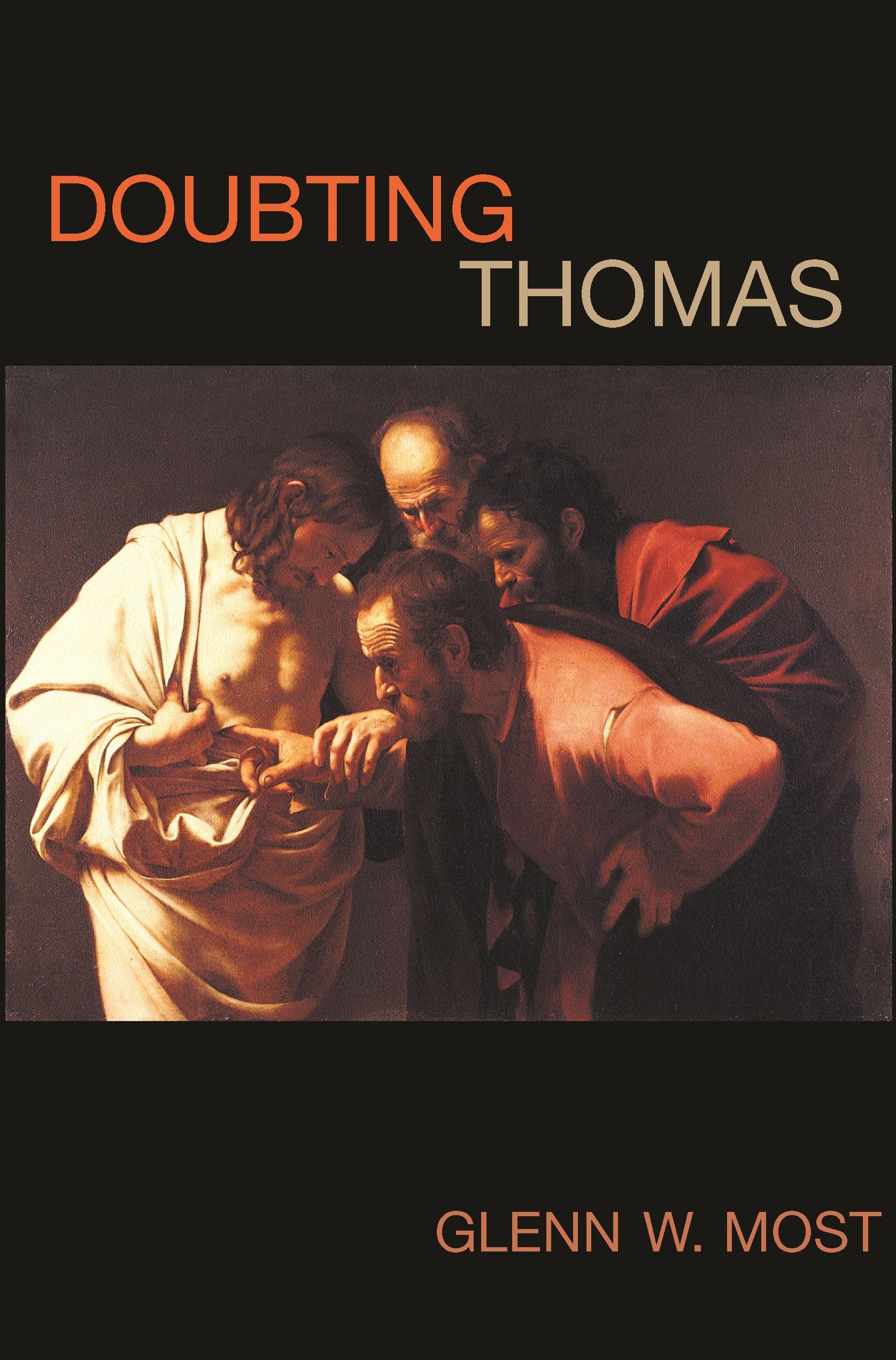
Doubting Thomas
About the disciple known as Doubting Thomas, everyone knows at least this much: he stuck his finger into the risen Jesus' wounds. Or did he? A fresh look at the Gospel of John reveals how little we may really understand about this most perplexing of biblical figures, and how much we might learn from the strange twists and turns Thomas's story has taken over time.
From the New Testament, Glenn W. Most traces Thomas's permutations through the centuries: as Gnostic saint, missionary to India, paragon of Christian orthodoxy, hero of skepticism, and negative example of doubt, blasphemy, stupidity, and violence. Rife with paradoxes and tensions, these creative transformations at the hands of storytellers, theologians, and artists tell us a great deal about the complex relations between texts and their interpretations—and about faith, love, personal identity, the body, and twins, among other matters.
Doubting Thomas begins with a close reading of chapter 20 of the Gospel of John, set against the conclusions of the other Gospels, and ends with a detailed analysis of the painting of this subject by Caravaggio, setting it within the pictorial traditions of late antiquity, the Middle Ages, and the Renaissance. Along the way, Most considers narrative reactions to John's account by storytellers of various religious persuasions, and Christian theologians' interpretations of John 20 from the second century ad until the Counter-Reformation. His work shows how Thomas's story, in its many guises, touches upon central questions of religion, philosophy, hermeneutics, and, not least, life.
eBook