
Catalogue Search | MBRL


Are you sure you want to remove the book from the shelf?

{{itemTitle}}
193
result(s) for
"Motyl, Alexander J"
Sort by:


Putin's Russia as a fascist political system
There is a broad consensus among students of contemporary Russia that the political system constructed by Vladimir Putin is authoritarian and that he plays a dominant role in it. By building and expanding on these two features and by engaging in a deconstruction and reconstruction of the concept of fascism, this article suggests that the Putin system may plausibly be termed fascist. Not being a type of group, disposition, politics, or ideology, fascism may be salvaged from the conceptual confusion that surrounds it by being conceived of as a type of authoritarian political system. Fascism may be defined as a popular fully authoritarian political system with a personalistic dictator and a cult of the leader—a definition that makes sense conceptually as well as empirically, with respect to Putin's Russia and related fascist systems.
Journal Article

Russia's Engagement with the West
The Putin and Bush presidencies, the 9/11 attack, and the war in Iraq have changed the dynamics of Russian-European-US relations and strained the Western alliance. Featuring contributions by leading experts in the field, this work is the first systematic effort to reassess the status of Russia's modernization efforts in this context. Part I examines political, economic, legal, and cultural developments in Russia for evidence of convergence with Western norms. In Part II, the contributors systematically analyze Russia's relations with the European Union, Eastern Europe, Central Asia, and the United States in light of new security concerns and changing economic and power relationships.
eBook

THE SURREALISM OF REALISM: Misreading the War in Ukraine
Most general readers following events in Ukraine may not be aware that much of the debate and many of the policy prescriptions among \"experts\" have been dominated by a school of thought in international relations scholarship known as \"realism.\" In a nutshell, realists have argued that US policy toward the Russo-Ukrainian conflict should be driven by pragmatic American interests and by the realities of Russia's regional great-power status -- two propositions few would disagree with. Realist arguments become more controversial, however, when they go on to insist that Russia's behavior toward Ukraine is actually a reasonable response to Western attempts to wrest Ukraine from Russia's sphere of influence and that the culprit behind the ongoing Russo-Ukrainian war is, thus, the West in general and the US and NATO in particular. Realists can be found on the right (Henry Kissinger and Nikolas K. Gvosdev), on the left (Stephen F. Cohen and Michel Chossudovsky), and in the center (John J. Mearsheimer and Stephen M. Walt).
Journal Article
PUTIN'S ZUGZWANG: The Russia-Ukraine Standoff
The choice of outcome in the Russia-Ukraine standoff is largely Vladimir Putin's. Ukraine and the West are not powerless, but they can at most anticipate, prepare for, and deter what might be Putin's next move. This does not mean that they are victims of superior statecraft, however. His admirers may regard Putin as a master strategist, whose petulance and unpredictability give him the upper hand in relations with the West and Ukraine. In fact, the opposite is true. Putin has maneuvered himself, and Russia, into a position of Zugzwang -- a chess term denoting a condition in which one's king has to move, but cannot, because any move would result in check. Putin has twisted himself into policy as well as rhetorical knots as a result of his absurd insistence that Ukraine's post-Yanukovych government is unconstitutional. If Russia continues to rattle sabers, threaten to invade, and foment unrest in Ukraine's southeast, there will be cold war.
Journal Article
FASCISTOID RUSSIA: Whither Putin's Brittle Realm?
The massive demonstrations that rocked Russia in the aftermath of the Duma elections of Dec 4, 2011, surprised everyone, including most Russians. But they shouldn't have. The conditions for such an upheaval have been ripening as a result of the growing power and decrepitude of Putinism. It is likely that popular mobilization will continue, and that the regime's days may be numbered. Although this story is correct, it is incomplete. The roots of the Russian uprising are found in the nature of the regime Putin constructed and in its inherent brittleness and ineffectiveness. Too many Western and Russian observers took the regime's claims of stability at face value, causing them to miss the fact that Putin had actually built a profoundly unstable political system, one that was likely to decay, decline, and possibly even crash. As the early warnings of the December protests suggest, this may be starting to happen.
Journal Article

The social construction of social construction: implications for theories of nationalism and identity formation
Although most contemporary theories of nationalism and identity formation rest on some form of social constructivism, few theorists of nationalism and identity formation interrogate social constructivism as a social construction – a social science concept “imposed” on the non-self-consciously constructivist behaviors of people, who generally do not believe they are engaging in construction. Since social constructivism – unless it is a metaphysics about what is real – is really about the concept of social construction, the first task of constructivists is to ask not how various populations have engaged in social construction but how social construction should be defined. As this article shows, constructivism is at best a run-of-the-mill theoretical approach – perfectly respectable, but no different from any other theoretical approach in the social sciences. It is only when social constructivism makes outlandishly radical claims – that all of reality or all of social reality is constructed – that it is unusual, exciting, and wrong.
Journal Article
DELETING THE HOLODOMOR: Ukraine Unmakes Itself
According to Yale University historian Timothy Snyder, The peoples of Ukraine and Belarus, Jews above all but not only, suffered the most, since these lands were both part of the Soviet Union during the terrible 1930s and subject to the worst of the German repressions in the 1940s. Others insisted that it was not just a by-product of agricultural policy gone haywire, but a conscious political act that had to be viewed in the context of Stalin's vicious crackdown on Ukrainian national identity.\\n As the Kremlin's unofficial Ukraine spokesman, Konstantin Zatulin, noted with alarm in 2010, A significant portion of Ukraine's citizens has accepted nationalist clichés.
Journal Article
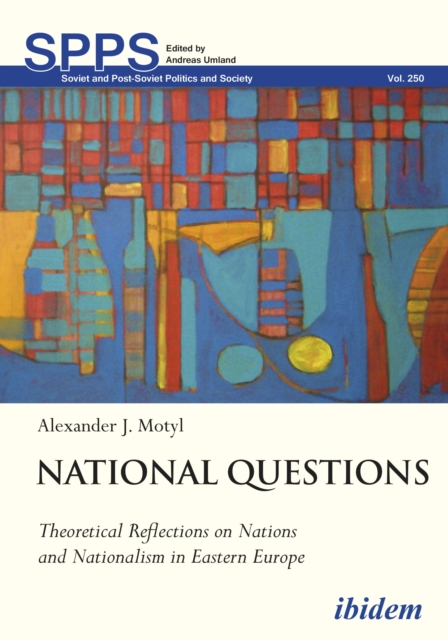
National Questions: Theoretical Reflections on Nations and Nationalism in Eastern Europe
Combining social science with the multi-disciplinarity of area studies, Alexander Motyl discusses in fifteen essays the malleability and modernity of national identity, the attractions and limits of social constructivist imaginings of nations, the impact of national discourses, binary morality, and historical narratives on interpretations of the Holocaust and the Holodomor, the relationship between liberalism, nationalism, and fascism, and the role of national identity and nationalism in Eastern Europe in general and the Soviet Union, Ukraine, and Russia in particular. Throughout the chapters, Motyl questions conventional wisdom, exposes its inconsistencies and weaknesses, and encourages readers to rethink their views in light of conceptual clarity, theoretical rigor, elementary logic, and empirical evidence.
eBook