
Catalogue Search | MBRL


Are you sure you want to remove the book from the shelf?

{{itemTitle}}
88
result(s) for
"Munro, Lucy"
Sort by:


Speaking History
In this essay, Lucy Munro focuses on a very specific example of the way in which the present made the past a reality: the imitation of archaic words and styles in the history plays of Shakespeare, Thomas Middleton, Anthony Munday, and others. All speakers of English—no matter their social status—came into contact with old words, and dramatists capitalized on the capacity that these fragments of earlier practices had to conjure the past in the present. Unlike the modern historical novel, however, early modern history plays do not aim to represent the past in a verisimilar manner. Instead, works such as Shakespeare's 2Henry IVandHenry Vmingle archaism with neologism so as to critique particular perspectives and modes of behavior in both the historical past and the present day. Manipulating linguistic memory, they suggest that the past was open to appropriation and revision, not only by elite writers but also by the popular stage and its spectators.
Journal Article

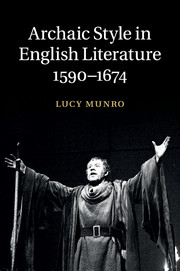
Archaic Style in English Literature, 1590–1674
Ranging from the works of Shakespeare, Spenser, Jonson and Milton to those of Robert Southwell and Anna Trapnel, this groundbreaking study explores the conscious use of archaic style by the poets and dramatists between 1590 and 1674. It focuses on the wide-ranging, complex and self-conscious uses of archaic linguistic and poetic style, analysing the uses to which writers put literary style in order to re-embody and reshape the past. Munro brings together scholarly conversations on temporality, memory and historiography, on the relationships between medieval and early modern literary cultures, on the workings of dramatic and poetic style, and on national history and identity. Neither pure anachronism nor pure nostalgia, the attempts of writers to reconstruct outmoded styles within their own works reveal a largely untold story about the workings of literary influence and tradition, the interactions between past and present, and the uncertain contours of English nationhood.
eBook


As it was Played in the Blackfriars
This essay places Jonson, Chapman, and Marston’s Eastward Ho! at the center of a set of textual, theatrical, and financial negotiations that are revealed by a hitherto overlooked lawsuit in the Court of Chancery. It reveals for the first time that Jonson—like Marston—had a financial stake in the Blackfriars playhouse where Eastward Ho! was performed, and it argues that the play both epitomizes and scrutinizes a set of social and literary transactions surrounding the playhouse. In doing so, it reappraises three important contexts for the production of Eastward Ho! First, it revises our understanding of the Blackfriars enterprise and its investors. Second, it reassesses the careers of Jonson and Marston in the years 1604–1606—revisiting their collaboration with Chapman, their interpersonal relationships, and the revision of Jonson’s The Case is Altered and Every Man in his Humor—and offers a new picture of Jonson as a company man. Third, it offers fresh insights into city comedy’s engagements with London during a crucial period of its development. A coda turns to Jonson’s The Alchemist, suggesting that this play glances back at Jonson’s own contractual and emotional involvement with the Blackfriars venture and its entangled financial structures. [L.M.]
Journal Article

Living by Others' Pleasure
We have known for over a century that John Marston held a share in Children of the Queen's Revels, the all-boy playing company that first performed The Dutch Courtesan in 1604, but how this knowledge affects our understanding of his plays requires further exploration. Drawing on neglected documentary sources, this essay reappraises the company's links with the Chapel Royal choir to argue that Dutch Courtesan capitalizes on the skills that most clearly connected its performers with the royal choir, even while scrutinizing the ways in which the company turned pleasurable recreation into profit.
Journal Article

Recent Studies in Tudor and Stuart Drama
An assessment of recent scholarly work treating the literature of Tudor and Stuart Drama and some general observations on the state of the profession. A full bibliography and price list of works received by SEL for consideration follow.
Journal Article

The Queen and the Cockpit
This article will take a fresh look at Queen Henrietta Maria's patronage of the commercial theatre, and, in particular, her patronage of the companies that bore her name, which operated first at the Cockpit playhouse and later at Salisbury Court. Recent work by Rebecca Bailey and Karen Britland, among others, has demonstrated that the queen consort's patronage of drama extended beyond the masque and plays staged at court such as Arténice, Florimène and The Shepherds' Paradise, encompassing the promotion of commercial plays at court and the support of dramatists such as James Shirley and William Davenant. However, the queen's household accounts, which are gradually coming to scholarly attention through the work of Britland, Martin Butler, Barbara Ravelhofer and others, suggest that her financial backing of these companies was greater than has been assumed, and that she continued to support her players after they were reconstituted at Salisbury Court in 1637. Taking as its starting point a payment of 100 marks by the queen to Queen Henrietta Maria's Men in 1630, the essay will explore in detail the company's relationship with the court in the late 1620s and early 1630s, drawing on prologues, epilogues and the paratexts of printed plays to revisit the court performances of dramas such as Thomas Heywood's The Fair Maid of the West and Love's Mistress and Marlowe's The Jew of Malta. In doing so, it will explore new questions about the queen's personal and political involvement in commercial theatre.
Journal Article