
Catalogue Search | MBRL


Are you sure you want to remove the book from the shelf?

{{itemTitle}}
63
result(s) for
"Munt, Sally R."
Sort by:

Queer Attachments
Why is shame so central to our identity and to our culture? What is its role in stigmatizing subcultures such as the Irish, the queer or the underclass? Can shame be understood as a productive force? In this lucid and passionately argued book, Sally R. Munt explores the vicissitudes of shame across a range of texts, cultural milieux, historical locations and geographical spaces - from eighteenth-century Irish politics to Philip Pullman's His Dark Materials trilogy, from contemporary US academia to the aesthetics of Tracey Emin. She finds that the dynamics of shame are consistent across cultures and historical periods, and that patterns of shame are disturbingly long-lived. But she also reveals shame as an affective emotion, engendering attachments between bodies and between subjects - queer attachments. Above all, she celebrates the extraordinary human ability to turn shame into joy: the party after the fall. Queer Attachments is an interdisciplinary synthesis of cultural politics, emotions theory and narrative that challenges us to think about the queerly creative proclivities of shame.
Contents: Series editors' preface: After shame; Foreword, Donald L. Nathanson; The cultural politics of shame: an introduction; Queer Irish sodomites: the shameful histories of Edmund Burke, William Smith, Theodosius Reed, the Earl of Castlehaven and diverse servants - among others; Shove the queer: Irish/American shame in New York's annual St Patrick's Day parades; Expulsion: the queer turn of shame; Queering the pitch: contagious acts of shame in organisations; Shameless in Queer Street; A queer undertaking: uncanny attachments in the HBO television drama series Six Feet Under; After the fall: queer heterotopias in Philip Pullman's His Dark Materials trilogy; A queer feeling when I look at you: Tracey Emin's aesthetics of the self; Bibliography; Index.
Sally R. Munt is Professor of Media and Cultural Studies at the University of Sussex , UK. She has published extensively in cultural studies and is the author or editor of seven previous books including Heroic Desire: Lesbian Identity and Cultural Space (1998) and (as editor) Cultural Studies and the Working Class: Subject to Change (2000). She has given numerous keynote speeches and invited lectures in Europe and the US.
eBook

Queer Spiritual Spaces
Drawn from extensive, new and rich empirical research across the UK, Canada and USA, Queer Spiritual Spaces investigates the contemporary socio-cultural practices of belief, by those who have historically been, and continue to be, excluded or derided by mainstream religions and alternative spiritualities. As the first monograph to be directly informed by 'queer' subjectivities whilst dealing with divergent spiritualities on an international scale, this book explores the recently emerging innovative spaces and integrative practices of queer spiritualities. Its breadth of coverage and keen critical engagement mean it will serve as a theoretically fertile, comprehensive entry point for any scholar wishing to explore the queer spiritual spaces of the twenty-first century.
eBook

Cultural Studies and the Working Class
This work challenges the field of British cultural studies to return to the question of social class as a primary focus of study.The chapters examine contemporary working-class life and its depiction in the media through a number of case studies on topics such as popular cinema, football, romance magazines and club culture.
eBook

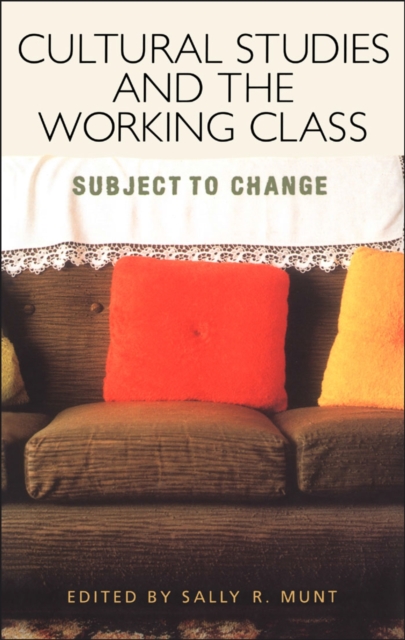
Cultural studies and the working class : subject to change
This work challenges the field of British cultural studies to return to the question of social class as a primary focus of study. The chapters examine contemporary working-class life and its depiction in the media through a number of case studies on topics such as popular cinema, football, romance magazines and club culture. The essays pose methodologies for understanding working-class responses to dominant culture, and explore the contradictions and limitations of the traditional Marxist model. The book's contributors conclude that it is time for cultural theorists to revisit issues of working-class cultural formations and to renew the original radical intentions of the discipline by reintegrating class analysis into social templates of race, sexuality and gender.
eBook
Queer Spiritual Spaces
This introduction presents an overview of the key concepts discussed in the subsequent chapters of this book. The book represents the more 'mainstream' religions and addresses the spiritual spaces that are presumed to embrace, refuse and refute traditions whilst re-establishing their own norms It offers an engagement with the key social scientific and theological literature that have to date intersected sexualities, with religion and spiritualities. The book shows the Internet can be perceived as a mystical domain for those who have never been there, and for those who perhaps go there too much. It notes how commonality and collectivity under banners such as 'gay and lesbian', LGBT and LGBTQI can be used to create belonging, agitate around inequities, and be used to find safe, welcoming spiritual spaces. The book draws attention to the historical and cultural logic of queer spiritualities, arguing that their current manifestation is far from being a jarring juxtaposition, and more like a diffractive crystal.
Book Chapter
Quakers: Post-Christian Selfhoods within the Liberal Sphere
The pioneering Religious Society of Friends, or 'Quakers', was initially dedicated to living in accordance with what they called the 'Inward Light', or direct inward and individual apprehension of God, without screening or interference by set creeds, clergy, or other ecclesiastical forms. Quakers tend to be a highly literate group of organic intellectuals deliberately cognisant of their religious identity and history, but also significantly cosmopolitan in their curiosity toward other faiths and views. A Quaker meeting is not usually entirely quiet though; members are individually moved to speak, to offer fitting words to the assembled group: Friends may worship entirely without words, but usually there will be some brief spoken contributions. Quakerism is predicated on an idea of the endowed modern liberal self, indeed Quakers often describe themselves as 'Liberal Quakers', to discriminate themselves from the smaller group of 'Orthodox Quakers' who remain committed to a traditional Trinitarian God, espousing a somewhat conservative Christian theology.
Book Chapter

‘I Teach Therefore I Am’: Lesbian Studies in the Liberal Academy
The article discusses the origins of Lesbian Studies as arising out of an intellectually engaged grassroots lesbian community and an emergent Women's Studies within the academy. The article contrasts Lesbian Studies in the UK with the USA, which has ‘professionalized’ work in Lesbian and Gay Studies, which concomitantly has produced its own problems. Feminism bequeathed to Lesbian Studies the axiom ‘the personal is political’ and this is discussed as both a positive and a negative inheritance. The academy itself collapses the personal on to the Lesbian Studies lecturer which produces particular pressures from students, colleagues, the institution, and upon one's own intellectual trajectory in the form of the ‘taint’ of subjectivity. Finally the article attempts to identify an ambivalent relationship to liberalism which has made a limited space for Lesbian Studies but also continues to seek to police that sphere.
Journal Article

Grief, Doubt and Nostalgia in Detective Fiction or... \Death and the Detective Novel\: A Return
The circular and uneven journey through grief, melancholia, mourning and nostalgia in detective fiction is examined.
Journal Article
'I Teach Therefore I Am': Lesbian Studies in the Liberal Academy
The article discusses the origins of Lesbian Studies as arising out of an intellectually engaged grassroots lesbian community and an emergent Women's Studies within the academy. The article contrasts Lesbian Studies in the UK with the USA, which has 'professionalized' work in Lesbian and Gay Studies, which concomitantly has produced its own problems. Feminism bequeathed to Lesbian Studies the axiom 'the personal is political' and this is discussed as both a positive and a negative inheritance. The academy itself collapses the personal on to the Lesbian Studies lecturer which produces particular pressures from students, colleagues, the institution, and upon one's own intellectual trajectory in the form of the 'taint' of subjectivity. Finally the article attempts to identify an ambivalent relationship to liberalism which has made a limited space for Lesbian Studies but also continues to seek to police that sphere.
Journal Article