
Catalogue Search | MBRL


Are you sure you want to remove the book from the shelf?

{{itemTitle}}
223
result(s) for
"NGÚGÍ WA THIONG’O"
Sort by:

Writers in Politics
Ngugi has put together a new collection under an old title, rewriting most of the pieces that appeared in the original 1981 edition, and adding completely new essays, such as 'Freedom of Expression', written for the campaign to try to save Ken Saro-Wiwa and other Niger Delta activists and writers from execution in Nigeria. Kenya: EAEP
eBook

The politics of translation
Recently the author published a collection of essays with Seagull Press, under the title, Secure The Base: Making Africa Visible in the World. When two armies fight, they protect their own base, while they try to destabilize and even capture their opponent's. Both sides gather intelligence about the other's base through covert and overt means. But suppose the spies sent to the other side are held captives or willingly enjoy the reception, so that instead Of sending back what they know, they give away the information about their own base? One side is said to lose a battle when their base is overrun by the enemy forces. If the defeated want to fight back, they try and secure their base. The security one's base, even when two armies are cooperating to achieve a jointly held tactical or strategic end against a third, is necessary. so either in opposition or in cooperation, fighting units keep their bases secure, and not in disarray.
Journal Article

The Politics of National Theatre: The Example of Kenya
The celebration of the 250th anniversary of Poland’s national theatre, Teatr Narodowy, inspired reflections on the National Theatre of Kenya, the debate over what constitutes a national theatre, and the founding of the Kamĩrĩthũ Community Education and Cultural Center.
Journal Article
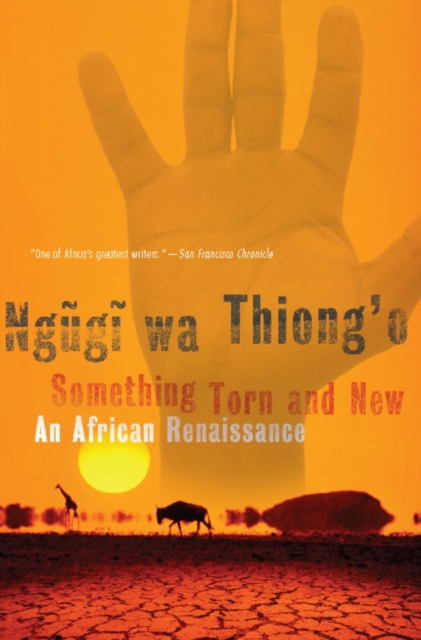
Something Torn and New
Novelist Ngugi wa Thiong'o has been a force in African literature for decades: Since the 1970s, when he gave up the English language to commit himself to writing in African languages, his foremost concern has been the critical importance of language to culture. InSomething Torn and New, Ngugi explores Africa's historical, economic, and cultural fragmentation by slavery, colonialism, and globalization. Throughout this tragic history, a constant and irrepressible force was Europhonism: the replacement of native names, languages, and identities with European ones. The result was the dismemberment of African memory.Seeking to remember language in order to revitalize it, Ngugi's quest is for wholeness. Wide-ranging, erudite, and hopeful,Something Torn and Newis acri de coeurto save Africa's cultural future.
eBook

A Globalectic Heterotopia: Writing a Novel from a Liminal Space
This essay looks at the novel as a globalectic heterotopia. It draws on a personal history of my writing the novel
while a political prisoner in a maximum-security prison in Kenya in 1977–78. In explaining why I turned to the novel rather than any other genre, this essay uses the concepts of globalectics, heterotopia, liminality, and heteroglossia to argue that the novel is the ultimate heterotopia, containing in itself or rather reflecting in a more holistic manner than probably any other genre all the other spaces of the economy, politics, culture, values, and the psyche. The Blakean vision of eternity in an hour and the world in a grain of sand underlies the heterotopia of the novel. The essay argues that the novel contains the global; that the world it mirrors is one of unity in disunity, of oneness in diversity, of constant motion and change. Prison is seen as a liminal space, as betwixt the inside and outside of society; but in its mimicry of the outside, prison is a Foucauldian heterotopia connecting to all communities, all social groups in society. The essay argues that the novel has a future precisely because of its elasticity, its capacity to reinvent itself, its openness, its endless capacity to make a story and give us a view of the world informed by our innermost, our most intensely personal experiences.
Journal Article
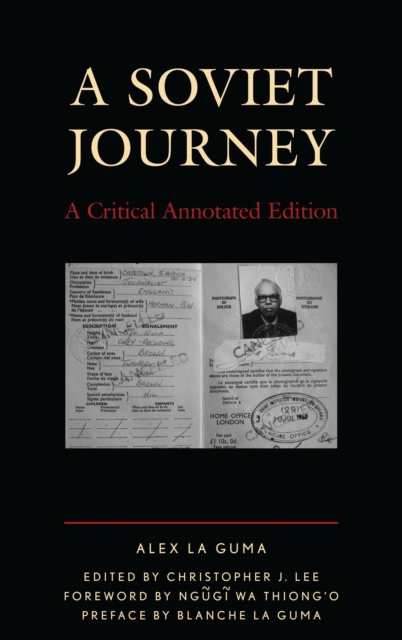
A Soviet Journey
In 1978, the South African activist and novelist Alex La Guma (1925-1985) published A Soviet Journey , a memoir of his travels in the Soviet Union.Today it stands as one of the longest and most substantive first-hand accounts of the USSR by an African writer.
eBook
Tongue and pen: a challenge to philosophers from Africa
A challenge to philosophers from Africa is presented. If philosophers want to develop knowledge, philosophy, and other arts through African languages, then they have to learn how to listen to what African tongues are saying. The pen should work with the tongue; walk together; help widen, spread, and store the products of the tongue in productive spaces. Pen and tongue should journey together to search for education, knowledge and philosophy, help it grow and spread.
Journal Article

A Globalectical Imagination
As William Blake saw eternity in an hour, Ngũgĩ wa Thiong'o argues for an ethics of reading that assumes the interconnectedness of time and space in the area of human thought and action. This globalectical approach reads every center as a center of the world and each text as its mirror.
Journal Article

Black Linguistics
Enslavement, forced migration, war and colonization have led to the global dispersal of Black communities and to the fragmentation of common experiences. The majority of Black language researchers explore the social and linguistic phenomena of individual Black communities, without looking at Black experiences outside a given community. This groundbreaking collection re-orders the elitist and colonial elements of language studies by drawing together the multiple perspectives of Black language researchers. In doing so, the book recognises and formalises the existence of a \"Black Linguistic Perspective\" highlights the contributions of Black language researchers in the field. Written exclusively by Black scholars on behalf of, and in collaboration with local communities, the book looks at the commonalities and differences among Black speech communities in Africa and the Diaspora. Topics include: * the OJ Simpson trial * language issues in Southern Africa and Francophone West Africa * the language of Hip Hop * the language of the Rastafaria in Jamaica With a foreword by Ngugi wa Thiong'o, this is essential reading for anyone with an interest in the linguistic implications of colonization.
Sinfree Makoni is Associate Professor in Linguistics, Applied Language Studies and African American Studies at Penn State University, USA. Geneva Smitherman is University Distinguished Professor of English at Michigan State University, USA, and Director of My Brother's Keeper Program in Detroit. Arthur K. Spears is Professor of Anthropology and Linguistics at the City University of New York, USA. Arnetha Ball is Associate Professor of Education at Stanford University, USA.
'This book will be of interest not only to people whose focus is language varieties used by Blacks, but also to those concerned with a critical history of linguistics, to anthropologists and sociolinguists, particularly those working on language policy and planning, variation, and language in education.' - Kay McCormick, University of Cape Town
eBook