
Catalogue Search | MBRL


Are you sure you want to remove the book from the shelf?

{{itemTitle}}
65
result(s) for
"Nafisi, Azar"
Sort by:
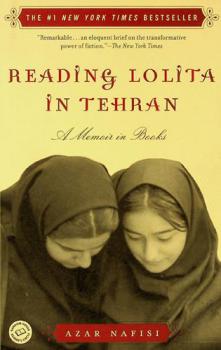
Reading Lolita in Tehran : a memoir in books
This is the story of Azar Nafisi's dream and of the nightmare that made it come true. For two years before she left Iran in 1997, Nafisi gathered seven young women at her house every Thursday morning to read and discuss forbidden works of Western literature. They were all former students whom she had taught at university. They were unaccustomed to being asked to speak their minds, but soon they began to open up and to speak more freely, not only about the novels they were reading but also about themselves, their dreams and disappointments. Nafisi's account flashes back to the early days of the revolution, when she first started teaching at the University of Tehran amid the swirl or protests and demonstrations. Azar Nafisi's tale offers a fascinating portrait of the Iran-Iraq war viewed from Tehran and gives us a rare glimpse, from the inside, of women's lives in revolutionary Iran.
Book

Remember This
A powerful remembrance of the lessons and legacy of Jan Karski, who risked his life to share the truth with the world--and a cautionary tale for our times.Richly illustrated with stills from the black-and-white film adaptation of the acclaimed stage play, Remember This: The Lesson of Jan Karski tells the story of World War II hero, Holocaust witness, and Georgetown University professor Jan Karski. A messenger of truth, Karski risked his life to carry his harrowing reports of the Holocaust from war-torn Poland to the Allied nations and, ultimately, the Oval Office, only to be ignored and disbelieved. Despite the West's unwillingness to act, Karski continued to tell others about the atrocities he saw, and, after a period of silence, would do so for the remainder of his life. This play carries forward his legacy of bearing witness so that future generations might be inspired to follow his example and \"shake the conscience of the world.\"Accompanying the text of the stage play in this volume are essays and conversations from leading diplomats, thinkers, artists, and writers who reckon with Karski's legacy, including Secretary of State Madeleine Albright, Ambassador Stuart Eizenstat, award-winning author Aminatta Forna, best-selling author Azar Nafisi, President Emeritus of Georgetown Leo J. O'Donovan, SJ, Ambassador Samantha Power, Ambassador Cynthia P. Schneider, historian Timothy Snyder, Academy Award™ nominated actor David Strathairn, and best-selling author Deborah Tannen.
eBook


The Voice of Akbarganji
A brief profile of Akbar Ganji, who represents the democratic movement in Iran, focuses on the courage he has exhibited by revealing the \"true face\" of the Islamic Republic of Iran. It is pointed out that Ganji is a former Islamist militant who helped bring about the Islamic Revolution. His transformation to a courageous defender of democracy & human rights offers hope for Iran's potential for change. Although Ganji has been in prison since 2000, he continues to challenge the Islamic regime from political, cultural, & ideological perspectives. His prison writings reject the constitution & the rule of the supreme leader in favor of a secular & democratic Iran. He has used methods like a hunger strike to call for non-violent resistance through the use of such things as an election boycott. The many risks faced by Iranians who choose to hear Ganji's voice are pointed out. J. Lindroth
Journal Article
THE VOICE OF AKBAR GANJI
Nafisi discusses the lines of suffering etched on the visage of Akbar Ganji's courageous dissident. Among the former revolutionaries who have questioned the Islamic Republic, none has shown the intellectual and moral courage that Ganji has demonstrated in interrogating and holding accountable not just the Islamic regime but also his own former self.
Journal Article

The Quest for the \Real\ Woman in the Iranian Novel
Shahrnush Parsipur's novel, Tuba va Mana-ye Shab (Tuba and the Meaning of the Night) begins with a series of interesting images. Nafisi explores the place and direction of women under autocratic rulers of Iran and women's attempts to create a personal space for themselves in Parsipur's novel Tuba va Mana-ye Shab. He points out that the novel demonstrates the degree to which Iran's past dilemmas are still very much alive within its present historical and political context.
Journal Article

Liberal Education and the Republic of the Imagination
Some assume that the only way academics can engage the politics of the day is by coming out of their ivory tower and protesting in front of the White House. In conveying knowledge, the academy has a far more important and subversive way of dealing with political issues. Knowledge provides people with a way to perceive the world. Imaginative knowledge provides them with a way to see themselves in the world, to relate to the world, and thereby, to act in the world. The way they perceive themselves is reflected in the way they interact, the way they take their positions, and the way they interpret politics. In this article, the author talks about curiosity, the desire to know what one does not know, which is essential to genuine knowledge. Especially in terms of literature, it is a sensual longing to know through experiencing others--not only the others in the world, but also the others within oneself. Here, she emphasizes imaginative knowledge through which one can experience the world.
Journal Article