
Catalogue Search | MBRL


Are you sure you want to remove the book from the shelf?

{{itemTitle}}
25
result(s) for
"Naidoo, Rajani"
Sort by:

Handbook on globalization and higher education
This text explores worldwide convergences and divergences in national higher education systems resulting from increased global co-operation and competition.
Book

Knowledge Beyond Colour Lines
Knowledge remains timely in education. The need for academics to contemplate its relevance, worth, use and everything in-between deems a continuous intellectual project, rather than a conundrum to be solved. This book takes the South African context by the horns as it challenges the often dormant and traditionalist ways in which higher education spaces see knowledge. Through original research and the voices of academics and students, this book argues for repurposing knowledge generation, knowledge sharing and critical pedagogy so that more inclusive teaching and learning environments can be both imagined and sustained. The contentious tensionalities that this creates for LoLT and SoTL, in particular, are unlocked so as to trouble the South African higher education landscape with the intent to proffer alternative pathways for a knowledge beyond colour lines. Prof Shan Simmonds (PhD) NWU This edited volume bristles with fresh scholarly approaches and insights of an emergent generation of engaged scholars grappling with the issues and problems of higher education in South Africa. The issues dealt with here are varied and encompassing. They are treated with intellectual delicacy and probing sensitivity, articulacy, informed data and bold conclusions. They serve well! Prof. Kwesi Kwaa Prah, Emeritus Professor of Sociology, University of the Western Cape, and Founder of the Centre for Advanced Studies of African Society
eBook

Fields and institutional strategy: Bourdieu on the relationship between higher education, inequality and society
This paper takes as its focus the concept of 'field', which has received relatively less attention than Bourdieu's other concepts such as 'cultural capital' and 'habitus' in the sociology of education. The development of the concept is outlined to present Bourdieu's understanding of higher education as a field consisting of cognitive and structural mechanisms that mediate sociopolitical and economic forces while simultaneously reproducing fundamental principles of social stratification. As an illustration of its widespread application, Bourdieu's framework is applied to develop an analytical understanding of institutional strategies developed by South African universities during a period of political instability. Drawing insights from the South African case study and Bourdieu's empirical research, the article concludes that Bourdieu's theory may be seen to have transcended more simplistic conceptions of universities as closed systems detached from the sociopolitical complex or as mere reflections of external power relations. However, the strict relational nature of Bourdieu's framework and his concept of the 'arbitrary' have placed limits on the extent to which his theory can offer a more in-depth account of the relationship between higher education and society.
Journal Article

Higher education and the achievement (and/or prevention) of equity and social justice
The article examines the theoretical and empirical literature on higher education's role in relation to social equity and related notions of citizenship, social justice, social cohesion and meritocracy. It considers both the education and the research functions of higher education and how these impact upon different sections of society, on who benefits and who loses from them. Questions for future research on the wider impact of higher education are posed as well as some research questions on the narrower issue of widening participation. 8HRK / Abstract übernommen).
Journal Article
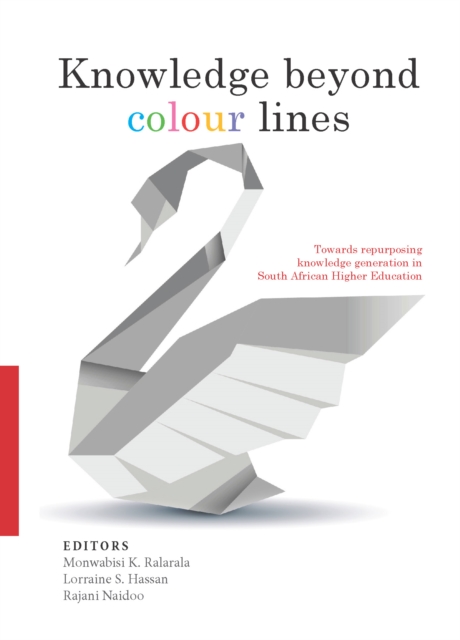
Knowledge Beyond Colour Lines
Knowledge remains timely in education. The need for academics to contemplate its relevance, worth, use and everything in-between deems a continuous intellectual project, rather than a conundrum to be solved. This book takes the South African context by the horns as it challenges the often dormant and traditionalist ways in which higher education spaces see knowledge. Through original research and the voices of academics and students, this book argues for repurposing knowledge generation, knowledge sharing and critical pedagogy so that more inclusive teaching and learning environments can be both imagined and sustained. The contentious tensionalities that this creates for LoLT and SoTL, in particular, are unlocked so as to trouble the South African higher education landscape with the intent to proffer alternative pathways for a knowledge beyond colour lines.Prof Shan Simmonds (PhD)NWUThis edited volume bristles with fresh scholarly approaches and insights of an emergent generation of engaged scholars grappling with the issues and problems of higher education in South Africa. The issues dealt with here are varied and encompassing. They are treated with intellectual delicacy and probing sensitivity, articulacy, informed data and bold conclusions. They serve well!Prof. Kwesi Kwaa Prah, Emeritus Professor of Sociology, University of theWestern Cape, and Founder of the Centre for Advanced Studies of African Society
eBook

L'État et le marché dans la réforme de l'enseignement supérieur au Royaume-Uni (1980-2007)
Transnational Higher Education: A New Strategic Issue? T hroughout the 1990s, transnational higher education, i.e. everything involving international student and teacher mobility, curricular exchanges and inter-institutional educational cooperation, has grown considerably and constitutes one of the most notable forces transforming higher education systems. This article documents the growth and diversification of transnational higher education and analyzes the strategies of various countries and higher education institutions, which can be spurred on by motives as diverse as mutual comprehension, improve quality and competitiveness of their higher education offer, attracting talents, the construction of a service export industry. It argues that the various forms of transnational higher education should continue to grow in the coming decades, whether there is international convergence or diversity of national strategies.
Journal Article
The State and the Market in Higher Education Reform in the United Kingdom (1980-2007)
Throughout the 1990s, transnational higher education, i.e. everything involving international student and teacher mobility, curricular exchanges and inter-institutional educational cooperation, has grown considerably and constitutes one of the most notable forces transforming higher education systems. This article documents the growth and diversification of transnational higher education and analyzes the strategies of various countries and higher education institutions, which can be spurred on by motives as diverse as mutual comprehension, improve quality and competitiveness of their higher education offer, attracting talents, the construction of a service export industry. It argues that the various forms of transnational higher education should continue to grow in the coming decades, whether there is international convergence or diversity of national strategies.
Journal Article
The State and the Market in the Reform of Higher Education at the United Kingdom 1980-2007
Throughout the 1990s, transnational higher education, ie., everything involving international student & teacher mobility, curricular exchanges & inter-institutional educational cooperation, has grown considerably & constitutes one of the most notable forces transforming higher education systems. This article documents the growth & diversification of transnational higher education & analyzes the strategies of various countries & higher education institutions, which can be spurred on by motives as diverse as mutual comprehension, improve quality & competitiveness of their higher education offer, attracting talents, the construction of a service export industry. It argues that the various forms of transnational higher education should continue to grow in the coming decades, whether there is international convergence or diversity of national strategies. Adapted from the source document.
Journal Article