
Catalogue Search | MBRL


Are you sure you want to remove the book from the shelf?

{{itemTitle}}
5
result(s) for
"Nelson, Bill, (Cartographer)"
Sort by:

Invisible countries : journeys to the edge of nationhood
A thoughtful analysis of how our world's borders came to be and why we may be emerging from a lengthy period of \"cartographical stasis\" What is a country? While certain basic tenets-such as the clear demarcation of a country's borders, and the acknowledgment of its sovereignty by other countries and by international governing bodies like the United Nations-seem applicable, journalist Joshua Keating's book explores exceptions to these rules, including \"breakaway,\" \"semi-autonomous,\" or \"self-proclaimed\" countries such as Abkhazia, Kurdistan, Somaliland, a Mohawk reservation straddling the U.S.-Canada border, and an island nation whose very existence is threatened by climate change. Through stories about these countries' efforts at self-determination, as well as their respective challenges, Keating reveals that there is no universal legal authority determining what we consider a country. He argues that although our current world map appears fairly static, economic, cultural, and environmental forces in the places he describes may spark change. Keating ably bridges history with incisive and sympathetic observations drawn from his travel and personal interviews with residents, political leaders, and scholars in each of these countries.
Book
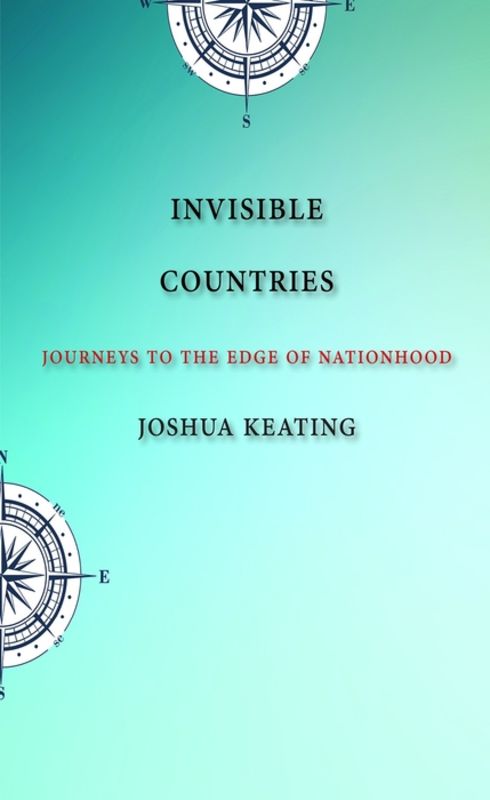
Invisible Countries
A journalist explores how our world's borders came to be and how self-proclaimed countries across the globe could change the map.
What is a country? While certain basic criteria—borders, a government, and recognition from other countries—seem obvious, journalist Joshua Keating investigates what happens in areas of the world that exist as exceptions to these rules. Invisible Countries looks at semiautonomous countries such as Abkhazia, Kurdistan, and Somaliland, as well as a Mohawk reservation straddling the U.S.-Canada border, and an island nation whose very existence is threatened by climate change.
Through stories about these would-be countries' efforts at self-determination, Keating shows that there is no universal legal authority determining what a country is. He also argues that economic, cultural, and environmental forces could soon bring an end to our long period of cartographical stasis. Keating combines history with incisive observations drawn from his travels and interviews with residents, political leaders, and scholars in each of these \"invisible countries.\"
eBook


Victory at Sea
A sweeping, lavishly illustrated one-volume history of the
rise of American naval power during World War II
\"A brilliant and gripping book by a master historian
working at the top of his powers.\"-Fredrik Logevall, Harvard
University \"Paul Kennedy has written a classic in
this sweeping narrative account of the desperate struggle to
command the seas and America's rise as a superpower during the
Second World War.\"-John H. Maurer, U.S. Naval War College
In this engaging narrative, brought to life by marine artist Ian
Marshall's beautiful full‑color paintings, historian Paul Kennedy
grapples with the rise and fall of the Great Powers during World
War II. Tracking the movements of the six major navies of the
Second World War-the allied navies of Britain, France, and the
United States and the Axis navies of Germany, Italy, and
Japan-Kennedy tells a story of naval battles, maritime campaigns,
convoys, amphibious landings, and strikes from the sea. From the
elimination of the Italian, German, and Japanese fleets and almost
all of the French fleet, to the end of the era of the big‑gunned
surface vessel, the advent of the atomic bomb, and the rise of an
American economic and military power larger than anything the world
had ever seen, Kennedy shows how the strategic landscape for naval
affairs was completely altered between 1936 and 1946.
eBook
